



- Home
- /
- Top Stories
- /
- Mediation More Enduring Than...
Mediation More Enduring Than Judicial Decision: Justice Narasimha On Supreme Court's 'Samadhan Samaroh' Program
Saima Anjum
20 Aug 2026 12:27 PM IST
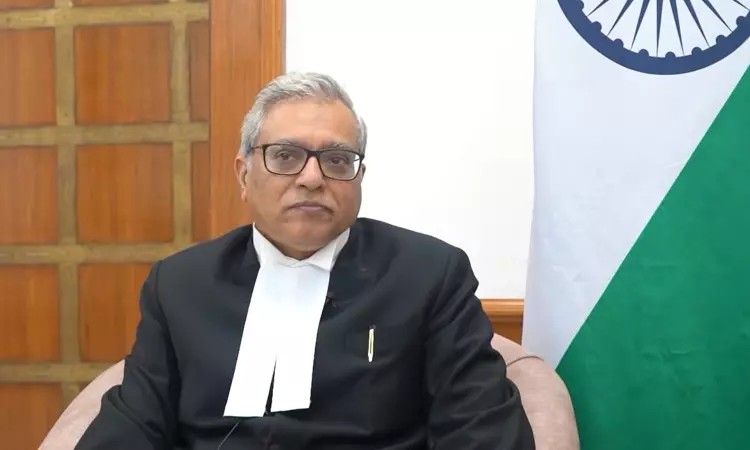
Justice PS Narasimha recently spoke on the Supreme Court's Samadhan Samaroh initiative, a nationwide mediation-driven exercise aimed at amicable, consent-based resolution of cases pending before the Supreme Court. The initiative, which began on 21st April, will culminate in a Special Lok Adalat to be held from 21st to 23rd August.In an interview to Akashvani's News On AIR, Justice...
This is a premium content
Available exclusively to
Our subscribers
Subscribe Premium 
INR 1099+GST
Your support helps us to bring you more content at
an affordable subscription scheme !!!
All payment options available
Justice PS Narasimha recently spoke on the Supreme Court's Samadhan Samaroh initiative, a nationwide mediation-driven exercise aimed at amicable, consent-based resolution of cases pending before the Supreme Court. The initiative, which began on 21st April, will culminate in a Special Lok Adalat to be held from 21st to 23rd August.
In an interview to Akashvani's News On AIR, Justice Narasimha explained the rationale behind the initiative. He identified two distinct concerns. “The main problem is about the large pendency of cases,” he said, adding that the second issue was “the method by which disputes can be resolved easily comfortably without too much of a technical procedure.” Samadhan Samaroh seeks to address both, he added.
Describing Samadhan Samaroh as “the new name that the Chief Justice of India has given for what is popularly known as mediation,” Justice Narasimha drew a distinction between mediation and conventional adjudication. He explained that in mediation, “the persons who are litigating before the court are given the power to decide the dispute,” as opposed to a court hearing where “an independent body like that of a judge irrespective of the likes and dislikes of a party will finally decide.”
“The advantage of a mediation is that the resolution is arrived at through a voluntary process of those who are involved in it. That is the greatest advantage of resolution as against decision-making by a court of law. It is far more enduring. It is far more satisfying,” he stated.
Justice Narasimha also traced the evolution of the Court's mediation efforts, noting that while Lok Adalats have long been held by the Supreme Court, a more structured approach began in 2024. Initially, litigants were reached through the National Legal Services Authority (NALSA) at the Taluka level, with resolutions transmitted back to the Court for acceptance. This year, the Court additionally involved Advocates-On-Record and advocates of the institutions concerned.
“A person filed a case against an insurance company. The individual claiming insurance was before the Court. We also had the advocate representing the insurance company and we also had officers belonging to the insurance company coming here. So all three were there,” he gave an example.
He noted that while this engagement took place, “simultaneously, NALSA was also contacting the clients at the grassroot level,” with both strands eventually integrating into a settlement before the Court for acceptance.
On the binding character of mediated settlements, Justice Narasimha clarified that such agreements carry “the sanctity of law and that agreement will be in the nature of a decree of a court which can really be enforced.” He added that a party unwilling to abide by the settlement “will be bound by execution in a court of law.”
Addressing the question of costs, he said,“so far as the litigants are concerned, as of now, there is no cost at all.” He further clarified that court fees and stamp duty paid at the time of filing are also refunded to the parties who arrive at a settlement through the process. He described this as “kind of a very positive incentive to settle it, rather than to litigate.”
Responding to a question on how the initiative relates to the existing Lok Adalat mechanism under the Legal Services Authorities Act, 1987, Justice Narasimha clarified that Samadhan Samaroh is not a separate legal regime; “This is no different from that. It is one and the same, except that the name has been changed.” He explained that while the Act “gives the legal regime under which the whole system operates,” the actual resolution is achieved through mediation under the Mediation Act, 2023, with the two statutes working “in tandem.”
Reflecting on lessons learnt from earlier special Lok Adalats, Justice Narasimha stressed the need for its permanence. “There is a necessity to institutionalize it. It cannot be once in two years or once in three years ...we need to have it as a permanent setup,” he stated.
With regards to challenges, Justice Narasimha pointed to the shortage of dedicated, professionally trained mediators, noting that the current pool is “about 80% a resource of lawyers themselves.” He stated that the lawyers seeking to serve as mediators “will have to shed a great amount of techniques that they would have learned as lawyers and relearn the techniques of mediators,” describing the process as time-consuming. He also flagged the need for a permanent institutional department within the Supreme Court, and for mediators with domain expertise, stating, “I believe there is no area which cannot be resolved through mediation, even very highly technically contested topics, like insolvency, can be mediated very easily and effectively.”
Asked about the categories of disputes being taken up, Justice Narasimha listed land acquisition matters, matrimonial issues, cases involving property, declaration, ownership rights, injunction, as well as commercial matters. “A large number of appeals relating to motor accident claims,” and “cheque-bouncing cases.” He added, “there is no periphery for that.”
On what motivates the parties to opt for mediation, Justice Narasimha pointed to three practical considerations: time, cost, and the uncertainty of litigation outcomes.
Justice Narasimha also pointed out that the process this year involved sustained consultation by the Chief Justice of India with Chief Justices of High Courts, Advocates General, district judges, and government officials. “A large number of tax-related resolutions have also come forward this time because of the positive input from the finance ministry,” he said.
On being asked how the success of Samadhan Samaroh should be assessed as it concludes, Justice Narasimha said, “I will judge it from the perspective of how well we have formulated our institutional mechanism for mediation in times to come.” Describing the initiative as “a stepping stone” rather than a one-time exercise, and one that “must be very closely associated with the working of the court.”
“If we don't convert this into an institutional memory, then we would have lost it,” he concluded.


