



- Home
- /
- Top Stories
- /
- Menstrual Health Fundamental Right...
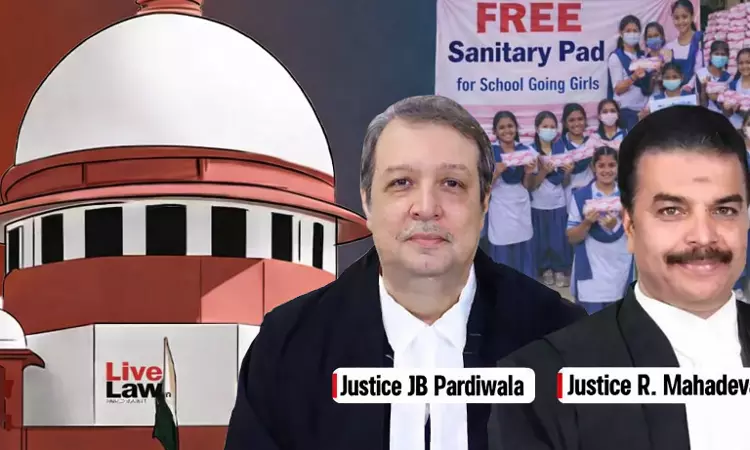
Menstrual Health Fundamental Right Under Article 21; Ensure Girls Get Free Sanitary Pads In Schools : Supreme Court
Gursimran Kaur Bakshi
30 Jan 2026 3:17 PM IST
"The absence of safe and hygienic menstrual management measures undermines dignified existence."
Declaring that the right to menstrual health is part of the right to life under Article 21 of the Constitution, the Supreme Court on Friday issued a slew of directions to ensure that every school provides biodegradable sanitary napkins free of cost to adolescent girls.The Court also issued directions to ensure that schools are equipped with functional and hygienic gender-segregated...
This is a premium content
Available exclusively to
Our subscribers
Subscribe Premium 
INR 1099+GST
Your support helps us to bring you more content at
an affordable subscription scheme !!!
All payment options available
Declaring that the right to menstrual health is part of the right to life under Article 21 of the Constitution, the Supreme Court on Friday issued a slew of directions to ensure that every school provides biodegradable sanitary napkins free of cost to adolescent girls.
The Court also issued directions to ensure that schools are equipped with functional and hygienic gender-segregated toilets.
The Court directed the pan-India implementation of the Union's national policy, 'Menstrual Hygiene Policy for School-going Girls' in schools for adolescent girl children from Classes 6-12.
A bench comprising Justice JB Pardiwala and Justice R Mahadevan has passed the following directions:
1. All States/UT must ensure that every school, whether government-run or privately managed, in both urban and rural areas, is provided with functional gender segregated toilets with usable water connectivity.
2. All existing or newly constructed toilets in schools shall be designed, constructed and maintained to ensure privacy and accessibility, including by catering to needs of children with disabilities.
3. All school toilets must be equipped with functional washing facilities and soap and water available at all times.
4. All states/UTs must ensure that every school, whether government-run or privately managed, in both urban and rural areas, provide oxo-biodegradable sanitary napkins manufactured in compliance with the ASTM D-6954 standards free of cost. Such sanitary napkins must be made readily accessible to girl students, preferably within toilet premises through sanitary napkin vending machines or, where not visible, at a designated place.
5. All States/UTs must ensure that every school, whether government-run or privately managed, in both urban and rural areas establish menstrual hygiene management corners. It must be equipped with spare innerwears, uniforms, disposable pads and other necessary materials to address menstrual urgency.
The Court has also issued directions for the disposal of sanitary waste.
1. All States and Union Territories shall ensure that every school, whether Government-run or privately managed, in both urban and rural areas, is equipped with a safe, hygienic, and environmentally compliant mechanism for the disposal of sanitary napkins, in accordance with the latest Solid Waste Management Rules.
2.Each toilet unit shall be equipped with a covered wastebin for the collection of sanitary material, and cleanliness and regular maintenance of such bins shall be ensured at all times.
Before parting, Justice Pardiwala, who has authored the judgment, said: "This pronouncement is not just for stakeholders of the legal system. It is also meant for classrooms where girls hesitate to ask for help. It is for teachers who want to help but are restrained due to a lack of resources. And it is for parents who may not realise the impact of their silence and for society to establish its progress as a measure in how we protect the most vulnerable. We wish to communicate to every girlchild who may have become a victim of absenteeism because her body was perceived as a burden when the fault is not hers."
The bench formed four questions:
1. Whether the unavailability of gender-segregated toilets and non-access to menstrual absorbent would be said to be in violation of the right to equality for adolescent girlchildren under Article 14?
Answer: The substantive approach to equality under Article 14 demands that treatment be accorded with due regard to the individual, institutional, systemic, and contextual barriers that impede the translation of rights in reality. At the same time, the State, as a benefactor, is under an obligation to remedy such structural disadvantage.
"For a menstruating girl child who cannot afford menstrual absorbents, the disadvantage is two-fold. First, vis-à-vis menstruating girl children who can afford menstrual absorbents. Secondly, vis-à-vis male counterparts or nonmenstruating counterparts. Further, when the menstruating girl child is also a child with disability, she is not merely facing disadvantages arising from menstrual poverty, but is additionally subjected to other disadvantageous consequences flowing from the intersection of gender and disability."
From the perspective of substantive equality, the absence of menstrual hygiene measures entrenches gendered disadvantage by converting a biological reality into a structural exclusion. The denial of basic enabling conditions, i.e., lack of clean and functional washrooms, menstrual products, disposal mechanism, and awareness about MHM measures, impedes not only a girl child's right to participate in education, but also her right to opportunity to compete, to advance, and to realize her potential throughout her life. It is crucial to address these deficiencies to prevent temporary exclusion from turning it into permanent inequality.
2. Whether the right to dignified menstrual health could be said to be a part of Article 21 of the Constitution?
Answer: The inaccessibility of menstrual hygiene management measures undermines the dignity of a girl child as dignity finds its impression in conditions that enable individuals to live in a condition without humiliation, exclusion or avoidable suffering. Privacy is inextricably linked with dignity as the collateral it entails a duty on the State to not only refrain from violating privacy but also an obligation on the State to take necessary measures to protect privacy. The right to life under Article 21 of the Constitution includes the right to menstrual health.
"The absence of safe and hygienic menstrual management measures undermines dignified existence by compelling the adolescent female students to either resort to absenteeism or adopt unsafe practices, or both, which violates the bodily autonomy of the menstruating girl children."
Access to effective and affordable menstrual hygiene management measures helps a girl child attain the highest level of sexual and reproductive health. The right to a healthy reproductive life embraces the right to access education and information about sexual health.
The Court also stated that using unhygienic absorbents leads to various diseases in girls, which in turn violates their right to bodily autonomy.
"It is limpid that when a girl child cannot access menstrual absorbents, she may resort to natural materials, newspaper, cloth, tissue, cotton wool, or any other unhygienic absorbent. In case of a lack of adequate clean water and soap, she may also struggle to properly clean and dry herself. It is not unknown that poor menstrual hygiene may cause reproductive tract infections such as bacterial vaginosis, which may in turn lead to infertility."
3. Whether the unavailability of gender-segregated toilets and non-access to menstrual absorbent could be said to be a violation of the right to participation and equality of opportunity as constitutional guarantees enshrined under Article 14 of the Constitution?
Answer: The right to equality is expressed through the right to participate on equal terms, and at the same time, the equality of opportunity necessitates that everybody has a fair chance to acquire the skills necessary to access benefits. Inaccessibility of menstrual hygiene management measures strips away the right to participate on equal terms in schools. The domino effect of the absence of education is the inability to participate in all walks of life in future.
"In the absence of clean and functional washrooms, girl children would be unable to manage menstruation with privacy and dignity in school. This will put her in constant anxiety of leakage, staining clothes, and exposure to embarrassment. It is this fear which discourages her from attending school altogether. Similarly, lack of access to menstrual absorbents affects participation by making it practically unfeasible for girls to remain in school for long hours or actively participate."
4. Whether the unavailability of gender-segregated toilets and non-access to menstrual absorbent could be said to be in violation of the right to education under Article 21A and the Right to Free and Compulsory Education under the 2009 Act?
Answer: The right to education is termed as a multiplier right as it enables the exercise of other human rights. The right to education forms a part of the broader framework of the right to life and human dignity, which can't be realised without access to education. The substantive approach to equality demands that the treatment be accorded with due regard to institutional, systematic and contextual barriers that impede the translation of rights in reality. The State as a benefactor is under an obligation to remedy such structural disadvantages.
The fundamental right to education under Article 21A and the RTE Act comprises free, compulsory and quality education. Free education includes all kinds of charges or expenses which would prevent a child from pursuing and completing elementary education.
"To enable a child's participation in school by way of affirmative measures reflects commitment to the substantive approach to equality, which goes beyond formal access to schooling. Such affirmative measures mandate State action to ensure all children are placed equally to avail educational opportunities."
All schools, whether run by the appropriate government or privately managed, must act in accordance with the norms and standards laid down in Section 19. In case a school is not controlled by appropriate government, or authority the found to be in contravention with the RTE Act, it would be derecognised. Insofar as school established or controlled by the appropriate government or local authorities is found to be in contravention of the provisions of the RTE Act, the State would be held accountable.
"The right to education as a human right does not merely demand parity between genders but further requires equality of opportunity in the enjoyment of that right for all. Inaccessibility of MHM measures perpetuates a systemic exclusion and discrimination that impacts the admission or continuation of girl children in school."
The judgment was reserved by the Court on December 10, 2024. On November 12, 2024, the bench had directed the Union Government through Additional Solicitor General Aishwarya Bhati to formulate an action plan on the implementation of the national policy. Based on this, Bhati suggested the way forward, which included that the Union Ministry shall coordinate with States and UTs for drawing up respective action plans. She stated that special attention shall be given to sensitisation and awareness activities for promoting safe menstrual hygiene practices in schools.
Before reserving the judgment, Justice Pardiwala confirmed whether the free pads are currently being provided in schools or not and whether the school girls have to make a demand for the same. To this, Bhati responded that a national policy on the same has been framed, and the same will have to be implemented by States and UTs. She added that the distribution will mostly take place through Schools and Anganwadis.
On November 28, 2022, a bench of former Chief Justice of India DY Chandrachud and Justice PS Narasimha issued notice to the Central Government and all states and Union Territories in a plea seeking free sanitary napkins for all adolescent girls in schools and including toilets for them. On April 10, 2023, the Court directed the central government to frame a National Policy on menstrual hygiene for school-going girls in the country.
The bench comprising former CJI DY Chandrachud, Justice PS Narasimha, and Justice JB Pardiwala then stated that the said policy must ensure low-cost sanitary napkins and safe disposal mechanisms of sanitary napkins in schools. While noting that the petitioner raised an "important issue of public interest bearing on the need of menstrual hygiene of girls who are studying in schools", the bench directed the Union Government to ensure that a uniform National Policy with regard to menstrual hygiene is made. It also took into account the counter affidavit placed on record by the Union Government, as per which three ministries of the Union, namely, the Ministry of Health and Family Welfare (MoHFW), Jal Shakti, and the Ministry of Education (MoE), dealt with the matter.
Also from the judgment -Menstruation Should Not Be Source Of Shame; School Boys Also Must Be Sensitised About It : Supreme Court
Headnote
Constitution of India, 1950 — Articles 14, 15(3), 21, and 21A — Right to Education and Menstrual Health — The Supreme Court held that the right to education is a "multiplier right" that enables the exercise of other human rights and forms an integral part of the right to life and human dignity - Noted that inaccessibility to Menstrual Hygiene Management (MHM) measures including clean gender segregated toilets, sanitary napkins, and safe disposal mechanisms constitutes a violation of the fundamental rights of adolescent girl students. [Paras 20-40]
Constitution of India, 1950 — Article 14 — Substantive Equality — The principle of substantive equality requires the State to remedy structural, institutional, and systemic disadvantages - Mere equal treatment is insufficient when individuals are placed in unequal positions due to biological, social, or economic factors. Inaccessibility of MHM measures converts a biological reality into a structural exclusion, violating the right to participate in education on equal terms. [Paras 41- 65]
Constitution of India, 1950 — Article 21 — Right to Dignity, Privacy, and Health — The right to life includes the right to a dignified existence and the right to menstrual health - Dignity is undermined when girl children are subjected to stigma or compelled to adopt unsafe practices due to a lack of facilities - Privacy is a concomitant of dignity, imposing a positive obligation on the State to facilitate a private space for menstrual management. [Paras 70 -80, 85 – 96]
Right of Children to Free and Compulsory Education Act, 2009 — Sections 3 and 19 — Mandatory Norms and Standards — Held that "Free education" under Section 3 includes the removal of any financial or gender-specific barrier, such as the cost of sanitary napkins, that prevents a child from pursuing education - The provision of separate toilets and "barrier-free access" under Section 19 and the Schedule is a mandatory constitutional and statutory obligation that cannot be avoided by pleading a paucity of funds - Key Directions Issued by the Court: i. Toilets - Provision of functional, gender-segregated toilets with usable water and hand washing facilities in all schools; ii. Menstrual Absorbents - Free distribution of oxo biodegradable sanitary napkins and the establishment of "MHM Corners" with spare uniforms and innerwear; iii. Disposal - Installation of safe, hygienic, and environmentally compliant disposal mechanisms; iv. Awareness - Integration of gender-responsive curricula by NCERT/SCERT and sensitization of both male and female teachers; v. Monitoring - Periodic inspections by District Education Officers (DEO) including anonymous student feedback. [Relied on: Right to Education: Mohini Jain (Miss) v. State of Karnataka (1992) 3 SCC 666; Unni Krishnan, J.P. v. State of A.P.(1993) 1 SCC 645; Joseph Shine v. Union of India (2019) 3 SCC 39; Janhit Abhiyan v. Union of India (2023) 5 SCC 1; Gaurav Kumar v. Union of India (2025) 1 SCC 641; Common Cause v. Union of India (2018) 5 SCC 1; Rajiv Raturi v. Union of India (2024) 16 SCC 654; Vikash Kumar v. UPSC (2021) 5 SCC 370; Society for Unaided Private Schools of Rajasthan v. Union of India (2012) 6 SCC 1; State of Orissa v. Mamata Mohanty(2011) 3 SCC 436; Paras 159 – 172, 173-180]
Case Details: DR. JAYA THAKUR v. GOVERNMENT OF INDIA AND ORS|W.P.(C) No. 1000/2022
Citation : 2026 LiveLaw (SC) 94
Appearances: Advocate Varun Thakur (for petitioner) and ASG Aishwarya Bhati (Union)
Gursimran Kaur Bakshi
Gursimran is the Principal Correspondent with LiveLaw for the Supreme Court. She can be reached out at: simrankaurbakshi@livelaw.in

