



- Home
- /
- Top Stories
- /
- 'Morality' Can't Be Interpreted As...
'Morality' Can't Be Interpreted As Societal Morality As It Can Be Based On Prejudices : Indira Jaising In Sabarimala Reference
Gursimran Kaur Bakshi
5 May 2026 10:44 AM IST
How to interpret the term 'morality' used in Articles 25 and 26 as one of the limitations on the exercise of religious freedoms is an issue which the nine-judge bench in the Sabarimala reference has been asked to settle. While the Union Government as well as the review-petitioners(who seek review of the Sabarimala women entry judgment) have argued that there is no place for...
This is a premium content
Available exclusively to
Our subscribers
Subscribe Premium 
INR 1099+GST
Your support helps us to bring you more content at
an affordable subscription scheme !!!
All payment options available
How to interpret the term 'morality' used in Articles 25 and 26 as one of the limitations on the exercise of religious freedoms is an issue which the nine-judge bench in the Sabarimala reference has been asked to settle.
While the Union Government as well as the review-petitioners(who seek review of the Sabarimala women entry judgment) have argued that there is no place for constitutional morality as it is based on subjectivity, and that it is the public morality which is represented by the Parliament as reflecting the will of the people, the respondents have argued that it can't be a morality which is dictated by majoritarianism.
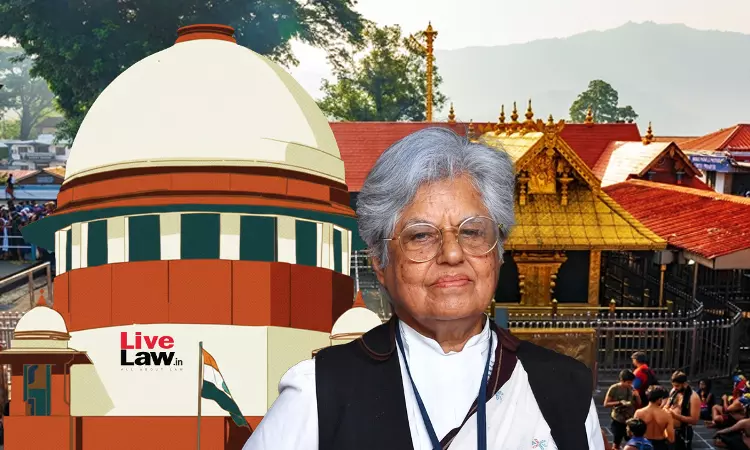
Senior Advocate Indira Jaising, for the respondents, made her submissions on April 29, the eleventh day of the hearing. At the outset, she submitted that morality can't be interpreted as something which is dictated by society at large because societal morality can be full of prejudice.
Petitioners have argued that constitutional morality cannot be invoked to strike down legislation. She averred that legislation has been struck down for violating fundamental rights.
"All these issues about constitutional morality is a ground for striking down legislation is a bogey, why, because no court has struck down anything on the ground of constitutional morality. They have used it to interpret the content of Articles 14, 15, 25 and 26. No single judgment. I don't want to address bogeys."
She represents two women, who entered the Sabarimala temple subsequent to the 2018 ruling, which allowed entry into the temple of women aged between 10 and 50 years old.
Ban on entry based on notions of pollution and purity relatable to menstruation
She argued that Article 17 disallows all forms of untouchability and a ban on the entry of women in the temple is based on the notion of "pollution and purity" relatable to her biological functions.
She claimed that when one of the petitioners, Bindu, had entered the temple, the Tanthri had done a purification ceremony thereafter. She added that the petitioner faced so much stereotyping that she migrated out of Kerala.
Jaising linked that this is indeed a violation of equality, which is a substantive deprivation of an individual's right under Article 25(1). She added that this is a right in rem.
Justice Nagarathna, however, remarked that the restriction cannot necessarily be perceived as stemming from notions of purity and pollution, but rather as a long-standing custom under which women between the ages of 10 and 50 have traditionally not been permitted entry. She stated that true devotees have never questioned it and inquired whether the respondents Jaising is representing are devotees or not.
Responding to Justice Nagarathna's question, Jaising said she doesn't accept the argument that only a devotee can enter the temple. She said that everyone should be welcomed to the house of God.
She said that what is required of a person is reverence and not to go with the intention of causing mischief.
"I have not accepted the proposition that I can go there just because I am a believer. I need to go with reverence, Shradda, and not for the purpose of mischief. We go to temples even though we don't completely follow the deity."
At one point, Justice Amanullah asked: "Is it reverence if you are upsetting the people there?"
Courts can't throw essential religious practice test
Further, unlike other parties, who have all argued for doing away with the Essential Religious Practice test (ERP test), Jaising advocated that this is the test that will allow the Court to set a limitation on the extent to which Article 25 rights can be limited vis-à-vis Article 26.
"You need the essential religious practice test to resolve the tension (between Article 25 and 26). Without the test, what are they asking you to replace it with? My bonafide belief? But who is going to sit in judgment over your bonafide belief."
Justice Nagarathna responded that limiting matters of religion to the ERP will cause damage. "Matter of religion under Article 26(b) is not restricted to essential religious practice. You can't give a restricted meaning but at the same time, Article 25(2) can operate and both have to be harmonised. By restricting the expression matter of religion to essential religious practice will be causing damage to that expression."
She suggested that it's better to go through the route of Article 25(2)(b), that is, through the State bringing laws on social reforms. She reiterated that even here, the limitation is not to bring reforms that hollow out the religion itself.
Justice Sundresh agreed and added that going through the route of social reforms brings more flexibility for the Courts as well.
Jaising maintained that either way, the outcome will be the same, that is, the right to enter the temple can't be restricted. She added that Courts are not being asked to decide what is essential because religion has a way of reforming itself.
"It is not the civil court or the constitutional court which is deciding essential or non-essential. All religious internally have that test. One example of that is the judgment of this Court in Sharaya Bano. The question arose whether triple talaq is essential religious practice or not. How was the Court decided? Not because the Court thinks its essential, it is the religion that thinks it's not essential decides. Even in Hinduism, there are dictates which are mandatory and there are those which are advisory."
Justice Amanullah responded that the arguments are shaky because there is a limitation to the idea of essentiality itself. He suggested that the test of a genuine believer, a test suggested by Dr Rajeev Dhavan, could be used. He said: "Basic question is also lifting the veil of the intent- if you are a true believer but you go to place and violate the general predominant sentiments of the [majority]."
Jaising responded that it is not her argument that she wants to interfere with how ceremonies and rituals take place and who performs them. "This court has protected ritualistic practices. How to perform puja- I can't go and tell how it has to be done. This line has been drawn."
Again, Justice Amanullah posed a question to her: "For Centuries, certain things which are custom and practice have crystallised and become an essential part. You can't forget history. After so much of passage of time has passed, it has been transformed into a basic element. Suddenly, after so many years, somebody comes up and questions it."
Also from the hearing of April 29 :
Gursimran Kaur Bakshi
Gursimran is the Principal Correspondent with LiveLaw for the Supreme Court. She can be reached out at: simrankaurbakshi@livelaw.in

