



- Home
- /
- News Updates
- /
- Prime Minister Inaugurates NGT's...
Prime Minister Inaugurates NGT's International Conference On 'The Future Of Environment And Climate Dynamics'
LIVELAW NEWS NETWORK
19 Sept 2026 6:26 PM IST
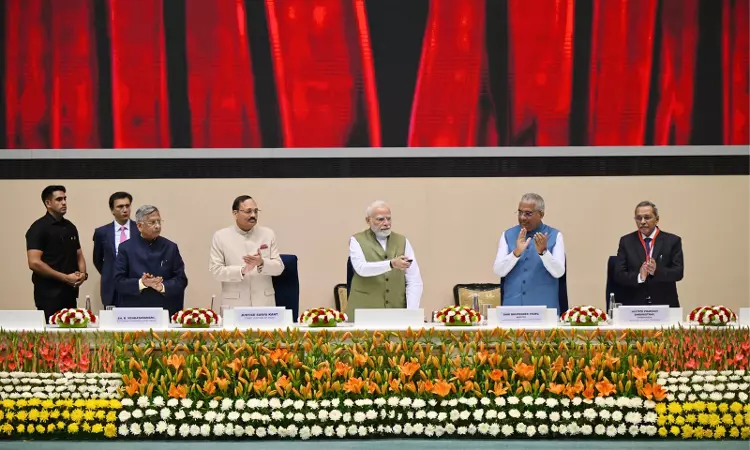
Prime Minister Shri Narendra Modi inaugurated the National Green Tribunal's (NGT) two-day International Conference on 'The Future of Environment and Climate Dynamics', in New Delhi today. The Prime Minister also launched the National Green Tribunal (NGT) Mobile Application during the inaugural session of the conference. The inaugural session was graced by Chief Justice of India Justice...
This is a premium content
Available exclusively to
Our subscribers
Subscribe Premium 
INR 1099+GST
Your support helps us to bring you more content at
an affordable subscription scheme !!!
All payment options available
Prime Minister Shri Narendra Modi inaugurated the National Green Tribunal's (NGT) two-day International Conference on 'The Future of Environment and Climate Dynamics', in New Delhi today. The Prime Minister also launched the National Green Tribunal (NGT) Mobile Application during the inaugural session of the conference. The inaugural session was graced by Chief Justice of India Justice Surya Kant, Attorney General for India Shri R. Venkataramani, Union Minister for Environment, Forest and Climate Change Shri Bhupender Yadav and Chairperson, National Green Tribunal, Justice Prakash Shrivastava.
In his address, Prime Minister Shri Narendra Modi highlighted India's civilisational commitment to environmental protection and its transformation into modern climate action, noting that India has fulfilled its Paris COP21 commitments ahead of schedule. He highlighted progress in renewable energy, clean mobility, water conservation, forest cover and circular economy, and called for collective global action to secure a sustainable future for generations to come.
Delivering his inaugural remarks, Chief Justice of India Justice Surya Kant highlighted India's longstanding environmental jurisprudence, noting that the Supreme Court has, over the decades, recognised the right to a pollution-free environment as a fundamental right and developed principles including the precautionary principle, polluter pays principle, absolute liability and public trust doctrine. The Chief Justice said Indian climate jurisprudence has brought climate-related rights into sharper constitutional focus, recognising that adverse effects of climate change can implicate fundamental rights relating to equality, livelihood and health. He called for collective judicial wisdom, scientific knowledge and international cooperation to strengthen global environmental stewardship.
Addressing the occasion, Shri Bhupender Yadav highlighted India's climate commitments under the leadership of Prime Minister Shri Narendra Modi, noting that non-fossil sources now account for 54.18 per cent of installed electricity capacity, surpassing the 2030 target of 50 per cent nine years ahead of schedule. He said India ranks third globally in renewable energy installed capacity and is the world's second-largest solar growth market, demonstrating that economic growth and climate action can advance together.
Shri Yadav also highlighted India's achievements in wildlife and ecosystem conservation, from the successful Cheetah reintroduction programme and conservation breeding programme of the Great Indian Bustard to the conservation and restoration of woodlands, grasslands and wetlands. He said India's forest and tree cover has reached 8.27 lakh square kilometres and quoted the Global Forest Resources Assessment 2025 by the UN FAO, according to which India has retained its third position globally in terms of annual net forest-area gain. Looking ahead to UNFCCC COP31 in Antalya, he said India will continue to advocate climate action centred on equity, implementation and the needs of vulnerable countries.
Shri Yadav said that forums bringing together judges, policymakers, scientists, practitioners and experts from across the world are vital at a time when environmental challenges transcend national boundaries. He emphasised that the choice before the world is not between development and environment, but between sustainable development and development that cannot be sustained. He said India's approach to environmental responsibility is rooted in its civilisational ethos, which views the Earth as a shared inheritance and a sacred trust, and reaffirmed India's commitment to collective action towards a sustainable, resilient and just future.
In his speech, Attorney General for India Shri R. Venkataramani said that no country can address the environmental challenge alone and that global action must move beyond declarations towards practical and enforceable mechanisms. Referring to Prime Minister Shri Narendra Modi's call that “global action must match global ambitions”, he said India can set examples through the balancing path it has chosen while pursuing development and environmental protection. He called for a new global environmental regulatory framework and stronger international institutions to address environmental justice, while integrating concerns relating to energy and food security, housing, health, water, ecosystems and economic opportunities.
Welcoming the delegates earlier, NGT Chairperson Justice Prakash Shrivastava highlighted India's comprehensive approach to environmental governance under the leadership of Prime Minister Shri Narendra Modi. He said that India's initiatives demonstrate the country's commitment not only to national action but also to global environmental cooperation. Justice Shrivastava said the initiatives reflect a larger vision of a cleaner, greener, more resilient and sustainable India. He emphasised that environmental protection is not the responsibility of any one institution or sector, but a collective national and global responsibility, with the consequences of environmental degradation often falling most severely on those least responsible for them.
The two-day Conference is bringing together jurists, academicians, policymakers, scientists, environmental experts and other stakeholders from 17 countries across the world, along with international organisations United Nations Environment Programme (UNEP) and Asian Development Bank (ADB). The event focuses on dialogue, knowledge exchange on judicial, scientific, policy and institutional best practices, while encouraging collaborative action on pressing environmental and climate challenges.
The Conference features four technical sessions covering key aspects of environmental and climate governance, two of which were held today.
Technical Session-I - 'Climate Justice, Equity and Inclusion: From Principles to Action' - focused on equity and inclusion in climate action, environmental and social safeguards, and the interconnected impacts of climate change and environmental degradation.
Technical Session-II - 'The Future of Environmental Law and Governance' - discussed strengthening institutions and enforcement mechanisms, sustainable and liveable cities, energy transition, green infrastructure and green finance.
The Conference seeks to strengthen environmental law and institutions, advance climate justice and inter-generational equity, promote sustainable and resilient cities, facilitate a just energy transition and foster collaborative action on transboundary environmental challenges. It also focused on sharing research, best practices and innovative solutions, building partnerships, and developing actionable recommendations and a roadmap for future cooperation.


