



- Home
- /
- Top Stories
- /
- Need To Debate Collegium System...
Need To Debate Collegium System Threadbare; High Court Chief Justice Isn't Trusted : Justice Manmohan
Gursimran Kaur Bakshi
22 March 2026 9:35 AM IST
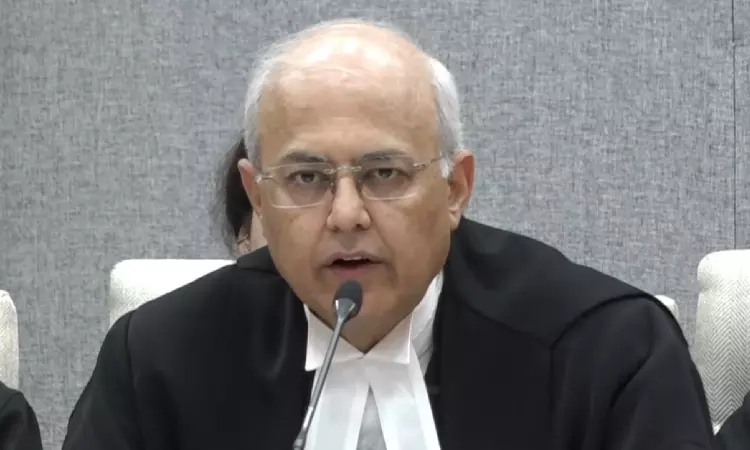
A High Court Judge can't function independently if there is a fear of transfer, Justice Manmohan added.
Justice Manmohan of the Supreme Court on Saturday said that the collegium system requires a thorough re-examination, pointing to what he described as a systemic mistrust of High Court Chief Justices whose recommendations for judicial appointments are routinely subjected to multiple layers of scrutiny.Speaking at the session titled "From Pendency to Prompt Justice: Rethinking Justice Delivery...
This is a premium content
Available exclusively to
Our subscribers
Subscribe Premium 
INR 1099+GST
Your support helps us to bring you more content at
an affordable subscription scheme !!!
All payment options available
Justice Manmohan of the Supreme Court on Saturday said that the collegium system requires a thorough re-examination, pointing to what he described as a systemic mistrust of High Court Chief Justices whose recommendations for judicial appointments are routinely subjected to multiple layers of scrutiny.
Speaking at the session titled "From Pendency to Prompt Justice: Rethinking Justice Delivery In Indian Courts" at the 1st Supreme Court Bar Association National Conference 2026, Justice Manmohan questioned why the recommendations of a Chief Justice of a High Court are not treated with confidence by either the Supreme Court Collegium or the government.
"I have always wondered if the Chief Justice of the High Court has recommended one person as a judge, why should there be a debate about that name? Chief Justice of a Court is not to be trusted? How do you get talent? You have to trust the man at the spot. The Chief Justice of a Court is not an ordinary officer; he is a constitutional functionary. We don't trust him. The Supreme Court Collegium will sit on it, the government will give its advice, the IB will give its advice. This mistrust in the system is costing us dearly. I think we need to debate the collegium system threadbare."
Fear of transfer affecting HC judges
Justice Manmohan also highlighted internal pressures within the judiciary, particularly the fear of transfers, which he said can undermine judicial independence and authority.
"A high court judge can only function when he has full power and full authority. He can't be scared of a transfer; you have to empower him. You can't emasculate a judge by putting the fear of transferring him."
Govt not delivering on assurances to improve judicial infrastructure
The judge further drew attention to structural challenges in the justice delivery system, especially the failure of the government to provide adequate infrastructure. Recounting his tenure as Chief Justice of the Delhi High Court, he described how recruitment was carried out based on the government's assurances that infrastructure would follow. But the Government did not deliver, and there was no courtrooms for the newly recruited judges.
"I was the Chief Justice of the Delhi High Court, and I realised very soon that there was a gap between the working strength and the sanctioned strength of my district judiciary. So, I decided to ramp up my strength. Within about six months' time, we were able to bring our actual strength to par with the sanctioned strength. Because in Delhi, there is no dearth of talent. You hold one exam, and you get good talent. We were assured throughout that as soon as recruitment takes place, infrastructure such as buildings would be provided. We did the recruitment, and we could not find a building that suited us. I did not know where to seat the people I had recruited. Can you imagine they had no place to sit?"
Justice Manmohan said that he had to start a digital court and make the judges sit in one room on a rotational basis.
Another instance of infrastructural inadequacy that he shared was at the Rohini Court. He said that a judge of a Family Court in Rohini was dealing with 3,700 matters instead of the average 1200-1300 matters. Justice Manmohan said that he visited the Court premises personally to see if he could find a spare room to accommodate another judge so that the burden could be proportionally divided.
"I went to the one courtroom, the judge told me a bomb blast had taken place over there a year and a half ago. I went to another courtroom, they told me two and a half years ago there has been a shootout in the court. There is no space. I had to make the judge sit in that district, I can't make him sit anywhere else. So, there is no space. I have a judge, I have a trained person but I can't make him sit."
Judge Manmohan said that the issue is not just limited to infrastructure. He shared that once he had visited the district court and found that there was a huge crowd outside one courtroom, but there was no judge as he was sitting in his chambers. Justice Manmohan shared that when he went to the judge and inquired as to why he was not sitting, he was told that there is only one Public Prosecutor that the two courtrooms share. Since the Public Prosecutor was engaged in another courtroom, the judge could not hold his court.
Government biggest litigant, but highly irresponsible
The judge also criticised the government's litigation practices, observing that officials often prefer to file appeals even when they believe they are unnecessary, out of fear of future scrutiny by investigative agencies.
"There is mistrust in the system. As was pointed out, if a officer genuiely writes that no appeal needs to be filed, he could be haunted by the police, CBI, or by investigative agency. He says why should I take the burden on myself? Better file an appeal and get it dismissed. As a result, the courts are getting cloaked. "
Justice Manmohan further questioned the government's stance on alternative dispute resolution, noting that while arbitration and mediation are widely promoted, the government itself has recently indicated reluctance to use arbitration in large disputes.
"Recently, they have said that they will not go for arbitration in big matters. I understand they have certain concerns how arbitration is operating but they are in charge of the situation. If it requires legislative amendment, they must do it. But that does not mean they will give up on arbitration, which is a very important way to resolve complex disputes."
Also Read- Govt Panel Lawyers Are Appointed On Party Lines, Not Actual Merits : Justice Manmohan
Gursimran Kaur Bakshi
Gursimran is the Principal Correspondent with LiveLaw for the Supreme Court. She can be reached out at: simrankaurbakshi@livelaw.in

