



- Home
- /
- Top Stories
- /
- NEET-UG 2026 Cancellation : 'UPSC...
NEET-UG 2026 Cancellation : 'UPSC Never Had Paper Leak, NTA Needs To Learn' : Supreme Court Seeks Union's Affidavit On Reforms
Gursimran Kaur Bakshi
29 May 2026 3:07 PM IST
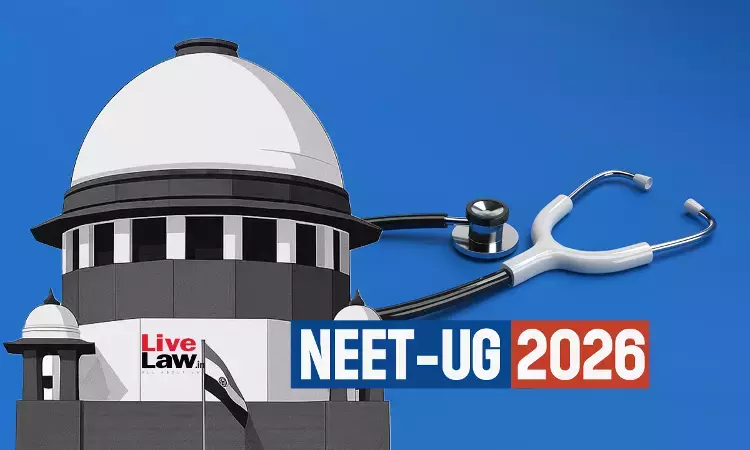
Referring to the ad-hoc nature of NTA, the Court stressed on the need to create "institutional memory of continuity".
Hearing a plea concerning the NEET-UG 2026 cancellation due to paper leak, the Supreme Court on Friday raised concerns over the ad-hoc nature of the National Testing Agency (NTA), and said that unless clear accountability is fixed, the problems will recur.A bench comprising Justice PS Narasimha and Justice Alok Aradhe considered petitions seeking to disband the NTA. During the heairng today,...
This is a premium content
Available exclusively to
Our subscribers
Subscribe Premium 
INR 1099+GST
Your support helps us to bring you more content at
an affordable subscription scheme !!!
All payment options available
Hearing a plea concerning the NEET-UG 2026 cancellation due to paper leak, the Supreme Court on Friday raised concerns over the ad-hoc nature of the National Testing Agency (NTA), and said that unless clear accountability is fixed, the problems will recur.
A bench comprising Justice PS Narasimha and Justice Alok Aradhe considered petitions seeking to disband the NTA. During the heairng today, the bench observed that the NTA needs to learn from other bodies like the UPSC which conduct large-scale competitive exams without any paper leak.
"UPSC has never been a situation, you need to learn," Justice Narasimha said.
"The real problem won't stop till actual accountability arises. Not in terms of so and so will be liable, it will be effective when we know which individual shoulders the responsibility. Unless you identify the specific duty bearers, it will be difficult," Justice Narasimha said.
"The problem is that most institutions are ad hoc. It's a phenomenon that is everywhere in the country. It's not the individual who has the capability but the institution," Justice Narasimha said.
After a brief hearing today, the Court asked the Union of India to file an affidavit indicating the method through which an "institutional memory of continuity" can be created through employment of specialised personnel so that the NTA will have the physical and intellectual wherewithal to conduct the exams in future without any blemish.
Bench interacts with the head of the monitoring committee
Today, Dr. K Radhakrishnan, the head of the Monitoring Committee constituted by the Court in 2024 to suggest recommendations to strengthen NEET, was present before the Court, pursuant to the previous order.
At the outset, Justice Narasimha questioned how the present controversy could arise despite the committee's recommendations and subsequent reforms.
"How much monitoring of implementation has happened? How has this failure occurred? Despite a high-powered committee, if this incident happened, there is something wrong with the original recommendation or there is no proper implementation," the judge remarked.
Responding, Radhakrishnan informed the Court that the committee had submitted 35 long-term recommendations and around 60 short-term recommendations, most of which had already been implemented.
He said that the reforms had largely yielded positive results in NEET-PG 2025, which was conducted "mostly satisfactorily" except for some issues such as power outages.
Addressing the controversy surrounding NEET-UG this year, Radhakrishnan submitted that the committee had made recommendations covering both the pre-examination and post-examination stages.
Justice Narasimha, however, pressed him on whether the committee had specifically contemplated the kind of failures now being alleged.
Radhakrishnan responded that the committee's primary concern at the time had been preventing tampering of question papers. While many safeguards had been implemented, he assured the Court that the vulnerabilities exposed this year had been addressed for the proposed re-NEET examination scheduled next month.
The Bench also sought details regarding the committee's functioning.
"Does the committee meet regularly?" Justice Narasimha asked.
After Radhakrishnan answered in the affirmative, the judge shifted the focus to the issue of institutional accountability.
Solicitor General Tushar Mehta, appearing for the Centre, assured the Court that the government was treating the matter with utmost seriousness, noting that the issue directly affected the country's youth.
Justice Narasimha, however, drew a comparison with other examination bodies and observed that such controversies had not arisen in examinations conducted by the Union Public Service Commission (UPSC).
Later in the hearing, Radhakrishnan elaborated on the committee's findings regarding structural deficiencies within the NTA. He said the committee had found that the agency lacked sufficient domain experts and had recommended bringing in specialists from different systems, including experts involved in conducting the Joint Entrance Examination (JEE).
He further stated that significant reforms had been undertaken in the transportation and handling of question papers, an area that had previously been vulnerable.
Justice Narasimha then broadened the discussion to the larger issue of institution-building in India, commenting on the ad-hoc nature of NTA.
The Solicitor General informed the Bench that following last year's controversy, a detailed examination had been undertaken of the entire examination chain, from the printing press to the point where a candidate receives the question paper. He said fresh vulnerabilities had been identified during the latest examination cycle and corrective mechanisms had been devised.
However, Mehta submitted that it would not be appropriate to place certain security-related measures in the public domain, though the committee had already identified the relevant areas and the reforms would be implemented before the next examination.
"The Hon'ble Prime Minister is personally supervising it," SG said.
Justice Narasimha said that what happened was "traumatic" for the lakhs of students who spent years preparing for the test. "We should not disappoint our youngsters, its very traumatising so much investment of emotions and time."
Justice Narasimha suggested the creation of a permanent mechanism to receive and evaluate inputs to strengthen the system.
"You can establish a small monitoring committee to accept such suggestions and collaborate with leading universities," he observed.
When the Solicitor General indicated that experts from the IITs could be involved, Justice Narasimha endorsed the idea of sustained academic collaboration.
"Have some collaboration full-time with some universities. Methods and ideas keep changing. For instance, in AI, we would be coordinating with a university," the judge said, stressing the need for continuous technological and institutional innovation in examination management.
Background
On the last hearing, it had expressed its anguish that the NEET-UG 2026 had to be cancelled over a paper leak. The Court orally remarked that despite the directions issued by the Court in 2024 regarding the paper leak two years ago, the National Testing Agency(NTA) has not learned its lesson.
It issued notice on petitions filed by doctors and medical students seeking to replace the NTA, and sought a status report from the NTA on the steps taken as per the recommendations of the High-Powered Committee, which was constituted, as per the Court's 2024 judgment, to suggest measures to strengthen the NEET mechanism.
The High-level Committee was constituted by the Union Government in the backdrop of the 2024 NEET UG leak. It was chaired by former ISRO chairman Dr K Radhakrishnan. In 2024, the Supreme Court refused to cancel the exam in Vanshika Yadav v UOI, but Court passed various directions aimed at tackling the paper leak and also a criterion for cancelling public exams.
The Court had expanded the mandate of Dr Radhakrishnan's committee and directed the committee to recommend reforms on examination security, transportation of papers, CCTV surveillance, candidate verification, encryption protocols, technological safeguards, real-time monitoring, grievance redressal and international best practices. It specifically directed the committee to examine the viability of comprehensive CCTV surveillance, surprise inspections, secure transportation systems, digital tracking and stricter identity verification mechanisms.
The Union Government filed a report dated December 17, 2024 detailing the steps taken following the recommendations of the High-Level Committee of Experts (HLCE). According to the compliance report, the HLCE recommended “Reformation of National Common Entrance Testing,” including strengthening of the NTA, institutional coordination with States, and involvement of specialised examination and knowledge partners.
As per the affidavits filed by the NTA, in the last meeting of Dr Radhakrishan's Committee, policy discussion regarding whether NEET UG should continue to be a pen and paper test or whether there is a need for transition to a computer-based test and other issues were discussed.
Based on these suggestions, the NTA has decided to conduct NEET UG through a computer-based test in the next examination cycle in consultation with the Ministry of Health and Family Welfare.
Details of petitions
The present petitions were filed in the backdrop of the NEET-UG 2026 cancellation. One filed by the United Doctors Front (UDF) has sought dissolution of the NTA in light of its “systemic failure” in conducting NEET-UG 2026. She stated that over 23 lakh students appeared in the exam.
The petition seeks the creation of a statutory national testing body through legislation enacted by Parliament with defined legal powers, transparency norms, and direct accountability to the Legislature. The petitioner has also sought a court-monitored committee to oversee the transition of upcoming national examinations to ensure “zero-leak” integrity.
Another petition was filed by the Federation of All India Medical Association (FAIMA) seeking directions to replace or fundamentally restructure the NTA and to conduct a fresh NEET-UG 2026 examination under judicial supervision.
The UDF petition states that the recurring compromise of NEET examinations violates Articles 14 and 21 of the Constitution and affects the futures of more than 22.7 lakh students. The plea highlights that despite assurances given by NTA regarding safeguards, the NEET UG 2026 examination was compromised.
The plea highlights that the NTA remains outside direct parliamentary scrutiny and mandatory Comptroller and Auditor General audits while continuing to discharge sovereign functions relating to national examinations. The petition also refers to the Supreme Court's observations in Vanshika Yadav v. Union of India concerning NEET-UG 2024, where the Court had cautioned the NTA against “flip-flops” and administrative lapses.
It further relies on the recommendations of the K. Radhakrishnan Committee to reduce dependence on private vendors and shift towards computer-based or hybrid examination models. The plea contends that despite the enactment of the Public Examinations (Prevention of Unfair Means) Act, 2024, the government failed to prevent organised cheating networks and paper leaks.
The petition states that the repeated examination leaks have caused psychological distress, financial hardship and uncertainty among students and families. It also highlights student suicides allegedly linked to examination-related stress.
Among other reliefs, the petition seeks directions to dissolve the NTA in its current form, enact legislation establishing a statutory national testing authority with defined transparency and accountability norms, and appoint a court-monitored committee for overseeing future national examinations.
Case Details: FEDERATION OF ALL INDIA MEDICAL ASSOCIATION v NATIONAL TESTING AGENCY AND ORS.|W.P.(C) No. 651/2026 and others
Click Here To Read/Download Order
The petitioners were represented by Adv Charu Mathur and Ritu Raniwal AOR (for UDF), and Adv Tanvi Dubey for (Federation of All India Medical Association (FAIMA)
Gursimran Kaur Bakshi
Gursimran is the Principal Correspondent with LiveLaw for the Supreme Court. She can be reached out at: simrankaurbakshi@livelaw.in

