



- Home
- /
- Top Stories
- /
- NEET-UG : Supreme Court Scrutinises...
NEET-UG : Supreme Court Scrutinises NTA Capacity, Says Dedicated & Scientifically Equipped Body Like UPSC Needed
Amisha Shrivastava
19 Aug 2026 1:15 PM IST
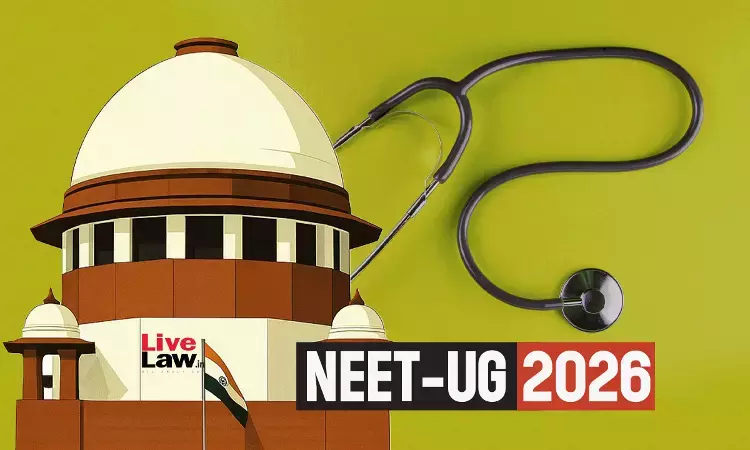
The Court stressed that reform measures must not be aimed at only one exam, and need to be institutionalised.
The Supreme Court on Wednesday sought the Union government's response on the steps taken to implement recommendations of the expert committee headed by former ISRO chairman K. Radhakrishnan, as improved by the expert committee headed by Nandan Nilakeni, for reforms in the National Testing Agency (NTA).The Bench comprising Justice PS Narasimha and Justice Alok Aradhe was hearing petitions filed...
This is a premium content
Available exclusively to
Our subscribers
Subscribe Premium 
INR 1099+GST
Your support helps us to bring you more content at
an affordable subscription scheme !!!
All payment options available
The Supreme Court on Wednesday sought the Union government's response on the steps taken to implement recommendations of the expert committee headed by former ISRO chairman K. Radhakrishnan, as improved by the expert committee headed by Nandan Nilakeni, for reforms in the National Testing Agency (NTA).
The Bench comprising Justice PS Narasimha and Justice Alok Aradhe was hearing petitions filed by the Federation of All India Medical Association (FAIMA) and United Doctors Front (UDF) seeking structural reforms in the NTA in the wake of the NEET-UG 2026 paper leak.
SG explains question-paper security system
During the hearing, Solicitor General Tushar Mehta explained the safeguards currently employed by the NTA to prevent question-paper leaks and other forms of malpractice. He submitted that the existing system was, in his assessment, “foolproof”, while acknowledging that human intervention always carries the possibility of error.
Mehta took the Court through the latest affidavit filed by the Centre explaining the various stages of the question-paper preparation and distribution process.
He said multiple moderators prepare questions, and another set of moderators select questions to prepare four question papers. The process is designed so that those involved do not know which paper will ultimately be administered to candidates. Of the four question papers, the NTA Director General selects two, which are then sent in sealed covers to two separate identified printing presses, according to the Solicitor General.
The printing presses are monitored through CCTV surveillance and CISF security. Mehta further explained that the question papers are transported in specially secured containers, with vehicles fitted with GPS tracking. The storage of the question papers in strong rooms is also videographed, with officials including bank managers, NTA representatives and city coordinators signing the relevant records.
On the morning of the examination, the sealed boxes are opened under videography and in the presence of two students, after which packets containing papers for each classroom are distributed.
Justice Narasimha, however, pointed out that the safeguards being described by the Solicitor General had already been considered by the Radhakrishnan Committee.
“All this was already under the purview of the Radhakrishnan Committee. We have gone through these systems which are being developed over a period of time. After another new person comes, new methods,” Justice Narasimha added.
The judge stressed that the issue before the court was not merely whether safeguards existed for a particular examination, but whether those safeguards had been institutionalised in a durable structure.
Justice Narasimha said the committee's recommendations contemplated the creation of an institutional framework and that the Union's affidavit needed to address what had actually been implemented.
“This is why the committee has suggested that these are things that need to be institutionalised. What is the body, how many officers are there, where is the office situated, how much staff and security? These are the matters with which we are seriously concerned,” the judge said.
The Bench indicated that simply developing increasingly sophisticated procedures for an individual examination would not adequately address the issue unless the reforms are institutionalised.
“These integrity [issues] are not for us to see. You will have to entrust [them] to a body which is scientifically [equipped] and also dedicated,” Justice Narasimha said.
Justice Narasimha referred to the need to train personnel not merely for conducting one examination but for handling examinations in the years to come.
“You have to train and prepare the personnel for times to come, not just for one examination... candidate-friendly arrangements, grievance mechanism, strengthening physical and intellectual capacity. This is the most important,” the judge said.
The judge said the NTA required secure office premises, confidential operations and a proper institutional structure, particularly for functions such as cybersecurity, testing infrastructure and research. He pointed out that the committee had recommended creation of 16 verticals within the testing system, including functions relating to testing centres, a General Manager, central network operations, candidate experience and information security. The judge questioned whether the infrastructure and manpower required for these verticals had actually been created.
“For each of these the committee has said that you need to create that infrastructure,” the Judge said, noting that the government had only recently begun employing more personnel.
Solicitor General Tushar Mehta responded: “Advertisements have gone out.”
"How many officers appointed? Have they taken charge?" Court asks
Justice Narasimha then referred to the senior positions proposed for the restructured NTA and sought specifics on appointments.
“You provided a Director General. There are two additional... joint secretary levels and IT directors and joint directors. How many of them have been appointed? Have they taken charge? Is there a separate premises? This is what we want to know by way of a regular affidavit,” the judge said.
The court also questioned whether the NTA had a dedicated department for digital infrastructure and whether full-time officers had been appointed for testing infrastructure and research and development.
Mehta replied that the government was in the process of hiring.
Bench cites UPSC example
Justice Narasimha invoked the UPSC as an example of how an examination-conducting body develops institutional expertise over time.
“Take UPSC for example. Over a period of time regularly they were conducting exam after exam and they have collected institutional memory and expertise because it happened over a period of time. The body which is entrusted in conducting the exam, ensures that it also upgrades itself and becomes a vibrant institution like that,” Justice Narasimha said.
Questions on sovereign database and software
The Bench also raised questions about the NTA's digital infrastructure and data security. Justice Narasimha asked whether the NTA had a sovereign database in which its examination data was stored. When asked what sovereign software was being developed, Mehta said the database was “in contemplation.”
“Then the security of your question papers. Where are you going to store? Storage is a big issue. So you need to develop that infrastructure and database ready,” Justice Narasimha said.
Mehta told the court that the government had accepted the Radhakrishnan Committee's recommendations “in toto.” He said that some recommendations had already been implemented and that the government would place before the court the progress made on the remaining measures.
The Solicitor General also informed the Bench that advertisements had been issued for posts including Technology Officer, Chief Finance Officer and General Manager, among other positions.
The Court also sought to know where the NTA was currently situated and whether it had adequate physical infrastructure and manpower.
The Bench was informed that the NTA was setting up its own technology team with support from the National Informatics Centre (NIC), onboarding professional teams and working towards the use of indigenous AI models for translation of question papers.
On the issue of translation, Mehta said the question bank of around 500 questions is translated into 13 languages. He clarified that the NTA was not presently relying on AI for the translation process and that the translations were done manually. However, he acknowledged that human involvement meant there could be a possibility of a breach. “There was a breach and the people who were involved are arrested,” Mehta told the court.
After the hearing, the Court dictated the order as follows :
"This court is concerned about institutionalisation of the National Testing Agency with all necessary infrastructure, manpower and other Technological capabilities. We are informed that the committee which has been constituted has considered various recommendations for reforms, focusing on leveraging advance technology like AI and blockchain to strengthen the security and integrity of the examination.
We direct the Secretary to file an affidavit indicating and detailing the steps that have been taken to implement the suggestions made by the Radhakrishnan committee as reflected and nuanced by the Nandan Nilekani committee. Affidavit with the indicative timelines to be filed within 3 weeks."
After dictating the order, Justice Narasimha reiterated the bench's primary concern : "The biggest problem is that if you don't institutionalise, experienced persons get transferred. Then the whole experience goes. It must flow down to the next level and the next level so that they could pick up from the seniors. Institutional memory does not depend on individuals."
Case Details: FEDERATION OF ALL INDIA MEDICAL ASSOCIATION v NATIONAL TESTING AGENCY AND ORS.|W.P.(C) No. 651/2026 and others
Appearances: FAIMA by Advocate Tanvi Dubey and Advocate Charu Mathur and Ritu Raniwal, AOR for UDF

Amisha Shrivastava
Amisha Shrivastava is a Senior Correspondent with LiveLaw, covering the Supreme Court of India. She can be reached at amisha@livelaw.in

