



- Home
- /
- Top Stories
- /
- Sabarimala Reference | Never...
Sabarimala Reference | Never Understood What Transformative Constitutionalism Is : Solicitor General Questions 'Constitutional Morality'
Gursimran Kaur Bakshi
8 April 2026 3:04 PM IST
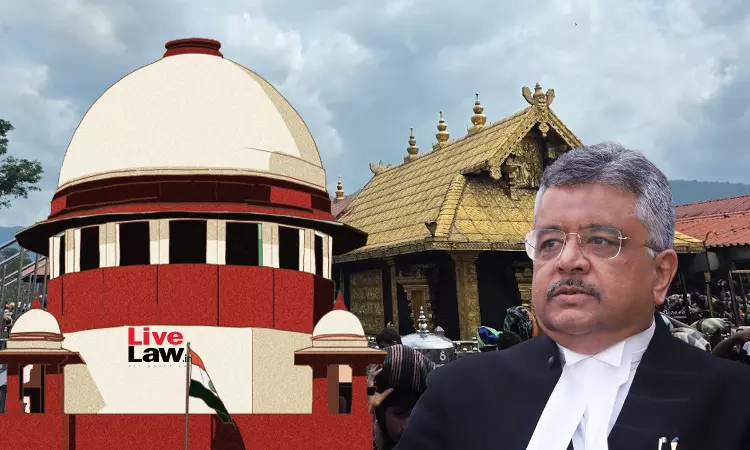
SG argued that constitutional morality cannot be used as a yardstick under Article 25 of the Constitution.
Before the nine-judge bench of the Supreme Court hearing the Sabarimala reference, Solicitor General Tushar Mehta questioned the use of concepts such as transformative constitutionalism and constitutional morality as standards to adjudicate claims under Article 25 of the Constitution. He submitted that constitutional morality cannot be a ground of judicial review and expressed difficulty...
This is a premium content
Available exclusively to
Our subscribers
Subscribe Premium 
INR 1099+GST
Your support helps us to bring you more content at
an affordable subscription scheme !!!
All payment options available
Before the nine-judge bench of the Supreme Court hearing the Sabarimala reference, Solicitor General Tushar Mehta questioned the use of concepts such as transformative constitutionalism and constitutional morality as standards to adjudicate claims under Article 25 of the Constitution.
He submitted that constitutional morality cannot be a ground of judicial review and expressed difficulty in understanding the doctrine of transformative constitutionalism.
"Transformative constitutionalism, I have not been able to understand it. I have been hearing this for some years, but in my limited understanding, I couldn't understand," SG Mehta submitted.
Justice BV Nagarathna clarified that the Court was not directly engaging with transformative constitutionalism in the present proceedings, but reiterated that constitutional interpretation must recognise the dynamic nature of morality in society. She referred to Mehta's own submission that public morality is not static.
"We are not on transformative constitutionalism. It is good for the Constitution. You said public morality is also not static, that is what I tried to say," she observed.
'Morality' under Article 25 not to be understood as 'Constitutional morality'
Mehta vehemently argued that 'constitutional morality' cannot serve as an independent ground to test the validity of religious practices under Article 25. According to him, the word 'morality' under Article 25 cannot be understood as 'constitutional morality'.
"I am before a nine-judge bench, so I will say constitutional morality is never a ground of judicial review," he said, adding that a former Attorney General had delivered a lecture that constitutional morality is an unfortunate thing that better dies sooner.
Justice Nagarathna acknowledged the concern that the concept of constitutional morality may be inherently subjective.
"Because sometimes it is very subjective, that's why," she remarked.
Elaborating further, Mehta argued that what constitutes constitutional morality may vary from one judge to another, thereby making it an uncertain standard for constitutional adjudication.
"Something which is constitutional morality for one judge can't be for another," he said.
Justice Joymalya Bagchi then emphasised the centrality of conscience in Article 25(1), noting that different sections of society may hold different moral standards, all of which can coexist within the broader constitutional framework.
"The word of Article 25(1) is conscience. So it is the conscience of a particular section of citizens to be governed by constitutional morality, so be it. But that doesn't mean that that section will have imprint over the conscience of another groups or sections whose morality would be different standards, but within the expansive, elastic idea of the society," the judge observed.
SG argued that the 2018 judgment, which allowed women entry in the Sabarimala temple, was wrong in adopting the yardstick of 'constitutional morality'. According to him, it is a "vague" term which cannot be used to substitute social morality.
As per the SG, the concept of 'constitutional morality' was envisaged by the Constitution framers as governing the conduct of Ministers and public functionaries. This was never meant to be applied as a standard to adjudicate religious claims.
"Sabarimala continuously proceeds on the ground that morality means constitutional morality and social morality is only mob, and therefore what is necessary is constitutional morality. Therefore, I am saying that as understood by constitutional framers, it is societal morality," Mehta submitted.
"Now social morality goes and replaced by vague term constitutional morality which never had a meaning which the courts have started giving," Mehta argued.
SG questions 'Joseph Shine' judgment which decriminalised adultery
Mehta also questioned the 2018 judgment in Joseph Shine which decriminalised adultery. While saying that he was not challenging the merits of the judgment, the Solicitor said that he had some reservations about the use of the concept of constitutional morality. The SG questioned the use of the quotes of American jurists in the judgment of one of the judges in Joseph Shine.
Chief Justice of India Surya Kant however said that regardless of the observations, the ratio of the Joseph Shine judgment was not in question in these proceedings.
SG said that there are observations in Joseph Shine to the effect that the sexual autonomy of a woman cannot be shackled by marriage. "Is fidelity a patriarchal conception? Fidelity applies to husband and wife equally. Fidelity which is expected out of marriage is termed by this Court as shackles on sexuality," SG stated. "This is not jurisprudence of our country," he added.
He argued that the observations in Joseph Shine formed the foundation of Sabarimala judgment.
The Chief Justice said that Section 497 IPC was problematic because adultery was made an offence only for the man, on the premise that women lacked agency. Justice Bagchi also backed CJI, saying that gender discrimination was the ground to invalidate Section 497 IPC.
A 9-judge bench of the Supreme Court is on the second day of the hearing the Constitutional issues referred to the larger bench in the Sabarimala review.
Apart from CJI Surya Kant, the Bench comprises Justice BV Nagarathna, Justice MM Sundresh, Justice Ahsanuddin Amanullah, Justice Aravind Kumar, Justice Augustine George Masih, Justice Prasanna B Varale, Justice R Mahadevan and Justice Joymalya Bagchi.
The hearing is progressing. Live updates can be followed here.
Gursimran Kaur Bakshi
Gursimran is the Principal Correspondent with LiveLaw for the Supreme Court. She can be reached out at: simrankaurbakshi@livelaw.in

