



- Home
- /
- Top Stories
- /
- Nithari Killings : Surendra Koli To...
Nithari Killings : Surendra Koli To Walk Free As Supreme Court Sets Aside His Only Remaining Conviction
Amisha Shrivastava
11 Nov 2025 11:42 AM IST
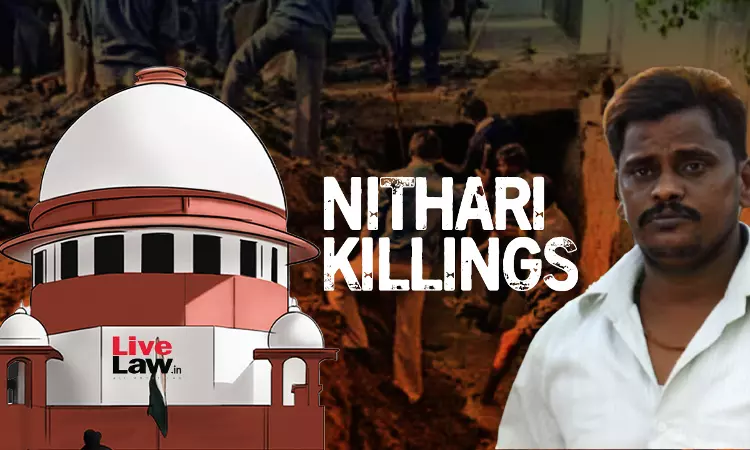
The Supreme Court on Tuesday set aside the conviction of Surendra Koli in the last remaining case related to Nithari killings.A bench of Chief Justice BR Gavai, Justice Surya Kant and Justice Vikram Nath allowed the curative petition filed by Koli against the 2011 judgment of the Supreme Court, which had confirmed his conviction in one of the cases. Koli sought curative on the basis of...
This is a premium content
Available exclusively to
Our subscribers
Subscribe Premium 
INR 1099+GST
Your support helps us to bring you more content at
an affordable subscription scheme !!!
All payment options available
The Supreme Court on Tuesday set aside the conviction of Surendra Koli in the last remaining case related to Nithari killings.
A bench of Chief Justice BR Gavai, Justice Surya Kant and Justice Vikram Nath allowed the curative petition filed by Koli against the 2011 judgment of the Supreme Court, which had confirmed his conviction in one of the cases. Koli sought curative on the basis of his subsequent acquittal in twelve other cases.
Justice Nath, who pronounced the order, stated that Koli is acquitted of the charges.
The judgment dated 15.02.2011 of the Supreme Court, which upheld his conviction, and the order dated 28.10.2014, which dismissed his review, were recalled and set aside. Allowing Koli's criminal appeal, the Court set aside the judgment dated 13.02.2009 of the Sessions Court and the judgment dated 11.10.2009 were set aside. Koli was directed to be released forthwith if not wanted in any other case.
Surendra Koli's curative petition before the Supreme Court challenges his conviction in one of the Nithari killings cases, arguing that the same evidence used to convict him was later found unreliable in the other cases where he has since been acquitted.
While reserving verdict on the curative plea, the bench had remarked that an anomalous situation will arise if the conviction is maintained, as he was acquitted in the remaining cases although the evidence in all of them were the same.
This is the last remaining conviction against him after the Supreme Court in July this year dismissed 14 appeals against the Allahabad High Court judgment acquitting him and co-accused Moninder Singh Pandher in other Nithari killings cases.
Court's observations
Allowing Koli's curative petition, the bench said that two sets of judicial outcomes based on the same evidentiary foundation could not stand together. One affirmed Koli's conviction and death sentence in 2011, while the other affirmed his acquittal in twelve companion cases in 2025.
“The tension is not peripheral. It goes to the integrity of adjudication,” the Court observed, adding that curative jurisdiction exists to correct “manifest miscarriages of justice” where inconsistent results persist on an identical record and undermine public confidence in the administration of justice.
Identical Evidence, Opposite Outcomes
The bench noted that both sets of cases rested on the same evidence: Koli's alleged confession under Section 164 of the Code of Criminal Procedure and the recoveries claimed under Section 27 of the Evidence Act. While these were relied upon to uphold the conviction in 2011, they were rejected as unreliable in twelve other cases by the Allahabad High Court in 2023, a conclusion later affirmed by the Supreme Court.
“There is no principled basis on which the same statement can be treated as voluntary and reliable in this case when it has been judicially discredited in all others,” the Court said.
The bench held that Koli's confession was recorded after nearly sixty days of uninterrupted police custody without effective legal aid and under circumstances suggesting coercion. The Magistrate who recorded the statement failed to make the clear satisfaction note required by law regarding voluntariness.
The Investigating Officer's proximity to the process, including his presence at the outset and continued access afterward, “compromised the environment of voluntariness.” The statement itself “repeatedly adverted to tutoring and prior coercion,” which made it inadmissible under Section 24 of the Evidence Act.
Recoveries Not Legally Proved
The Court also rejected the prosecution's reliance on alleged recoveries under Section 27 of the Evidence Act. It found that there was no contemporaneous disclosure memo and that the seizure records conflicted with the remand papers.
The supposed discoveries were made from areas already known to the police and the public where excavation had already begun. “These features negate the essential element of discovery by the accused and reduce the exercise to a seizure from an already known place,” the judgment stated.
Forensic Evidence Inconclusive
The Court found that searches of house D-5 in Nithari yielded no bloodstains, tissue, or transfer patterns consistent with multiple homicides. Weapons allegedly used in the crimes bore no traces of blood or hair, and while DNA tests linked skeletal remains to the victims' families, they did not connect the petitioner to the crimes.
“There was no credible chain of custody or expert testimony establishing that a domestic help with no medical training could perform the precise dismemberment described,” the bench noted. These gaps, the Court said, were central to the acquittals in other cases and were equally present here.
Systemic Lapses In Investigation
The judgment delivered a strong critique of the police investigation, describing it as marred by “negligence and delay” that corroded the fact-finding process.
“The scene was not secured before excavation began, the disclosure was not contemporaneously recorded, remand papers carried contradictory versions, and the petitioner was kept in prolonged police custody without a timely, court-directed medical examination,” the bench said.
It observed that crucial forensic opportunities were lost because material was not promptly preserved or brought on record. Investigators also failed to adequately question witnesses from the household and neighbourhood and did not pursue the “organ-trade angle” mentioned by a government committee.
Violation Of Articles 14 And 21
The Court held that upholding a conviction based on evidence already declared involuntary or inadmissible in identical cases would violate both Article 21 (right to life and fair procedure) and Article 14 (equality before law).
“Arbitrary disparity in outcomes on an identical record is inimical to equality before the law,” the bench stated.
While acknowledging the horrific nature of the Nithari crimes and the suffering of the victims' families, the Court underscored that criminal justice cannot compromise legality for expediency.
“Suspicion, however grave, cannot replace proof beyond reasonable doubt. Courts cannot prefer expediency over legality,” the judgment said. The presumption of innocence, it added, endures until guilt is proved through admissible and reliable evidence.
Expressing regret that the true perpetrator remains unidentified, the Court noted that despite the capability of investigative agencies, negligence and procedural violations had “foreclosed avenues that might have identified the real offender.”
Accordingly, the Supreme Court set aside Koli's conviction and sentence, recalled its earlier orders, and acquitted him, holding that the case “crosses the exacting threshold for curative relief” as laid down in Rupa Ashok Hurra.
Background
The Nithari killings came to light in December 2006, when skeletal remains of several children and women were found in a drain behind the house of businessman Moninder Singh Pandher in Noida's Nithari area. Surendra Koli, who worked as a domestic help in Pandher's household, was arrested soon after.
The Central Bureau of Investigation later took over the probe and registered 16 cases, charge-sheeting Koli in all of them for murder, abduction, rape, and destruction of evidence. Pandher was initially charge-sheeted in one case related to immoral trafficking, but a Ghaziabad court later summoned him in five more cases on petitions filed by victims' families.
CBI alleged that Koli murdered several girls, dismembered their bodies, and disposed of the remains in the backyard of Pandher's house. Nineteen sets of remains were reportedly recovered from the premises. The agency's case relied mainly on Koli's confession under Section 164 of the CrPC, recorded after about 60 days in custody, and recoveries made under Section 27 of the Indian Evidence Act.
Between 2009 and 2017, Koli was convicted and sentenced to death in 12 cases, while Pandher was convicted in two. In 2011, the Supreme Court upheld Koli's conviction and death sentence in one of the cases. In 2015, the Allahabad High Court commuted that sentence to life imprisonment citing “inordinate delay” in deciding his mercy plea.
In October 2023, the Allahabad High Court acquitted both Koli and Pandher in the remaining Nithari cases, holding that the prosecution failed to prove guilt beyond reasonable doubt and criticising the CBI's investigation as “botched up.” The High Court also noted that the possibility of organ trade being the motive for the killings was not investigated, even though a resident of a nearby house had earlier been arrested in connection with a kidney scam.
The CBI and families of the victims filed 14 appeals before the Supreme Court challenging the High Court's acquittal. The Supreme Court dismissed all 14 appeals, thereby upholding the High Court's acquittal of both accused.
During the hearing, Justice Gavai observed that the area behind Pandher's house, from where the remains were recovered, was not exclusively accessible by the accused. He remarked, “The law is that it has to be recovered from the place exclusively known to the accused alone and accessible by the accused alone.” He also commended the High Court judges for “withstanding media pressure” and described the trial court proceedings as having been influenced by a “media trial.”
While Pandher now stands acquitted in all cases, Koli continues to remain in prison because his 2011 conviction and life sentence in one case still stand. The present curative petition challenges that conviction, contending that it rests on the same evidence which has since been found unreliable in all the other Nithari cases.
Appearances :
For Koli : Dr. Yug Mohit Chaudhary, Mr. Siddhartha Sharma, Ms. Payoshi Roy, Mr. Prabu Ramasubramaniyan, Adv. Mr. Bharathimohan M, Advocates with Mr. Sai Vinod, AOR
For CBI - Raja Thakare, ASG
Case no. – Diary No. 49297-2025
Case Title – Surendra Koli v. State of UP
Citation : 2025 LiveLaw (SC) 1091
Click here to read the judgment
Tags

Amisha Shrivastava
Amisha Shrivastava is a Senior Correspondent with LiveLaw, covering the Supreme Court of India. She can be reached at amisha@livelaw.in

