



- Home
- /
- Top Stories
- /
- No Restriction On Women To Enter...
No Restriction On Women To Enter Mosque For Namaz; ERP Tests Wrongly Applied To Islam : AIMPLB Tells Supreme Court
Gursimran Kaur Bakshi
23 April 2026 5:58 PM IST
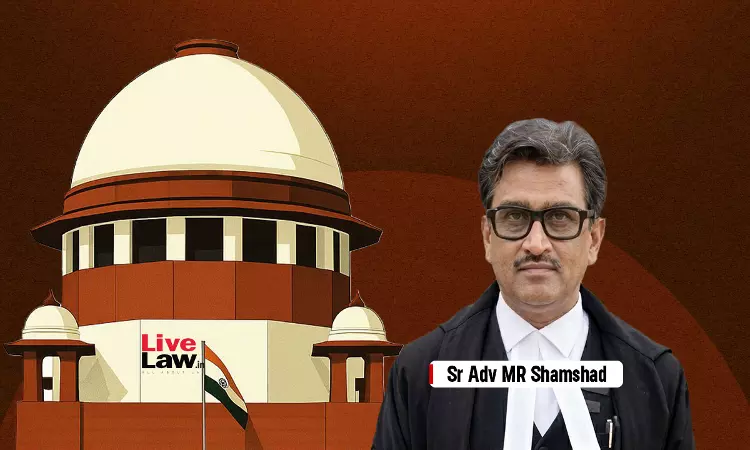
The senior counsel argued that Islamic practices have failed the Essential Religious Practice (ERP) test because the Courts applied the wrong parameters.
The All India Muslim Personal Law Board told the Supreme Court on Thursday that there was no restriction on women to enter mosques to offer namaz.Senior Advocate MR Shamsahd made this submission on behalf of the AIMPLB before the 9-judge bench, which is hearing the Sabarimala reference.The writ petitions seeking women's entry in mosques are also tagged along with the Sabarimala reference,...
This is a premium content
Available exclusively to
Our subscribers
Subscribe Premium 
INR 1099+GST
Your support helps us to bring you more content at
an affordable subscription scheme !!!
All payment options available
The All India Muslim Personal Law Board told the Supreme Court on Thursday that there was no restriction on women to enter mosques to offer namaz.
Senior Advocate MR Shamsahd made this submission on behalf of the AIMPLB before the 9-judge bench, which is hearing the Sabarimala reference.
The writ petitions seeking women's entry in mosques are also tagged along with the Sabarimala reference, since the Constitutional questions relating to the scope of Articles 25 and 26 arise there also.
Responding to the petitions, Shamshad said that there is no concept of 'sanctum sanctorium' in a mosque, though it is there in dargahs.
"If there is no sanctum santorum inside the mosque, then nobody can insist to stand at a particular place or, for that matter, to be the first to lead the namaz," he said.
At this point, Chief Justice of India Surya Kant asked, "For factual clarity, are women allowed to enter the mosque?"
Shamshad submitted that there was consensus among all denominations of Islam that there was no restriction for women to enter the mosque. But there is consensus that it is not essential for women to be part of the congregation performing namaz.
Justice Amanullah then told Shamshad, "You should elaborate for everybody's consumption that right from the beginning, there is also no dispute(that women can enter) and that it started from the holy Prophet himself."
"Yes, my lords. The Prophet himself said, don't stop women coming to the mosque. There is clarity on this. And many of those who have recorded the hadith in many volumes have recorded this narration that the Prophet instructed that don't stop women coming to the mosque," the senior counsel replied.
Shamsahd explained that for a man, it was obligatory to be part of the congregation, whereas for a woman, it is not mandatory.
"For woman, it is preferable that she stays at home and prays, and she gets the same religious reward. But if a woman wants to come, she can come," he said.
"Except that she can't be part of the congregation?" CJI asked. "No, they will be a part of the congregation. If they are going to mosque, the purpose is to participate in congregation, and that is permitted," the counsel clarified.
"So, it is not mandated for them(women) to attend a congregation?" Justice Nagarathna asked. Shamshad answered in the affirmative, and added that it is "not preferable" for a woman to attend the congregation in the mosque.
Justice Amanullah supplemented, "So the reason was that if everybody goes from the house, who looks after the children?"
The lawyer argued that there was no objection to the relief sought in the petition that women should be allowed to enter the mosque and offer prayers. Regarding the other prayer in the writ petition that women should be allowed to enter through the main door and have a right to visual and auditory access to the Musalla, Shamshad said, "They are trying to bring the sanctum sanctorium concept inside the mosque."
He also objected to the other prayer of the petitioners that women should be permitted to pray inside the Musalla without being separated by a barrier, and in mixed congregational lines. He said that one has to follow the inner discipline of the mosque after entering it.
Essential religious practice test wrongly applied in the context of Islam
Shamshad further submitted that the doctrine of Essential Religious Practice(ERP) has been wrongly applied by the Courts in the context of Islam religion. He pointed out that Islam is a heavily and thoroughly written religion, with elaborate detailing on dos and don'ts. While some acts are strictly categorised as forbidden, some are prescribed as mandatory, and some acts are recommended as desirable. The Islamic practices often failed the ERP tests because, to the Courts, they did not appear as mandatory.
"We were going through cases, except for one test, all other tests of essential religious practice, so far as Islam is concerned, have failed in Indian courts. Except Syedna (Dawoodi Bohra excommunication case), in all other matters, the court has gone into the Quran and said that if it's not found, go."
He added that the Courts have often relied upon inaccurate translations of Arabic Hadees, and this has resulted in wrong ERP parameters being applied to Islam.
As per these tests, a masjid was declared to be not essential to Islam in the Ismail Farooqui case, because the Court said that namaz can also be performed in the open.
"Masjid is the core of the belief of Muslims. All practices are ultimately relatable to mosque. But then we face a judgment saying Masjid is not essential. Then what will we do with Article 25?" Shamshad asked.
"It is as good as saying a temple is not essential. Who is the Court to decide that?" Justice Nagarathna observed. "Exactly, that is my point," Shamshad replied.
The senior counsel further referred to the judgment, which approved the termination of a Muslim man from the Army for keeping a beard, on the ground that a beard was not essential to Islam.
"If my Sikh brother can go and join the army with a beard, then why not a Muslim?"
CJI Surya Kant said that the Court will not get into a debate on this topic. He added that a beard is expressly mandated for a man in Sikhism as one of the 5 mandatory principles.
Shamshad further argued that many regulations and laws, which may appear facially neutral, may have a discriminatory impact on some sections. He cited the ASI rule, which mandates that a monument can be used only from sunrise to sunset. So, when a mosque is taken over by the ASI, he said, this rule will bar three namaz.
Before concluding his arguments, Shamshad submitted, "Here is a petition, which says for a Muslim women, mosque is essential. And I have a judgment, which says mosque is not essential."
Today was the eighth day of hearing in the Sabarimala reference matter.
The matter is before a bench comprising Chief Justice of India Surya Kant, Justice BV Nagarathna, Justice MM Sundresh, Justice Ahsanuddin Amanullah, Justice Aravind Kumar, Justice Augustine George Masih, Justice Prasanna B Varale and Justice Joymalya Bagchi.
Live updates from the hearing can be followed here.
Gursimran Kaur Bakshi
Gursimran is the Principal Correspondent with LiveLaw for the Supreme Court. She can be reached out at: simrankaurbakshi@livelaw.in

