



- Home
- /
- Top Stories
- /
- 'One Nation, One Election'...
'One Nation, One Election' Committee's Proposed Meeting With Supreme Court Judges Raises Questions
Manu Sebastian
1 Oct 2026 5:24 PM IST
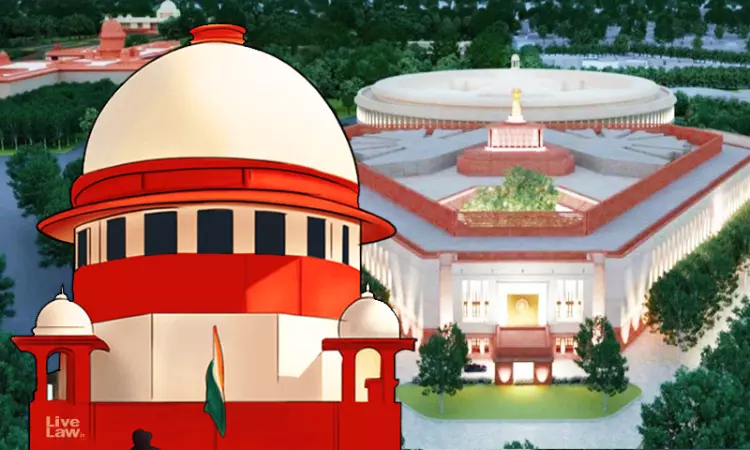
Kapil Sibal said that such a pre-legislative discussion with Judges has never happened in the history of India.
Update at 7.38 PM -Supreme Court Judges Not Meeting 'One Nation One Election' CommitteeThe Joint Parliamentary Committee examining the Constitution (One Hundred and Twenty-Ninth Amendment) Bill, 2024 and the Union Territories Laws (Amendment) Bill, 2024, which seek to facilitate simultaneous elections, is scheduled to hold discussions with the Chief Justice of India and other Supreme Court...
This is a premium content
Available exclusively to
Our subscribers
Subscribe Premium 
INR 1099+GST
Your support helps us to bring you more content at
an affordable subscription scheme !!!
All payment options available
Update at 7.38 PM -Supreme Court Judges Not Meeting 'One Nation One Election' Committee
The Joint Parliamentary Committee examining the Constitution (One Hundred and Twenty-Ninth Amendment) Bill, 2024 and the Union Territories Laws (Amendment) Bill, 2024, which seek to facilitate simultaneous elections, is scheduled to hold discussions with the Chief Justice of India and other Supreme Court judges on October 6, according to a revelation made by Senior Advocate Kapil Sibal in a press conference today.
Sibal criticised the proposed interaction, describing it as "unprecedented" and "unconstitutional". He argued that it raises concerns about the separation of powers, particularly because the Committee is examining proposed amendments that could potentially be challenged before the Supreme Court after their enactment.
"How can a Joint Committee have the courage to ask the Chief Justice of India to give them an audience for the purposes of briefing the Judges of the Supreme Court on the terms of the Bill, even before the Joint Committee has finalised the report? How did the judiciary accept that invitation from the Joint Committee, knowing well that the Bill raises issues of fundamental importance for the polity of the country and issues relating to the working of the Constitution?" Sibal asked.
Asserting that such a pre-legislative interaction between a parliamentary committee and Supreme Court judges had never taken place in India's history, Sibal said: "It is my belief that this particular step violates the separation of powers."
He pointed out that the Constitution envisages Parliament making laws and the judiciary examining their validity. However, in this instance, Supreme Court judges would be briefed on the proposed legislation even before Parliament has enacted it. The same Court could subsequently be called upon to adjudicate challenges to the constitutional validity of the amendments, if they are passed.
Sibal said the proposed amendments could have "huge consequences for the polity of the country" and were therefore likely to face a legal challenge.
He questioned why the CJI agreed to entertain the committee, and wondered what would be its implications for any future judicial challenge. "This is a joke on the Constitution. I am shocked, disturbed and dismayed," he said.
"This is entirely unconstitutional and a matter of great concern, not just for the lawyers but for the people of the country. This is something totally unheard of," Sibal added.
The committee, headed by BJP MP PP Chaudhary, has been conducting consultations with political parties, legislators, constitutional experts and other stakeholders as part of its examination of the two Bills. The committee has previously stated that it has also consulted former Chief Justices of India, former Supreme Court judges and other legal experts on the constitutional implications of simultaneous elections.
Unlike consultations with retired judges or constitutional experts, discussions with sitting judges stand on a different footing, as the very same judges are the potential adjudicators of a future challenge.
The Bills seek to establish a framework for synchronising elections to the Lok Sabha and State Legislative Assemblies, an issue which would requirel amendments to the Constitution and has generated debate over federalism, legislative tenures, premature dissolution of Houses and the basic structure of the Constitution.
[After the publication of the report, the Supreme Court sources clarified that the meeting is not taking place]
Manu Sebastian
Managing Editor

