



- Home
- /
- Top Stories
- /
- Parliament Passes VB G RAM G Bill...
Parliament Passes VB G RAM G Bill To Replace MNREGA On Rural Job Guarantee After Midnight Debate
Gursimran Kaur Bakshi
19 Dec 2025 8:41 AM IST

The Parliament passed the Viksit Bharat Guarantee for Rozgar and Ajeevika Mission (Gramin): VB-G RAM G Bill, 2025, replacing the Mahatma Gandhi National Rural Employment Guarantee Act, 2005 (MNREGA).The VG-G Ram Bill was passed in the Lok Sabha yesterday afternoon amidst strong opposition. It was tabled in the Rajya Sabha on the same day, and was passed in the midnight. Opposition...
This is a premium content
Available exclusively to
Our subscribers
Subscribe Premium 
INR 1099+GST
Your support helps us to bring you more content at
an affordable subscription scheme !!!
All payment options available
The Parliament passed the Viksit Bharat Guarantee for Rozgar and Ajeevika Mission (Gramin): VB-G RAM G Bill, 2025, replacing the Mahatma Gandhi National Rural Employment Guarantee Act, 2005 (MNREGA).
The VG-G Ram Bill was passed in the Lok Sabha yesterday afternoon amidst strong opposition. It was tabled in the Rajya Sabha on the same day, and was passed in the midnight. Opposition protested against the Bill saying that it was undermining the objective of MNREGA to guarantee jobs for the rural poor.
Key changes
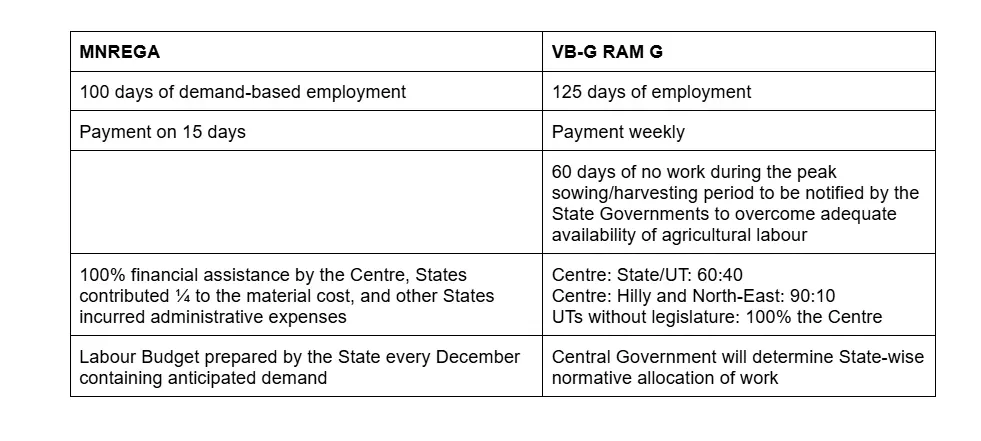
1. Days of employment: MNREGA guaranteed 100 days, while VB-G Ram G will guarantee 125 days of employment.
2. Payment: Under MNREGA, the payments were made within 15 days, but under VB-G Ram G, the payments will be weekly. If payments are not made within a maximum of 15 days, the worker is entitled to receive compensation at the rate of 0.05% of the unpaid wages per day of the delay beyond 16th day.
3. 60 day no-work period: 60 days of no-work period shall be notified by the State Government in advance, where no work shall commence, so that there is no shortage of labour during the peak sowing and harvesting season.
The State Governments may issue different notifications for 60 days for different areas of the State based on agro-climatic zones, local patterns of agricultural activities etc
4. Financial Burden: Under MNREGA, the Central Government provided 100% funding. Now, it is termed as a "centrally sponsored scheme".
Finance is divided into three categories: States, hilly States and North-East and Union Territories. Central Government will pay 60% and States and Union Territories will pay 40%. In hilly and North-Eastern States, the ratio is 90:10%. In Union Territories without a legislature, the Central Government will bear the entire expense.
The expenditure will be divided for payment of wages, material component of works, and administrative expenses. Under MNREGA, States bore 1/4th material costs and the cost of unemployment allowance. Under VG-B Ram G, the State will continue to bear the unemployment allowance.
VB-B Ram G provides that during natural calamities or extraordinary circumstances, the State Government can ask for special operational relaxation, including but not limited to temporary expansion of permissible work, enhanced wages etc.
5. Allocation of work: The Central Government will now determine State-wise normative allocation of work(funding) for each financial year, based on objective parameters. For any expenditure incurred by State in access of normative allocation, the State Government will borne the expense.
Under MNREGA, Labour Budgets were prepared by the District Programme Coordinator every December, containing anticipated demand for unskilled manual work in each district and the plan for engagement of labourers in works covered under the scheme.
6. Implementation of the Act: Under MNREGA, the principal authorities for planning and implementation of the scheme were the Panchayats at the district level. Their function was to finalise and approve the blockwise shelf of projects.
Now, there are National Level Steering and State Level Steering Committees, post which the Panchayats will be the authorities. The National Level Steering Committee will recommend decisions relating to normative allocation to States, and the State Level Steering Committee will provide operational guidance.
Tags
Gursimran Kaur Bakshi
Gursimran is the Principal Correspondent with LiveLaw for the Supreme Court. She can be reached out at: simrankaurbakshi@livelaw.in

