



- Home
- /
- Top Stories
- /
- 'Passport Issuance Also Outsourced...
'Passport Issuance Also Outsourced To Private Agencies', Supreme Court Tells Petitioner Opposing Aadhaar Use In SIR
Amisha Shrivastava
28 Jan 2026 4:23 PM IST
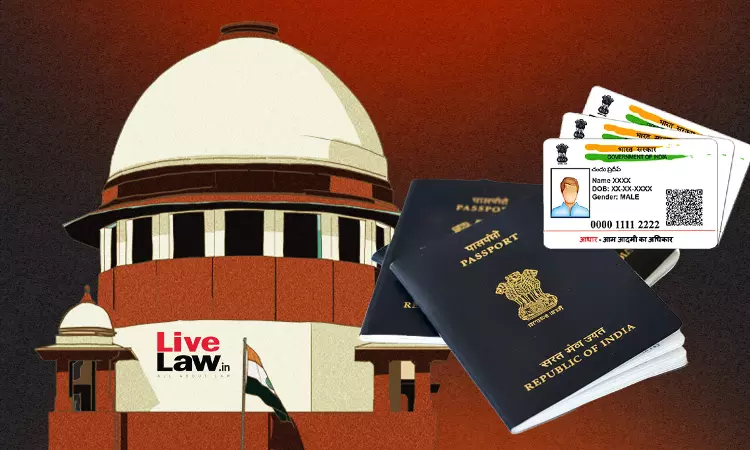
The Supreme Court on Wednesday questioned objections to the use of Aadhaar as a verification document in the Special Intensive Revision (SIR) of electoral rolls, observing that even the issuance of passports has been outsourced to private agencies.A Bench comprising Chief Justice Surya Kant and Justice Joymalya Bagchi was hearing petitions challenging the ongoing SIR exercise, including a...
This is a premium content
Available exclusively to
Our subscribers
Subscribe Premium 
INR 1099+GST
Your support helps us to bring you more content at
an affordable subscription scheme !!!
All payment options available
The Supreme Court on Wednesday questioned objections to the use of Aadhaar as a verification document in the Special Intensive Revision (SIR) of electoral rolls, observing that even the issuance of passports has been outsourced to private agencies.
A Bench comprising Chief Justice Surya Kant and Justice Joymalya Bagchi was hearing petitions challenging the ongoing SIR exercise, including a plea filed by Ashwini Upadhyay seeking a nationwide revision of electoral rolls in all States.
During the hearing, Senior Advocate Vijay Hansaria, appearing for petitioner Ashwini Upadhyay, opposed the Court permitting Aadhaar to be used as a document for verification in the SIR process. Last year, the Supreme Court had directed the ECI to include Aadhaar also as a document which can be submitted for SIR enumeration.
Hansaria argued that Aadhaar could not be treated as a reliable document since it is issued through privately run Aadhaar centres.
“Aadhaar is issued by privately run Aadhaar centres. It cannot be a relevant document for SIR,” Hansaria submitted.
Justice Bagchi, however, responded by pointing out that several public functions are today performed through private agencies.
“Do you know that even your passport issuance is outsourced to a private company?” the judge asked.
When Hansaria sought to distinguish Aadhaar on the ground that it does not require authentication, Justice Bagchi observed that the mere involvement of private entities does not render a document unreliable.
“Any document can be forged. Even a passport can be forged. While issuing Aadhaar, the private person is performing a public duty,” the judge said.
Hansaria clarified that his objection was not based on the possibility of forgery. “Aadhaar can be genuinely issued, but there is no control. A person can get a certificate from the municipal corporation and Aadhaar is issued,” he argued. He submited that anybody who is residing in India is eligible for Aadhaar. "Aadhaar number or authentication does not by itself confer any right or proof of citizenship or of domicile," he submitted.
Responding to this, Justice Bagchi reiterated that Aadhaar has consistently been recognised by the Court as a valid identity document, though not as proof of citizenship.
“Aadhaar is an acknowledged document of identity. We have never said Aadhaar can be used as the basis of citizenship. We have always said that the Election Commission can verify Aadhaar,” the judge said.
The Bench also noted that the list of documents prescribed for the SIR exercise need not have a direct nexus with citizenship in every case.
“These eleven documents need not always have a clear relation to citizenship. They may be of various species depending on the purpose the Election Commission has fixed to serve, in exercise of its plenary powers. Your argument is actually going cross-purposes with the Election Commission's view,” Justice Bagchi observed.
Hansaria, in response, submitted that Aadhaar could at best be used only to prevent duplication of entries in the electoral rolls.
Separately, the senior counsel also addressed allegations that the SIR exercise was politically motivated. He contended that deletions from electoral rolls had occurred across party lines.
“Every political party has won elections despite the deletions. It cannot be said that the exercise was done to favour any particular political party. No motive can be imputed to the Election Commission,” Hansaria submitted.
The Court also heard other petitioners, who oppose SIR, today. Hearing will continue tomorrow.
Case : Ashwini Kumar Upadhyay v. Union of India | W.P.(C) No. 634/2025
#SupremeCourt hearing the batch of pleas challenging the SIR across various states.
— Live Law (@LiveLawIndia) January 28, 2026
Bench: Chief Justice of India Surya Kant and Justice Joymalya Bagchi. pic.twitter.com/mEe1HPH3S9

Amisha Shrivastava
Amisha Shrivastava is a Senior Correspondent with LiveLaw, covering the Supreme Court of India. She can be reached at amisha@livelaw.in

