



- Home
- /
- Top Stories
- /
- People Voted For United Shiv Sena,...
People Voted For United Shiv Sena, How Can 2019 Vote Shares Be Evidence Of Support For Shinde Faction? Supreme Court
Amisha Shrivastava
17 Sept 2026 9:10 PM IST
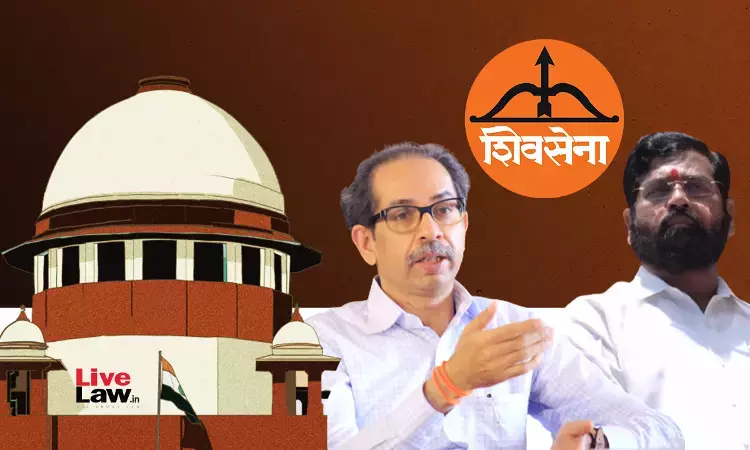
Shinde faction argued that ECI could not have allotted neutral symbols to both side as the Bow and Arrow Symbol has importance in voters’ minds.
In the Shiv Sena case, the Supreme Court on Thursday questioned whether votes cast for a united Shiv Sena in the 2019 elections could subsequently be treated as evidence of support for the Eknath Shinde faction, after the latter relied on MLA and vote-share figures to defend the Election Commission's decision recognising it as the real Shiv Sena.A bench of CJI Surya Kant, Justice Joymalya...
This is a premium content
Available exclusively to
Our subscribers
Subscribe Premium 
INR 1099+GST
Your support helps us to bring you more content at
an affordable subscription scheme !!!
All payment options available
In the Shiv Sena case, the Supreme Court on Thursday questioned whether votes cast for a united Shiv Sena in the 2019 elections could subsequently be treated as evidence of support for the Eknath Shinde faction, after the latter relied on MLA and vote-share figures to defend the Election Commission's decision recognising it as the real Shiv Sena.
A bench of CJI Surya Kant, Justice Joymalya Bagchi and Justice V Mohana was hearing the challenge made by Uddhav Thackeray to the Election Commission's decision recognising the Eknath Shinde faction as the real Shiv Sena and allowing it the use of the 'bow and arrow' symbol.
Senior Advocate Neeraj Kishan Kaul, appearing for the Shinde faction, defended the ECI's reliance on legislative majority test to recognise it as the Shiv Sena, arguing before the Supreme Court that pending disqualification proceedings could not retrospectively erase the electoral strength of the legislators supporting the faction.
He submitted that even if legislators were subsequently disqualified, their elections would not stand annulled and the votes polled by them would not be cancelled.
“Therefore, it is in this context that the ECI correctly relied on the test of legislative majority. A shroud of pending disqualification petitions has no bearing on this case. Even presuming that the members are disqualified, election is not annulled, votes are not cancelled. Disqualification is prospective. The votes and seats secured by the members remain relevant for the purpose of the ECI's determination,” Kaul submitted.
Relying on Paragraph 6 of the Election Symbols (Reservation and Allotment) Order and the Constitution Bench judgment in Sadiq Ali v. ECI, Kaul argued that seats secured and votes polled would be relevant to determining which faction represented a recognised political party.
He submitted that the 40 MLAs supporting Shinde accounted for 76% of the votes polled for the 55 winning Shiv Sena MLAs in the 2019 Maharashtra Assembly election, while the 15 MLAs supporting Uddhav Thackeray accounted for 23.5%. Of the 90,48,789 votes polled by Shiv Sena candidates in the election, including unsuccessful candidates, the Shinde-supporting MLAs represented 40% and the Thackeray-supporting MLAs 12%, he said.
Similarly, Kaul said, 13 MPs supporting Shinde accounted for 73% of the votes polled for the 18 elected Shiv Sena MPs in 2019, while the remaining five MPs accounted for 27%.
Justice Joymalya Bagchi questioned whether votes cast for a united Shiv Sena could subsequently be treated as evidence of support for one faction.
“That is a very, very, I would say, debatable way of going behind the idea of party democracy. The votes were polled for united Shiva Sena. Once their split is there, you don't know whether that person who voted would have voted for this split Shiv Sena candidate. So, Sadiq Ali does not require to look into that because 10th schedule was not in the contemplation of Sadiq Ali when it interpreted that we will straight away go off the voter and the candidate. But today it's not the voter and the candidate, it's the voter and a party. And today we are seeing the voter and a truncated party. Would the voter vote to the truncated party is a matter of conjecture. And that conjectural inference is drawn by ECI to the ratio of Sadiq Ali,” he observed.
He also questioned the reliance on legislative strength in circumstances where the legislators themselves were facing proceedings under the Tenth Schedule.
“Don't you feel that the ECI, the custodian of constitutional values, should fashion its discretion, keeping its mind open to the fact that the philosophy of 10th schedule is furthered and not curtailed?” he asked.
He remarked that if the legislative test was applied while the Tenth Schedule proceedings were pending against a faction alleged to have moved away from the political party, a higher threshold could be required before recognising that group as the political party in order to account for the anti-defection scheme.
“You apply the legislative test when 10th schedule itself has been questioned in respect of a group which is alleged to have moved away from the political party. On the basis of the legislative test, allotting the symbol would require a very, very high test for the split party or the split group to be identified as the political party till the disqualification is over”, observed.
He also referred to the broader philosophy of the Tenth Schedule.
“If you see the ethos of 10th Schedule, you will see a continual contraction of candidate autonomy and an expansion of party identity,” he said, pointing out that the original split exception based on one-third of legislators had subsequently been removed, while the merger exception continued.
Kaul, however, maintained that the proceedings under the Tenth Schedule and the ECI's proceedings under Paragraph 15 were distinct. He relied on the Constitution Bench judgment in Subhash Desai v. ECI to argue that the judgment did not prohibit the ECI from considering legislative majority.
He further argued that Subhash Desai judgment recognised that the ECI could fashion a test suited to the facts of a particular dispute and did not declare legislative majority invalid.
“Subhash Desai does not say legislative majority is invalid. It says that if disqualification is pending, the test gets diluted and at times may become futile. But it leaves it to the Election Commission whether legislative majority alone can be adopted and to fashion a test according to its wisdom and the facts of the case,” he submitted.
Kaul contended that the ECI had not relied solely on the number of MLAs. It had considered the party Constitution, aims and objectives and organisational majority before concluding that the latter tests could not reliably resolve the dispute.
He also argued that the ECI was not constitutionally required to wait for the Speaker's decision on disqualification before deciding the symbol dispute. Referring to Subhash Desai judgment, he submitted that such a requirement would indefinitely delay the ECI's determination because the Speaker's decision could itself be challenged before the courts.
“Proceedings before one constitutional authority cannot be halted in anticipation of the decision of another constitutional authority. When a dispute under Para 15 of the Symbols Order is pending adjudication, it is standard practice for the ECI to freeze the symbol reserved for that political party and allot interim symbols to the rival groups. If reserved symbol is frozen for an inordinate long period of time and the interim symbol orders must be resorted to for every by-election and election, it may well end the association between the reserve symbol and the political party in the minds of the electorate”, he submitted.
Justice Bagchi reiterated his question about whether the ECI had adequately considered all possible outcomes, such as letting both sides fight with neutral symbols, while exercising its discretion. He clarified that the Court was not seeking to substitute its own discretion for that of the constitutional authority.
Kaul contended that the Election Commission of India could not have continued the two interim symbols allotted to the rival Shiv Sena factions as a permanent arrangement, arguing that a reserved symbol carries a distinct significance for a recognised political party.
He was responding to Justice Bagchi's question raised yesterday, whether the two interim symbols could have been made the final arrangement instead of the Election Commission recognising one faction as the political party and giving it the reserved Shiv Sena symbol.
“My respectful submission and all humility will be that that would not be the course open here for the simple reason that when I read out Sadiq Ali v. ECI to your Lordships, your Lordships will see that there is a certain importance given to symbols which are allotted to a political party,” Kaul submitted.
He distinguished registration of a political party under the Representation of the People Act from recognition under the Symbols Order, pointing out that only a recognised State or national party is entitled to a reserved symbol.
Kaul relied on Sadiq Ali judgment to submit that, given the social conditioning in India, a substantial part of the electorate identifies a political party with its symbol. He argued that once the ECI, after examining the available tests, concluded that there was a split in the Shiv Sena, it was entitled to determine which faction represented the recognised political party rather than perpetually continue the interim arrangement.
Case: Sunil Prabhu v. Eknath Shinde SLP(C) No. 1644-1662/2024 (and connected case)
Tags

Amisha Shrivastava
Amisha Shrivastava is a Senior Correspondent with LiveLaw, covering the Supreme Court of India. She can be reached at amisha@livelaw.in

