



- Home
- /
- Top Stories
- /
- Permanently Vesting Secular...
Permanently Vesting Secular Functions Of Mathadhipati In Govt Officer Denies Concept Of Mahantship; Violates Article 26: Supreme Court
LIVELAW NEWS NETWORK
30 May 2026 10:49 AM IST
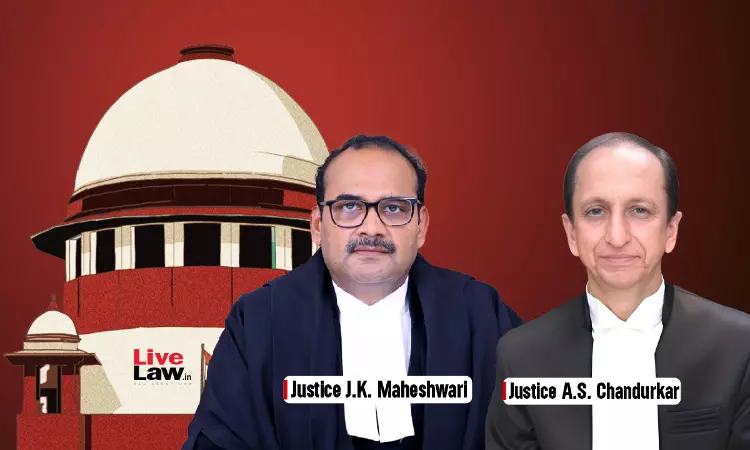
The Court set aside the AP Govt orders removing Arjun Dass as the Mathadhipati of the historic Sri Swamy Hathiramji Mutt in Tirupati.
The Supreme Court has held that the State cannot permanently separate the religious and secular functions of a Mathadhipati and vest the latter in a government-appointed administrator, observing that such an arrangement would amount to a denial of the very concept of Mahantship protected under Article 26 of the Constitution.A Bench comprising Justice JK Maheshwari and Justice Atul S...
This is a premium content
Available exclusively to
Our subscribers
Subscribe Premium 
INR 1099+GST
Your support helps us to bring you more content at
an affordable subscription scheme !!!
All payment options available
The Supreme Court has held that the State cannot permanently separate the religious and secular functions of a Mathadhipati and vest the latter in a government-appointed administrator, observing that such an arrangement would amount to a denial of the very concept of Mahantship protected under Article 26 of the Constitution.
A Bench comprising Justice JK Maheshwari and Justice Atul S Chandurkar made the observations while setting aside the Andhra Pradesh Government orders for the removal of Arjun Dass as the Mathadhipati of the historic Sri Swamy Hathiramji Mutt in Tirupati, and quashing orders appointing a "Fit Person" to administer the Mutt.
Referring to precedent in Shirur Mutt, the Court noted that in the conception of Mahantship, both the elements of office and property, of duties and personal interest, are blended together and neither can be detached from the other.
The Mahant is not merely the manager of the temporalities of the Mutt rather, he is the spiritual head and superior of a fraternity of disciples, charged with the propagation of the doctrines of the sampradaya to which the math belongs. The Court said that this concept is recognized by the Andhra Pradesh Charitable and Hindu Religious Institutions and Endowments Act, 1987
"The conception of Mahantship" combines both spiritual and temporal responsibilities, the Court said, adding that "both the elements of office and property, of duties and personal interest, are blended together and neither can be detached from the other."
The Court further held:
"Any arrangement which seeks to permanently bifurcate the religious functions of a Mathadhipati from the administrative and secular functions, or which vests the latter in a 'Fit Person' or a Custodian for an indefinite period notwithstanding that the lawful Mathadhipati continues in office, would amount to a denial of the very concept of Mahantship."
Emphasising the constitutional protection available to religious denominations under Article 26, the Court said that while the State may regulate the administration of religious properties through valid legislation, deprivation of the office of a spiritual head can be carried out only through procedures that are "demonstrably fair, neutral, and minimally invasive."
Background
The case arose from proceedings initiated against Arjun Dass, the 21st Mahant of Sri Swamy Hathiramji Mutt, a prominent religious institution associated with the Tirumala temple. Arjun Dass has been associated with the Mutt since 1970 and was appointed permanent Mahant in 2000 after being recognised by the Akhil Bharatiya Sri Panch Digambar Ani Akhada Panchayat as the sole surviving disciple of his predecessor.
His tenure, however, witnessed prolonged disputes with the Andhra Pradesh Endowments Department. In 2003, the Department attempted to set aside his appointment and retain control over the Mutt's secular affairs. The Andhra Pradesh High Court later directed that management of the Mutt's secular affairs and properties be handed over to him, a direction implemented through a government order in 2006.
Fresh proceedings were initiated in 2017 following newspaper reports alleging irregularities in the administration of the Mutt. After several rounds of litigation, the Andhra Pradesh Dharmika Parishad, constituted under the Andhra Pradesh Charitable and Hindu Religious Institutions and Endowments Act, 1987, resolved in May 2023 to initiate disciplinary proceedings against Arjun Dass.
On June 8, 2023, the Parishad simultaneously framed 16 charges against him, suspended him from office and appointed a "Fit Person" to administer the Mutt. The Endowments Department also took physical possession of the Mutt office and the Mahant's residence.
The charges included allegations of unauthorised dealings with Mutt properties, acquisition of personal assets, misappropriation of funds, nepotistic appointments, failure to protect Mutt properties, and other acts of maladministration. An enquiry committee constituted by the Dharmika Parishad found all 16 charges proved. Based on the report, the Parishad removed Arjun Dass from office in November 2023, a decision subsequently confirmed by the State Government.
The Andhra Pradesh High Court largely upheld the removal order, prompting Arjun Dass to approach the Supreme Court.
Proceedings Vitiated By Violations Of Natural Justice
Allowing the appeal, the Supreme Court held that the removal proceedings suffered from multiple and fundamental violations of natural justice.
The Court found that the 27-page charge memo and 29 supporting documents running to more than 600 pages were never properly supplied to the appellant despite repeated requests. It rejected the State's contention that service had been effected by affixing documents at the Mutt premises, noting that the authorities themselves had already taken possession of those premises.
Describing the State's argument as a "legal absurdity", the Court observed that authorities could not dispossess a person from his residence and then claim to have validly served notices by pasting them on the door of that very residence.
The Bench also found that the enquiry was conducted ex parte despite repeated requests by the Mahant for documents and adequate time to prepare his defence.
Apprehension Of Bias
The Court was equally critical of the manner in which the enquiry was conducted. It noted that the three-member enquiry committee consisted of members of the Dharmika Parishad itself, which had already resolved to initiate proceedings and suspend the appellant.
The judgment observed that permitting members of the body which initiated proceedings to subsequently sit in judgment over those proceedings raised serious concerns regarding impartiality and violated the principle that no person can be a judge in his own cause.
The Court also referred to the long history of attempts by the State to assume control over the Mutt's affairs, observing that the apprehension of bias could not be ruled out in the circumstances of the case..
Independent Enquiry Ordered Under Article 142
Invoking its powers under Article 142 of the Constitution, the Supreme Court devised a one-time mechanism for conducting a fresh enquiry.
The Court appointed retired District Judge Boddepalli Rama Rao as a one-member independent enquiry committee and directed that a fresh enquiry be conducted in accordance with principles of natural justice. The committee has been empowered to supply all relied-upon documents, permit cross-examination of witnesses and allow the appellant to adduce evidence in his defence before submitting its report.
Pending completion of the enquiry, the Court restored Arjun Dass to office and also constituted a six-member administrative committee headed by retired High Court judge Justice Duppala Venkata Ramana to assist in the administration of the Mutt and oversee its properties and affairs.
Headnote
Maharashtra Industrial Development Act, 1961 – Maharashtra Municipal Corporation Act, 1949 – Maharashtra Regional and Town Planning Act, 1966 – Property Tax vs. Service Charges – Exemption from Municipal Taxation - Territorial Jurisdiction of Municipal Corporation over Industrial Areas - the Trans Thane Creek (TTC) Industrial Area developed by the Maharashtra Industrial Development Corporation (MIDC) falls within the notified municipal limits of the Navi Mumbai Municipal Corporation (NMMC) - The revenue jurisdiction of the villages remains unaffected by their vesting with the MIDC for development - The power to impose and collect property tax (which includes water tax, sewerage tax, general tax, etc.) vests exclusively with the Municipal Corporation under Sections 127 and 128A of the MMC Act - the MIDC is only empowered under Section 17 of the MID Act to levy fees or service charges to cover its maintenance expenses - A fee/service charge linked to a specific amenity involves the element of quid pro quo and cannot be equated to a tax - the NMMC has the authority to levy property tax even if plot holders pay service charges to the MIDC. [Paras 58 – 69, 73-89]
Scope of Exemption Under Clause 7(1) of the First Schedule, MRTP Act - The statutory exemption from property tax provided under Clause 7(1) of the First Schedule of the MRTP Act applies not only to the MIDC itself but extends to all individual unit/plot holders occupying lands vesting in the MIDC - Restricting this exemption solely to the authority would render the provision otiose and absurd - This tax exemption is conditional and remains operational only so long as the industrial authority continues to provide the municipal amenities - Once the maintenance and infrastructure responsibilities are transferred to the Municipal Corporation (as done via the MoU/Agreement dated 01.12.2005 between MIDC and NMMC), the exemption ceases to exist - the NMMC is fully empowered to collect property tax from the plot holders from the date of such transfer. [Relied on Commr., Hindu Religious Endowments v. Sri Lakshmindra Thirtha Swamiar of Sri Shirur Mutt, (1954) 1 SCC 412; Corporation of Calcutta and Anr. v. Liberty Cinema, 1964 SCC OnLine SC 65; Sreenivasa General Traders and Ors. v. State of Andhra Pradesh and Ors., (1983) 4 SCC 353; Government of Kerala and Another v. Mother Superior Adoration Convent, (2021) 5 SCC 602; Paras 97 – 105]
Case : Arjun Dass v State of Andhra Pradesh
Citation : 2026 LiveLaw (SC) 569
Click here to read the judgment
Appearances: Mr. Puneet Jain, Senior Advocate,Ms. Christi Jain, AOR, Mr. Om Sudhir Vidyarthi, Mr. Aditya Jain, Mr. Siddharth Jain and Mr. Yogit Kamat, Advocates, appeared for the petitioners.
Mr. Sidharth Luthra, Senior Advocate, along with Mr. Guntur Pramod Kumar, AOR, Ms. Prerna Singh, Mr. Mihir Joshi, Mr. Sohail Ahmed, Ms. Vanshika Singh and Ms. Rakshita Rana, Advocates, appeared for the respondents.


