



- Home
- /
- Top Stories
- /
- “Pharmacy Council Of India An...
“Pharmacy Council Of India An Obsolete Institution”: Supreme Court Suggests Replacing PCI With Statutory Commission
Amisha Shrivastava
3 Aug 2026 7:36 PM IST
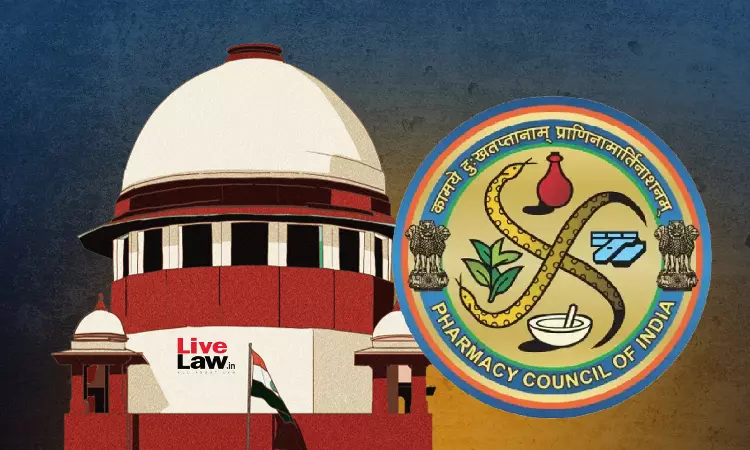
The Supreme Court on Monday remarked that the Pharmacy Council of India (PCI) should not continue to function in its present form, and asked the Centre why it could not be replaced with a new statutory commission on the lines of the National Medical Commission.A bench of Chief Justice of India Surya Kant, Justice Joymalya Bagchi and Justice V Mohana was hearing the Council's challenge to a...
This is a premium content
Available exclusively to
Our subscribers
Subscribe Premium 
INR 1099+GST
Your support helps us to bring you more content at
an affordable subscription scheme !!!
All payment options available
The Supreme Court on Monday remarked that the Pharmacy Council of India (PCI) should not continue to function in its present form, and asked the Centre why it could not be replaced with a new statutory commission on the lines of the National Medical Commission.
A bench of Chief Justice of India Surya Kant, Justice Joymalya Bagchi and Justice V Mohana was hearing the Council's challenge to a Delhi High Court judgment which held that once approval is granted to a pharmacy course under Section 12 of the Pharmacy Act, 1948, the institution cannot be required to seek continuation of that approval annually.
At the outset of the hearing, the bench asked why the PCI cannot be replaced like the Medical Council of India was replaced with the National Medical Commission.
“But like this old institution of Medical Council of India, you have replaced through a statute by constituting a Commission. Why this old obsolete institute is being allowed to work?”, the CJI asked during the hearing.
The CJI also referred to the presence of elected persons in the Council and expressed concern about vested interests. “It is occupied by the elected persons. They have their own interest, vested interest. Why can't you reconstitute, reframe the institution itself?,” he said.
Responding, Solicitor General Tushar Mehta informed the Court that a Bill was pending and said that it might come up in the current Parliament session. He said that the proposed framework was along the lines of the commission model adopted for medical education and contemplated a National Pharmacy Commission.
“The bill is pending. I cannot make any statement. It might come in this session as well, Milord. It's similar on lines of the Medical Commission. It would be National Pharmacy Commission”, he said.
The Ministry of Health and Family Welfare had on July 1, 2026, published the second version of the draft National Pharmacy Commission Bill, 2026 for public and stakeholder comments. The proposed law seeks to set up a National Pharmacy Commission and repeal the Pharmacy Act, 1948.
Under Section 3 of the draft Bill, the Central Government would constitute the National Pharmacy Commission. The proposed Commission would have a Chairperson, 15 ex-officio members and 13 part-time members.
The CJI said that if Parliament enacted a new statutory framework, it could prescribe the fee considered appropriate. The Court's concern, he said, was with the PCI functioning in its existing form. CJI Kant also expressed concern that institutions without adequate facilities were being permitted to operate and questioned the quality of pharmacy professionals emerging from such institutions.
“Our concern is that much only under the new statute, Parliament may prescribe any fee. We don't care if they don't want to run colleges, let them close down. We are not concerned about that. If you can bring a new, a new avatar, a new legislative form, that's fine. This institution in the present form is creating a lot of problem. The biggest problem is that they are allowing, unfortunately for all extraneous considerations, to open and run the institutes which are….Therefore, the quality of product which is coming is very questionable. And it is playing with the life of the people”, the CJI said.
In the issue involved in the case, SG Mehta raised concerns about pharmacy institutions operating without adequate infrastructure. He said some institutions were functioning from office complexes and that the system before the High Court's judgment involved annual inspections followed by extensions of approval.
The CJI said that the Court was not against inspections, but questioned the collection of a fee every year for the exercise. “Inspection we can allow but you can't ask for fee every time every year,” he said.
Mehta told the Court that the charge was Rs 900 per student. He, however, agreed that the fee need not necessarily be linked to the number of students since the nature of an inspection would remain the same whether an institution had 50 students or 5,000 students. He said he would discuss the issue with the Council.
Justice Bagchi pointed out that the High Court had not held that an institution, once granted approval, could continue irrespective of subsequent deficiencies. He said that if approval was given for a course of a particular duration, the PCI could not break it down into yearly permissions. If an inspection subsequently revealed deficiencies, the Council could take action, including suspension, he said.
“You can do for B Pharma, you can do for M Pharma or any other diploma etc. which the college is offering to the students. But you can't say that the B Pharma course of 3 year, it will be a license for one year and then again a second year,” he said.
He added that such a system created uncertainty for students. Mehta agreed that uncertainty was undesirable and said he would speak to the authorities and return with instructions.
The Solicitor General also pointed to problems faced during inspections. He said faculty members were sometimes hired temporarily and machinery and equipment were also taken on hire. The CJI observed that the Court was aware of malpractices by such colleges.
Attorney General for India R Venkataramani supported the Solicitor General's submissions, and suggested that a workable arrangement could be arrived at.
The Court posted the matter for further consideration after August 20. In the meantime, it said the PCI would not be obligated to refund Pharmacy Education Regulatory Charges (PERC) already collected from pharmacy institutions.
Background
The dispute concerns a PCI circular dated December 14, 2023 governing approvals for the 2024-25 academic session. It required even institutions whose D.Pharm, B.Pharm, M.Pharm, Pharm.D, Pharm.D (PB) and B.Pharm (Practice) courses were already approved under Section 12 of the Pharmacy Act to apply again for continuation of approval, submit information and documents and pay Pharmacy Education Regulatory Charges (PERC). Institutions which already had approval for 2024-25 or beyond were also required to apply and pay PERC to retain their approval. Failure to apply could result in a "No Admission Year".
The Delhi High Court Single Judge held that the Pharmacy Act did not contemplate periodic renewal of an approval already granted under Section 12 and struck down the requirements relating to continuation of approval and PERC.
The Division Bench upheld that decision. It held that the PCI retained sufficient powers to monitor institutions even without annual renewal. Section 12(3) permitted the Council to seek information from institutions from time to time, while Section 16 empowered its Executive Committee to inspect institutions running approved courses. Section 13 also empowered the Council to withdraw approval where an approved course ceased to conform to the applicable regulations.
The Division Bench further agreed that an approval under Section 12 was for the entire "Course of Study" and not something that had to be renewed each year. It noted that decisions granting approval between 1986 and 2020 did not reflect a practice of year-to-year approval. It consequently dismissed the PCI's appeal.
When the matter came before the Supreme Court on June 17, the Court declined the PCI's prayer for interim stay. It also observed that statutes such as the Pharmacy Act, 1948, under which autonomous statutory bodies regulate professional, scientific and technical education, may need to be revisited in light of changing circumstances. The Court requested the Attorney General to assist it on the broader issue and directed the Registry to prepare a list of similar statutes.
Case no. – Diary No. - 36158/2026
Case Title – Pharmacy Council of India v. SLS College of Pharmacy
Tags

Amisha Shrivastava
Amisha Shrivastava is a Senior Correspondent with LiveLaw, covering the Supreme Court of India. She can be reached at amisha@livelaw.in

