



- Home
- /
- Top Stories
- /
- Plea To Regulate Institutions...
Plea To Regulate Institutions Imparting Religious Education | Supreme Court Asks Petitioner To Await Centre's Decision
Gursimran Kaur Bakshi
11 May 2026 12:22 PM IST
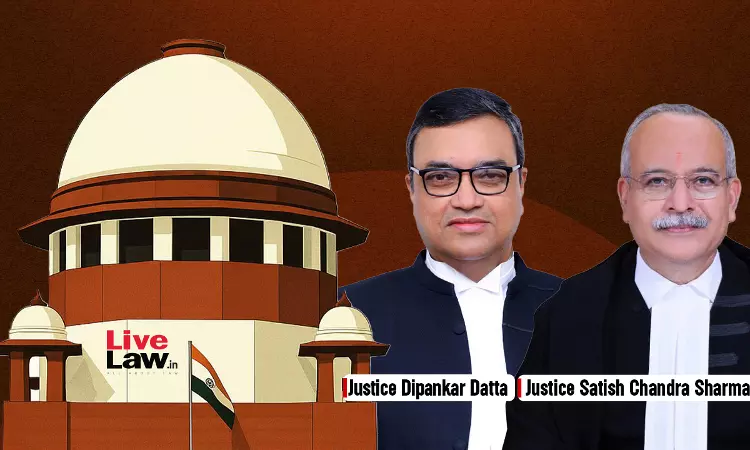
The Supreme Court today (May 11) disposed of a writ petition seeking registration, recognition and supervision of all institutions imparting religious education to children up to 14 years. It directed the petitioner to await the outcome of the representation made to the Secretary, Ministry of Education.A bench comprising Justice Dipankar Datta and Justice Satish Chandra Sharma heard...
This is a premium content
Available exclusively to
Our subscribers
Subscribe Premium 
INR 1099+GST
Your support helps us to bring you more content at
an affordable subscription scheme !!!
All payment options available
The Supreme Court today (May 11) disposed of a writ petition seeking registration, recognition and supervision of all institutions imparting religious education to children up to 14 years. It directed the petitioner to await the outcome of the representation made to the Secretary, Ministry of Education.
A bench comprising Justice Dipankar Datta and Justice Satish Chandra Sharma heard the petitioner-in-person advocate Ashwini Kumar Upadhyay briefly in this matter.
As per Upadhyay's petition, thousands of non-registered institutions are radicalising gullible young children under the garb of imparting religious instructions, as they are not supervised by the State. He has stated that this has serious implications not only for internal security but also fraternity, unity and national integration, as one can easily brainwash young children in the name of religion.
Justice Datta said that in another similar writ petition [WP 143/2026], filed by the same petitioner, the Court had refused to interfere and had directed Upadhyay to make a representation. The judge pointed out that that it has been only three months since the petitioner submitted the representation.
Upadhyay pleaded that his plea may be considered as the Court has previously accepted similar writ petitions.
Refusing to entertain his plea, Justice Datta said: "You are before a bench having judges who are very conservative and traditional. We need not jump the gun. The first time you came without a representation, we said that once you are seeking a mandamus in terms of the 1974 judgment, you are required to first go to the authority for your grievance. They have not done it, [but] not much time has lapsed. 10th of February, you submitted your representation."
Justice Datta orally remarked that justice is not a one-way traffic and the executive and legislature are equally responsible to uphold it.
Upadhyay then requested that this petition be considered as a representation, but the Court said, since representation has already been made, let it be first decided.
He has also sought a direction that semi-religious minority and non-minority educational institutions can't fall under Article 30, as it is a specific reiteration of Article 19(1)(g) and doesn't confer any additional rights. And, 'educational institutions of their choice' in Article 30(a) means 'secular/professional educational institutions of their choice' and not religious educational institutions. Institutions which impact religious instructions to promote any 'religion' are covered under Article 26(a).
Case Details: ASHWINI KUMAR UPADHYAY Vs UNION OF INDIA|W.P.(C) No. 590/2026
Gursimran Kaur Bakshi
Gursimran is the Principal Correspondent with LiveLaw for the Supreme Court. She can be reached out at: simrankaurbakshi@livelaw.in

