



- Home
- /
- Top Stories
- /
- President Donald Trump's Global...
President Donald Trump's Global Tariffs Illegal : US Supreme Court
LIVELAW NEWS NETWORK
20 Feb 2026 9:25 PM IST
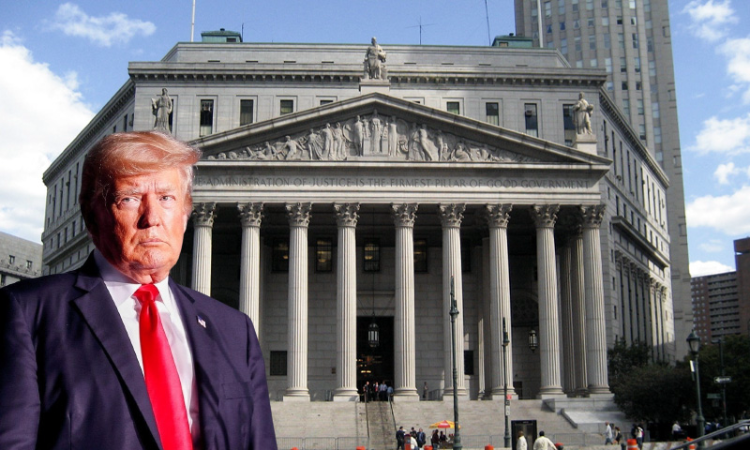
The Supreme Court of the United States ruled that the global tariffs imposed by President Donald Trump are illegal. In a 6:3 verdict, the Court ruled that the International Emergency Economic Powers Act (IEEPA) does not authorize the President to impose tariffs.Justices Clarence Thomas, Samuel Alito, and Brett Kavanaugh dissented.Chief Justice John Roberts announced the judgment of the Court...
This is a premium content
Available exclusively to
Our subscribers
Subscribe Premium 
INR 1099+GST
Your support helps us to bring you more content at
an affordable subscription scheme !!!
All payment options available
The Supreme Court of the United States ruled that the global tariffs imposed by President Donald Trump are illegal. In a 6:3 verdict, the Court ruled that the International Emergency Economic Powers Act (IEEPA) does not authorize the President to impose tariffs.
Justices Clarence Thomas, Samuel Alito, and Brett Kavanaugh dissented.
Chief Justice John Roberts announced the judgment of the Court and delivered the principal opinion in large part. The Court concluded that the Constitution vests the taxing power, including the power to impose tariffs, in Congress alone. Because tariffs are a form of taxation, the President must point to clear congressional authorization before imposing them. According to the majority, IEEPA's grant of authority to “regulate … importation” does not amount to such authorization.
The case arose after President Donald Trump declared national emergencies relating to the influx of illegal drugs and persistent trade deficits. Invoking IEEPA, he imposed a 25 percent duty on most imports from Canada and Mexico, a 10 percent duty on many Chinese imports, and later broader reciprocal tariffs of at least 10 percent on imports from nearly all trading partners. Some tariffs on Chinese goods ultimately reached effective rates of 145 percent.
Small businesses and a coalition of states challenged the tariffs in separate lawsuits. The United States Court of International Trade granted summary judgment against the government, and the United States Court of Appeals for the Federal Circuit, sitting en banc, largely affirmed. The Supreme Court granted review and consolidated the cases.
Majority's Constitutional Analysis
The Court grounded its reasoning in Article I of the Constitution, which gives Congress the power to “lay and collect Taxes, Duties, Imposts and Excises.” The majority emphasized that tariffs are “very clear[ly] … a branch of the taxing power,” and that the Framers deliberately vested that authority in Congress alone
Applying what it described as the “major questions” doctrine, the Court held that when the Executive asserts a highly consequential power of vast economic and political significance, it must identify clear congressional authorization. The government's reading of IEEPA would have allowed the President to impose tariffs of unlimited amount, duration, and scope, constrained only by his declaration of a national emergency. The majority found no evidence that Congress intended such a sweeping delegation.
The Court also rejected arguments that emergency statutes or foreign affairs contexts justify a more permissive reading. Even in matters implicating international trade, the Constitution assigns tariff power exclusively to Congress during peacetime.
The Dissents
Justices Clarence Thomas, Samuel Alito, and Brett Kavanaugh dissented. Justice Kavanaugh authored the principal dissent, joined by Justices Thomas and Alito. Justice Thomas also filed a separate dissent.
The dissenters argued that the statutory text authorizing the President to “regulate … importation” should be read more broadly. In their view, tariffs are a traditional tool of regulation in foreign commerce and fall within the ordinary meaning of the term “regulate.” They contended that the majority improperly narrowed the statute by treating taxation and regulation as categorically distinct.
Justice Kavanaugh's dissent also criticized the majority's application of the major questions doctrine. He argued that IEEPA was specifically designed to grant the President substantial flexibility to respond to foreign threats and economic emergencies. According to the dissent, Congress intended to confer broad authority in precisely such high-stakes contexts. Limiting that authority, he warned, risks undermining the Executive's ability to respond swiftly to national crises.
Justice Thomas, in his separate dissent, went further, questioning the scope and legitimacy of the major questions doctrine itself and suggesting that Congress may constitutionally delegate significant powers to the President without the stringent clarity demanded by the majority.
Click here to read the judgment


