



- Home
- /
- Top Stories
- /
- 'Private School Fee High, But...
'Private School Fee High, But Hurried Regulation Not Good' : Supreme Court Questions Midyear Enforcement Of Delhi School Fee Law
Amisha Shrivastava
19 Jan 2026 7:02 PM IST
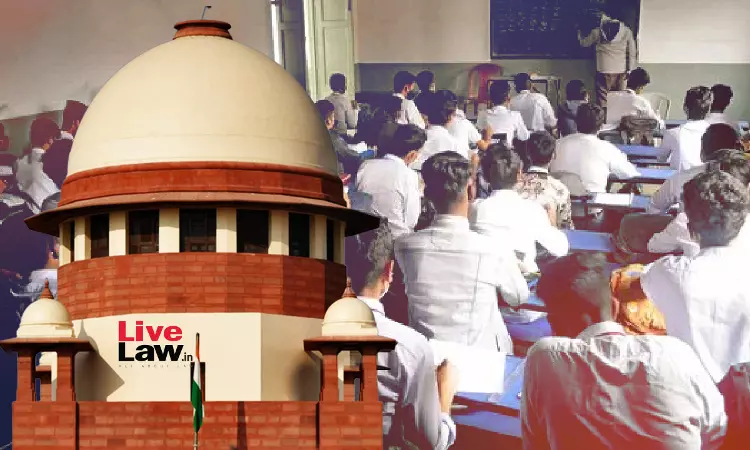
The Supreme Court on Monday raised concerns over the manner in which the Delhi School Education (Transparency in Fixation and Regulation of Fees) Act, 2025, a law enacted last month to regulate fees of private schools in Delhi, and a subsequent government circular were being implemented for the ongoing academic year.A bench of Justice PS Narasimha and Justice Alok Aradhe noted that while...
This is a premium content
Available exclusively to
Our subscribers
Subscribe Premium 
INR 1099+GST
Your support helps us to bring you more content at
an affordable subscription scheme !!!
All payment options available
The Supreme Court on Monday raised concerns over the manner in which the Delhi School Education (Transparency in Fixation and Regulation of Fees) Act, 2025, a law enacted last month to regulate fees of private schools in Delhi, and a subsequent government circular were being implemented for the ongoing academic year.
A bench of Justice PS Narasimha and Justice Alok Aradhe noted that while the object of the legislation was for public welfare, hurried and retrospective implementation could create practical and financial difficulties for schools.
“We are completely in favour of the legislation, this is not the final word or anything, but what we are saying is, hurry may end up not properly constituting the committees… This year has already started. This is completely convoluted. The approval should have been done by July and that has also passed. What is the over anxiety here? Of course the fees are phenomenally high, it's a legislation for public welfare. But in your anxiety you will end up creating institutions which are not viable”, Justice Narasimha said.
Background Facts
The new Act, notified on December 10, seeks to regulate fee hikes through a three-tier committee system. The Circular dated December 24, 2025 directed all private schools to constitute a School Level Fee Regulation Committee (SLFRC) by January 10 and submit fee proposals by January 25, in terms of the 2025 Act and its rules.
The Delhi High Court on January 8 issued notice on various petitions challenging the constitutionality of the 2025 Act and the Circular. The High Court also extended the time for constituting the School Level Fee Regulation Committee (SLFRC) for the academic year 2025–26 till January 20 and the deadline for fee proposal till February 5.
The Supreme Court was hearing a batch of pleas challenging the January 8 order and seeking stay on the Act and the Circular.
Proceedings before the Supreme Court
Senior Advocate Mukul Rohatgi for the petitioners(school managements) said the matter involved a clash between a central legislation and a local law. He argued that the 2025 Act was repugnant to the Delhi School Education Act, 1973 enacted by Parliament. He said the petitioners had sought a stay on the entire Act before the Delhi High Court, but no interim relief was granted.
Rohatgi also challenged the circular dated December 24, saying that even assuming the Act was valid, the circular was contrary to the statute. He submitted that the Act should not have been implemented for the current academic year. He pointed out that under the Act, school managements cannot fix fees but can only propose them, and that for the academic year 2025–26, the fee being charged is deemed to be the proposed fee.
Taking the bench through Section 5 of the Act, Rohatgi said the Act required schools, after constitution of the SLFRC, to submit details of the proposed fee for the next block of three years by July 31 of the current academic year. He said this timeline had already passed. He highlighted that the circular sought to retrospectively fix fees through SLFRCs even for the academic year that began on April 1, 2025, even thought the Act commenced only in December.
Justice Narasimha observed that the court was not against the legislation. He said the concern was that hurried implementation could result in SLFRCs not being properly constituted. He questioned how fees could be fixed for a year that had already begun and noted that the statutory timeline for approval by July had also elapsed.
Additional Solicitor General SV Raju, appearing for the Directorate of Education, said the issue had been elaborately argued before the Delhi High Court and that timelines had been extended at the request of the schools. He submitted that there were two parts to the Act, one dealing with the current academic year and the other with subsequent years. He said what was being charged would be deemed to be the proposed fee for 2025–26 and would then go to the SLFRC.
When asked by Justice Narasimha from when the approved fee would be implemented, Raju said it would apply from April 2025. The bench remarked that this made the scheme convoluted since the academic year had already started. Justice Narasimha added that retrospective fixation could also lead to recovery from schools.
“It will be unviable. You are forcing people overnight to get up and do it. It's a very ideal Act which is done for a very good purpose. Implement it in a proper way. The Act is talking about next year, you are saying that you will start from this year retrospectively”, he said.
Justice Narasimha said the court would interfere as little as possible and indicated that constitution of the SLFRCs by itself was not objectionable.
“If it is innocuous, merely saying constitution of the committee there is no harm in that. But it will also impose the fees retrospectively for 25-26...We will interfere with the order only if you say your intention is to regulate fees for 2025-26”, he said.
He asked the government to reflect on the issue of fee fixation and its retrospective effect and come back with clarity. Rohatgi, however, said he did not want the court to grant any seal of approval to the SLFRCs.
The Court directed the matter to be listed again next Tuesday.
Case no. – SLP(C) No. 2602/2026
Case Title – Rohini Educational Society v. Directorate of Education and connected cases
Tags

Amisha Shrivastava
Amisha Shrivastava is a Senior Correspondent with LiveLaw, covering the Supreme Court of India. She can be reached at amisha@livelaw.in

