



- Home
- /
- Top Stories
- /
- 'Privy Purse Privileges To Princely...
'Privy Purse Privileges To Princely Rulers Can't Be Claimed As Legal Rights' : Supreme Court Rejects Mizo Chiefs' Claim
Gursimran Kaur Bakshi
14 March 2026 8:34 AM IST
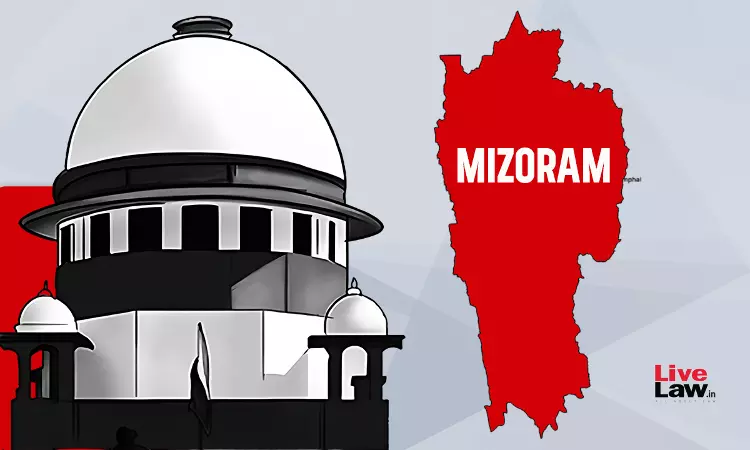
The Court rejected the argument of Mizo Chiefs that they were at par with the other princely rulers and hence entitled to privy purse benefits.
The Supreme Court today(March 11) dismissed a writ petition filed by the Mizo Chief Council claiming that the Union of India had acquired the lands of tribal chieftains of the erstwhile Lushai Hills district(present-day State of Mizoram) without paying due compensation.While the Court recognised that their claims arose when the right to property was a fundamental right under Article 19(1)(f)...
This is a premium content
Available exclusively to
Our subscribers
Subscribe Premium 
INR 1099+GST
Your support helps us to bring you more content at
an affordable subscription scheme !!!
All payment options available
The Supreme Court today(March 11) dismissed a writ petition filed by the Mizo Chief Council claiming that the Union of India had acquired the lands of tribal chieftains of the erstwhile Lushai Hills district(present-day State of Mizoram) without paying due compensation.
While the Court recognised that their claims arose when the right to property was a fundamental right under Article 19(1)(f) and Article 31, the chiefs failed to establish any violation of their rights.
They had also claimed that they stood on equal footing with rulers of the erstwhile Princely States. But the Court rejected this on the grounds that privy purposes were a result of pre-constitutional political and contractual arrangements negotiated between the rulers and the government.
A bench comprising Justice JB Pardiwala and Justice R Mahadevan said: "However, this assertion, much like its above claims, is entirely devoid of any legal basis and thereby merits outright rejection. The privy purses and other privileges granted to the erstwhile rulers of the Princely States were the direct outcome of specific, pre-constitutional political and contractual arrangements negotiated between those rulers and the Government. Consequently, it would be legally flawed to equate and elevate these entitlements to the status of a right, which all erstwhile rulers were constitutionally bestowed upon. Such political arrangements cannot be claimed as a matter of a legally enforceable right, much less a fundamental right."
To lay out the context, Mizo society was traditionally governed by the Mizo Chieftainship system, where chiefs held the territory called 'Ram'. The chiefs exercised full control over 'Ram' and allotted farmlands from his to the villagers, and in return, he was entitled to receive a portion of the annual agricultural produce, primarily paddy ('Fathang').
It was then taken over by the British, who retained the chieftain administration. Post-independence, the Lushai Hills district was administered as a part of Assam. Under the Assam Lushai Hills District (Acquisition of Chief's Rights) Act, 1954, it was renamed the Mizo District. With this legislation, the State acquired the power to transfer and vest in itself the land in turn of compensation, which was notified in 1955. A total of Rs. 14,78, 980 was paid to the chiefs as compensation.
The chiefs filed the writ petition in 2014, alleging that they were paid compensation limited to the Fathang, and it did not include the value of the lands. They argued that Mizo Chiefs stood on equal footing with the rulers of the erstwhile Princely States. While the Princely rulers across the country were systematically integrated into the Union with the solemn guarantee of privy purses, Mizo chiefs were singled out.
What did the Supreme Court say?
The bench first went into the issue of whether the writ petition could be dismissed on grounds of six decades of delay.
It dealt with the doctrine of delay and laches and said that when it comes to violations of fundamental rights, a rigid and mechanical application of it would serve to perpetuate historical wrongs and systematic inequalities. A context-specific and flexible approach to laches ensures that the historical realities and practical impediments faced by litigants are duly considered in such cases.
The bench relied on cases such as the Tilokchand and Motichand & Ors v. H.B. Munshi & Anr(2014) and Citizenship Act, 1955, Section 6-A(2024) on this approach.
"When this Court is confronted with claims that are inextricably linked to notions of historical wrong or systemic injustice, the judicial scales must largely tilt in favour of granting access to the court. The ultimate adjudication on the merits may or may not find the substantive law to be in favour of a petitioner. However, the very act of allowing these claims to be heard and deliberated upon is an essential aspect of constitutional recognition. It ensures that the procedural threshold of laches does not become an insurmountable wall."
The Court said that in such cases, the adequacy of explanation for the delay constitutes the paramount consideration when determining whether the Article 32 petition should be dismissed on the ground of laches.
"Stated differently, the operative test is not one of 'unreasonable delay' but of 'unexplained delay'. This principle is fortified by the fact that, even in instances where this Court has declined relief to prevent the disruption of crystallised third-party rights, such as in Aflatoon (supra) and others, the foundational premise for dismissal was a petitioner's failure to furnish a cogent and satisfactory explanation for the delay."
Applying the analysis, the Court concluded that while the delay is inordinate, it was not inclined to dismiss the petition solely on this ground. This is because of the various mitigating factors, such as the region's unique and tumultuous nature, the records which had indicated hopes for amicable settlements, which were never outrightly rejected by the chiefs.
"Nevertheless, we are not inclined to dismiss this petition at the threshold solely on the ground of delay. It is evident from the record that the State of Mizoram (respondent no.2) has held out hope for an amicable settlement and never outrightly rejected the grievances of the chiefs. It is this unique combination, the continuous representations made by the chiefs coupled with the State's supportive stance, that understandably pushed the chiefs to seek an administrative resolution rather than immediately pursuing legal remedies.
Equally significant is that, on two prior occasions when the chiefs approached the High Court, the matter was not adjudicated on the merits. Instead, owing to the ongoing dialogue between the parties, the High Court left the avenue open for the chiefs to pursue appropriate legal remedies in the future. To shut the doors on them at this third instance, without ever examining the substance of their claims, would be highly unjust."
Second, it looked at whether the petitioners were able to establish that their fundamental right to property had been violated. The Court said that to succeed, the petitioner must prove a clear title of the Mizo Chiefs of the lands. Secondly, they will also have to prove that the government deprived them of their property without lawful authority or without providing adequate compensation.
On both accounts, the bench said, the petitioners failed. The Court said that the Union was prima facie able to show that during British administration, the title over the land never vested in the Chiefs. Whereas, the evidence adduced by the petitioner was primarily accounts and writings of scholars and British officials. These texts did not unequivocally establish that the chiefs were the absolute owners.
"The material adduced by the respondent, at least on a prima facie examination, indicates that during the British administration of the Lushai Hills district, the title over the land never vested in the Chiefs. Furthermore, the record before us is bereft of any comprehensive compilation or analysis of the boundary papers issued to the Chiefs, nor is it established that these documents were uniform in their conferment of rights and duties. However, an examination of the boundary paper available on record entirely belies the petitioner's claim, as nothing therein even remotely suggests the conferment or recognition of absolute ownership of land. Consequently, we are constrained to hold that the petitioners have woefully failed to discharge their burden of proving title over the subject lands."
Further, on the issue that the compensatory given to them was "illusory," the Court said that the petitioners could not base their arguments on the precedents where the Court has determined the parameters when the compensation becomes legally illusory.
Headnote
Constitution of India – Article 32 – Writ Petition – Delay and Laches – Right to Property – Writ petition filed by Mizo Chief Council seeking compensation for lands allegedly acquired without due process in 1954-55 - Respondents raised preliminary objection regarding inordinate delay of nearly six decades - The Supreme Court reiterated that while Article 32 is a fundamental right, it is not immune from general principles of law and reasonable procedure - Petitions agitating stale claims ought not to be entertained to prevent disturbing settled positions and causing prejudice to third parties - Supreme Court clarified that the operative test is not "unreasonable delay" but "unexplained delay.
Mitigating Factors for Delay - Supreme Court observed that delay is not a rigid rule of law but a flexible rule of practice guided by judicial discretion - In the present case, Supreme Court declined to dismiss the petition at the threshold despite a 60 year delay due to: i. The unique historical trajectory and political insurgency in Mizoram; ii. Continuous agitation of claims by the Chiefs before various forums; iii. Official assurances and conduct of the State Government that engendered a legitimate expectation of an amicable resolution, thereby dissuading immediate litigation.
Right to Property and Burden of Proof – i. Burden of Proof - In cases alleging fundamental rights violations, the initial burden lies on the petitioner to establish the existence and invasion of such rights; ii. Title over Land - held that the petitioner failed to prove that Mizo Chiefs were absolute owners of the land under the British regime - Documents (boundary papers) suggested they functioned as administrative heads rather than proprietary owners; iii. Privy Purses - rejected the plea of discrimination comparing Mizo Chiefs to rulers of Princely States, noting that privy purses were outcomes of specific pre-constitutional contractual arrangements and not a legally enforceable fundamental right - the petitioner failed to establish a clear title to the lands or a specific breach of fundamental rights under the erstwhile Articles 19(1)(f) and 31, the petition was dismissed. [Relied on Tilokchand and Motichand & Ors v. H.B. Munshi & Anr (1969) 1 SCC 110; Rabindranath Bose & Ors v. Union of India & Ors (1970) 1 SCC 84; Assam Sanmilita Mahasangha & Ors vs Union of India & Ors (2015) 3 SCC 1; G.P. Doval & Ors v. Chief Secretary, Government of U.P. (1984) 4 SCC 329; Paras 27-64]
Case Details: MIZO CHIEF COUNCIL MIZORAM, THR. PRESIDENT SHRI L. CHINZAH v UNION OF INDIA & ORS.|WRIT PETITION (Civil) NO. 22 OF 2014
Citation : 2026 LiveLaw (SC) 241
Tags
Gursimran Kaur Bakshi
Gursimran is the Principal Correspondent with LiveLaw for the Supreme Court. She can be reached out at: simrankaurbakshi@livelaw.in

