



- Home
- /
- Top Stories
- /
- 'Quick Justice Sine Qua Non Of Art...
'Quick Justice Sine Qua Non Of Art 21' : Supreme Court Quashes 35-Year-Old Simple Hurt Case For Violation Of Speedy Trial Right
Amisha Shrivastava
12 May 2026 7:17 PM IST
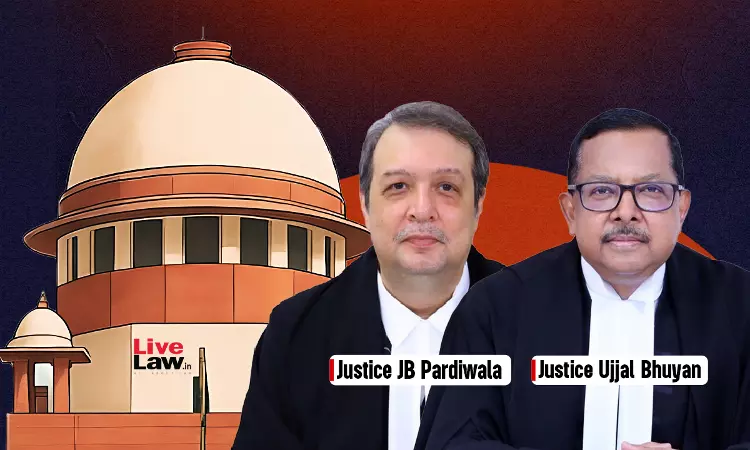
The Court noted that it was unfair and unjust to allow the trial to continue despite the enormous delay.
The Supreme Court recently quashed criminal proceedings pending for 35 years against a former Uttar Pradesh police constable, holding that continuation of the case would violate his fundamental right to speedy trial under Article 21 of the Constitution.“The Right to have a speedy trial is one of the requirements of Article 21 of the Constitution irrespective of the fact whether the accused...
This is a premium content
Available exclusively to
Our subscribers
Subscribe Premium 
INR 1099+GST
Your support helps us to bring you more content at
an affordable subscription scheme !!!
All payment options available
The Supreme Court recently quashed criminal proceedings pending for 35 years against a former Uttar Pradesh police constable, holding that continuation of the case would violate his fundamental right to speedy trial under Article 21 of the Constitution.
“The Right to have a speedy trial is one of the requirements of Article 21 of the Constitution irrespective of the fact whether the accused is in jail or on bail and furthermore irrespective of the nature of the crime. This speedy trial is one of the requirements of Article 21 of the Constitution and from the facts and circumstances of a given case if the High court finds that the proceeding if allowed to continue will amount to violation of Article 21 of the Constitution then the High court should not hesitate to exercise its inherent powers under Section 528 of the BNSS 2023 or in exercise of its writ jurisdiction under Article 226 of the Constitution”, the Court held.
The Court allowed an appeal filed by Kailash Chandra Kapri against a 2024 Allahabad High Court order refusing to quash the proceedings.
A bench of Justice JB Pardiwala and Justice Ujjal Bhuyan, hearing Advocates Rajesh G. Inamdar and Shashwat Anand, observed that the case involved a minor altercation between the petitioner and his co-workers, and no prosecution witness was ever produced in trials of his co-accused.
It highlighted that the petitioner was 22 years old when the FIR was registered and was now 59 years old and no summons were issued to him by the trial court till 2021.
The Court added, “Having regard to the nature of offence, there is enormous delay in proceeding with the criminal prosecution- 35 years for a trial for simple hurt and criminal intimidation is too long a time. Quick justice is sine qua non of Article 21 of the Constitution. Keeping a person in suspended animation for 35 years and that too a public servant without any cause at all- and none was indicted before the High court or before us- gone by with the spirit of procedure established by law. In that view of the matter, it is just unfair and in accordance with equity to direct that the trial or prosecution of the appellant to proceed no further.”
The case arose from an FIR lodged on February 19, 1989 by a constable posted at GRP Rambagh police station in Allahabad alleging that Kapri and four other constables assaulted him in a police mess after accusing him of being close to the mess manager. The FIR alleged offences under Sections 147, 323 and 504 of the IPC and Section 120 of the Railways Act.
The Court noted that the incident arose out of a trivial dispute among police constables over food in the police mess.
A chargesheet was filed and the case remained pending before the Additional Chief Judicial Magistrate (Railway), Allahabad. Two co-accused died during the pendency of proceedings, while the remaining two were acquitted in February 2023 after the prosecution failed to examine even a single witness despite the case remaining pending for over three decades.
The trial court, while acquitting the co-accused, observed that repeated efforts had been made to secure the presence of prosecution witnesses, all of whom were police personnel. Summons and radiograms were sent to senior police authorities, including the Director General of Police, Uttar Pradesh, but no witness was produced. Eventually, the prosecution evidence was closed in May 2022.
Before the Supreme Court, the State submitted that proceedings against Kapri did not continue along with the co-accused because he was transferred to Uttarakhand after the bifurcation of Uttar Pradesh and summons could not be served on him.
The issue before the Court was whether criminal proceedings pending for 35 years deserved to be quashed on the ground that the accused's right to speedy trial under Article 21 had been infringed.
The Court reiterated that the right to speedy trial is implicit in Article 21 and applies irrespective of whether the accused is in jail or on bail and regardless of the nature of the offence.
Referring to several judgments including Hussainara Khatoon, AR Antulay and KA Najeeb, the Court discussed principles governing the right to speedy trial and stressed that courts must balance factors such as nature of offence, reasons for delay and prejudice caused to the accused.
The Court reiterated that that merely being accused of a crime affects a person's reputation, standing in society, mental peace and finances, and that the “tag of accused” itself deprives a person of the right to live with full human dignity. It held that speedy trial is an integral part of fair trial and therefore a human right.
“there can be no doubt that the tag of 'accused' would deprive a man the right to live with full human dignity. It is these facets and factors that fetched 'fair trial' the recognition as a human right. Speedy trial is an integral part of fair trial. Therefore, we are of the view that the right to speedy trial is also a human right and no civilized society can deny the same to an accused”, the Court held.
The bench further observed that society has an interest not only in punishing the guilty quickly but also in giving an accused an early opportunity to clear his name.
“Furthermore, it should always be the concern of the society to see that a real culprit is given the condign punishment at the earliest and also to see that an accused is given an early opportunity to clear the cloud of suspicion shrouded around him and to remove the tag of 'accused'”, the Court said.
Allowing the appeal, the Court held that permitting the prosecution to continue after 35 years in a case involving a minor altercation would amount to oppression and abuse of process. It accordingly quashed the criminal proceedings pending against Kapri.
Also from the judgment - Supreme Court Seeks Data From Allahabad High Court On Pending Criminal Cases, Undertrial Custody In UP
Headnote
Criminal Procedure – Inherent Powers – Quashing of Proceedings – Right to Speedy Trial as a Fundamental Right under Article 21 - The Supreme Court allowed the appeal and quashed the criminal proceedings pending against the appellant for 35 years arising out of a dispute over food in a police mess involving minor offences under Sections 147, 323, and 504 of the Indian Penal Code, 1860 and Section 120 of the Railways Act - Supreme Court emphasized that a quick trial is a sine qua non of Article 21 of the Constitution of India - Keeping a public servant in suspended animation for 35 years without any fault on his part runs completely contrary to the spirit of the "procedure established by law" - Right to speedy trial is not an abstract or illusory safeguard; it is a fundamental right and a human right that no civilized society can deny to an accused - If the continuation of proceedings amounts to a violation of Article 21, the High Court should not hesitate to exercise its inherent powers under Section 528 of the Bharatiya Nagarik Suraksha Sanhita, 2023 (BNSS) or its writ jurisdiction under Article 226 of the Constitution. [Paras 30 - 42]
Judiciary and Case Management – Non-accountability of Trial Courts – Ineffectiveness of Guidelines - The Supreme Court lamented that multiple guidelines issued by it over the last two decades for the expeditious conduct of criminal trials often remain merely on paper - Trial courts frequently fail to implement these guidelines because there is an absolute lack of accountability and no one is made answerable or held accountable for the resulting systemic delays. [Para 39]
Judicial Monitoring – Systematic Pendency Data – Directives to High Court - To make the right to a speedy trial meaningful and real rather than illusory, the Supreme Court directed the Registrar General of the Allahabad High Court to submit a comprehensive affidavit on oath detailing the statistics of pending cases before Judicial Magistrates and Sessions Courts, the functional and vacant strength of the judicial cadre, and categorized data regarding the period of custody undergone by undertrial prisoners awaiting bail. [Relied on Abdul Rehman Antulay & Ors. v. R.S. Nayak & Anr., (1992) 1 SCC 225; P. Ramachandra Rao v. State of Karnataka, (2002) 4 SCC 578; Union of India v. K.A. Najeeb, (2021) 3 SCC 713; Imtiyaz Ahmad v. State of Uttar Pradesh & Ors., (2012) 2 SCC 688; State of Kerala v. Rasheed, (2019) 13 SCC 297; Paras 42 - 44]
Case no. – Special Leave Petition (Crl.) No. 6564 of 2026
Case Title – Kailash Chandra Kapri v. State of Uttar Pradesh & Ors.
Citation : 2026 LiveLaw (SC) 487

Amisha Shrivastava
Amisha Shrivastava is a Senior Correspondent with LiveLaw, covering the Supreme Court of India. She can be reached at amisha@livelaw.in

