



- Home
- /
- Top Stories
- /
- Regional Language Or English Used...
Regional Language Or English Used In Navodaya Schools In Non-Hindi Regions : Centre To Supreme Court On Tamil Nadu Opposition
Amisha Shrivastava
11 March 2026 7:55 PM IST
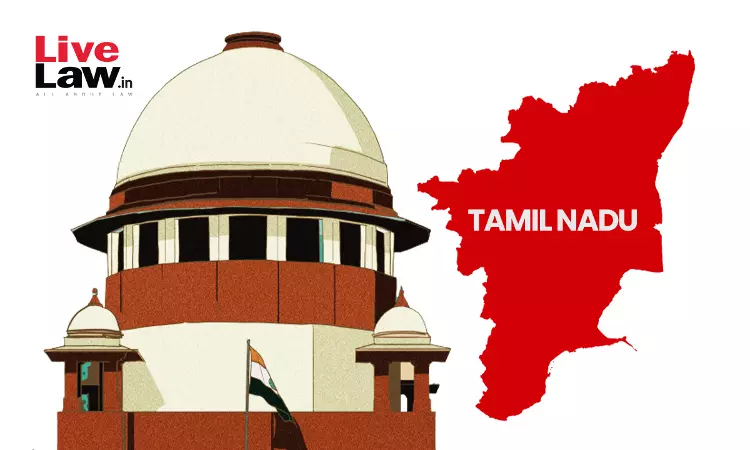
The Union Government has submitted before the Supreme Court that the medium of instruction in Jawahar Navodaya Vidyalayas (JNV) in non-Hindi speaking regions is primarily the regional language or English, responding to Tamil Nadu's concerns that the scheme is incompatible with its statutory two-language policy.Clarifying the language pattern followed in Navodaya schools, the Union...
This is a premium content
Available exclusively to
Our subscribers
Subscribe Premium 
INR 1099+GST
Your support helps us to bring you more content at
an affordable subscription scheme !!!
All payment options available
The Union Government has submitted before the Supreme Court that the medium of instruction in Jawahar Navodaya Vidyalayas (JNV) in non-Hindi speaking regions is primarily the regional language or English, responding to Tamil Nadu's concerns that the scheme is incompatible with its statutory two-language policy.
Clarifying the language pattern followed in Navodaya schools, the Union Government stated that in non-Hindi speaking regions the medium of instruction from Classes VI to VIII is the regional language or English. For higher classes, subjects such as science, mathematics, social sciences and humanities are taught in English.
“That the medium of instructions in JNVs in Non-Hindi speaking regions is as under: (i) Class VI to VIII:- Regional Language or English (Mostly in English, some children write in Regional Language). Class IX to XII: (Sciences & Mathematics: English, Social Sciences & Humanities: English”, the affidavit states.
The affidavit by Ministry of Education provides -

In an affidavit filed before the Court, the Centre said the National Policy on Education, 1986 envisaged the setting up of residential schools known as Jawahar Navodaya Vidyalayas in each district to provide quality modern education and bring out rural talent.
The affidavit stated that the schools are run by the Navodaya Vidyalaya Samiti, an autonomous body under the Ministry of Education. As on date, 689 Jawahar Navodaya Vidyalayas have been sanctioned in 666 districts across the country. According to the Union Government, such schools have not been opened in any district of Tamil Nadu because the State Government has not accepted the scheme.
The Union Government has stated that opening new Navodaya schools depends on several factors, including acceptance of the scheme by the State Government and availability of land and funds, and that its role in establishing such schools in Tamil Nadu would arise only after the State agrees to adopt the scheme.
The Centre said several efforts have been made by the Ministry of Education and the Navodaya Vidyalaya Samiti to persuade the State to adopt the scheme so that meritorious children from Tamil Nadu can benefit from it. However, the State has not accepted the proposal so far.
The Union Government also stated that the State Government or Union Territory administration must provide around 30 acres of suitable land free of cost and provide temporary rent-free accommodation along with infrastructure such as electricity and water to house about 240 students and staff for three to four years until the permanent school building is constructed.
The affidavit further said that the Union Government remains committed to establishing Jawahar Navodaya Vidyalayas across the country to provide quality education to children from rural and economically weaker sections. It stated that the Ministry of Education has no objection to establishing such schools in Tamil Nadu if the State agrees to the proposal and fulfils the required norms and conditions.
Background
The matter arises from a petition filed by the State of Tamil Nadu challenging a Madras High Court order directing establishment of Jawahar Navodaya Vidyalayas in every district of the State and requiring the State to provide temporary accommodation for 240 students in each district.
The Supreme Court had stayed the High Court order in December 2017. In December 2025, the Court directed the State to identify the extent of land required for establishing Navodaya schools in each district and to hold consultations with the Union Government on the issue.
Case no. – SLP(C) No. 33459/2017
Case Title – State of Tamil Nadu v. Kumari Maha Sabha
Tags

Amisha Shrivastava
Amisha Shrivastava is a Senior Correspondent with LiveLaw, covering the Supreme Court of India. She can be reached at amisha@livelaw.in

