



- Home
- /
- Top Stories
- /
- Sabarimala Reference | Judicial...
Sabarimala Reference | Judicial Review Over Superstitious Practices Not Barred, Says Supreme Court In Hearing
Anmol Kaur Bawa
8 April 2026 5:24 PM IST
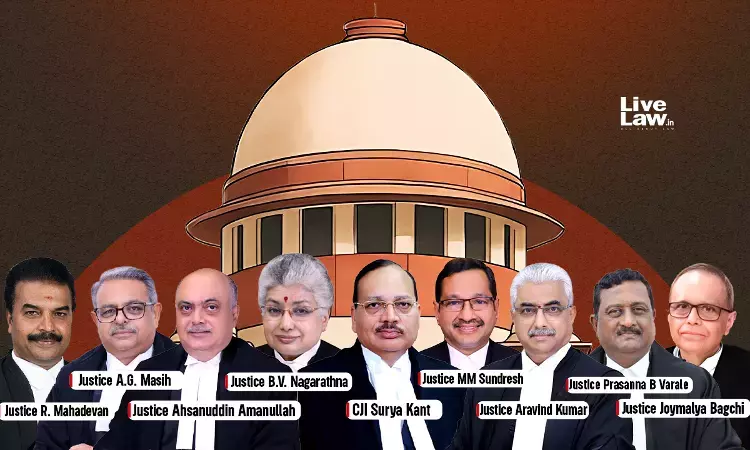
The Court said that it can interfere with practices which violate public order, morality or health.
While hearing the Sabarimala Reference, the Supreme Court today verbally expressed that Courts cannot be barred from striking down practises or 'superstition' if they violate public order, morality or health, even if the legislature has powers to make laws for reform of religion under Article 25(2)(b) of the Constitution. The Court also remarked that any 'Essential Religious Practice' (ERP)...
This is a premium content
Available exclusively to
Our subscribers
Subscribe Premium 
INR 1099+GST
Your support helps us to bring you more content at
an affordable subscription scheme !!!
All payment options available
While hearing the Sabarimala Reference, the Supreme Court today verbally expressed that Courts cannot be barred from striking down practises or 'superstition' if they violate public order, morality or health, even if the legislature has powers to make laws for reform of religion under Article 25(2)(b) of the Constitution.
The Court also remarked that any 'Essential Religious Practice' (ERP) has to be seen from the philosophical lens of the particular religion in question alone.
The 9-judge Constitution bench led by CJI Surya Kant, and comprising Justice BV Nagarathna, Justice MM Sundresh, Justice Ahsanuddin Amanullah, Justice Aravind Kumar, Justice Augustine George Masih, Justice Prasanna B Varale, Justice R Mahadevan and Justice Joymalya Bagchi is hearing the reference.
During the hearing, Solicitor General Tushar Mehta, appearing for the Union, submitted that it would not be in the domain of the Courts to decide what constitutes a 'superstition' and that the power lay squarely in the domain of the legislature by way of Article 25(2)(b). He made this submission in the context of criticising Chief Justice Gajendragadkar's opinion in the Ajmer Dargah Committee case that superstitious beliefs cannot claim protection under Article 25. He questioned whether the Courts can decide what is superstition and what is belief.
Mehta referred to the Prevention and Eradication of Inhuman Evil Practices and Black Magic Act (notably in Maharashtra, 2013, and Karnataka, 2017) as an example of a law passed by the legislation to curb superstition.
"Suppose there is a supertitious practice, the answer is not for the Court to decide. It is under Article 25(2)(b) for the Legislature to say, no we will reform it ....it is not within the judicial review for the Court to say this is superstition."
However, seemingly in disagreement, Justice Amanullah opined that the Court's power of judicial review cannot be taken away in deciding what would amount to superstition. If the court decides under judicial review, it is then left for the legislation to bring in any law.
"You made it too simplistic... the court has the right and jurisdiction in judicial review to hold what is superstition, and what will follow is for the legislature how to deal with it. But then to the Court you cannot say that whatever is the last word, the legislature decides."
The SG replied that Courts and judges, especially in a secular society, cannot decide what constitutes a religious practice, considering that judges were experts in law and not the religion in question. He said :
"A secular court can't decide a religious practice as mere superstition because you don't have scholarly competence. My lords are scholars in the field of law, not in the field of religion....."
He further added that India has a diverse and pluralistic society, with complex belief systems. So what may be considered as superstition in one state or community could be viewed as religious in another. In such a scenario, it may not be ideal for the courts to interfere.
"Something which may be religious for Nagaland may be completely superstitious for me. We are a very pluralistic society with a variety of people, religions, and belief systems, and it would be very hazardous for the court to say."
Would Courts Be Barred From Exercising Jurisdiction Under Articles 32, 226, When Law is Silent On A Discriminatory Practice?
Justice Bagchi weighed in to inquire, "If witchcraft is considered as a part of religious practice, would you or would you not describe it as superstitious?"
SG agreed that he would.
Justice Bagchi then explained that the Union's stand can be that it is up to the legislature to prohibit witchcraft and regulate any practice which promotes witchcraft.
However, Justice Bagchi highlighted that in instances where a particular practise is challenged under Article 32 or 226, and there is no legislation categorically prohibiting it, the Court would still have the power to strike it down if it is contrary to public health, morality and order.
"Since there is a religious practice of witchcraft and the legislature is silent, can't the court use the principles of an unoccupied field to give directions for prohibiting such practices? Keeping in mind and not going into the Essential Religious Practise, or otherwise, but the beacons of prohibition like health, morality, and public order."
Justice Sundresh also remarked that judicial self-restraint in matters of religious practise cannot be confused with a complete exclusion of the Court's power to adjudicate in instances like the above.
"We (courts) can adopt a hands-off approach, but to say that there should be a complete embargo?"
Justice Bagchi explained that while the legislature may have the power to make adequate reformatory laws, that alone cannot bar the courts from exercising their powers under judicial review.
"We understand the purpose of the legislature under article 25(2)(b), but that doesn't take away the residual jurisdiction of the court in an appropriate case."
The SG clarified that the Court can certainly strike down practices which expressly 'shock the conscience of this Court', such as human sacrifice, cannibalism or witchcraft.
The CJI added, "The moment there is this kind of practice, the court will simply say it violates the public order, morality, or health"
What Is The Extent To Which Courts Can Intervene To Determine ERP? Bench Mulls
The bench steered the discussion to the extent to which courts can indulge in determining an Essential Religious Practice (ERP).
Notably, the ERP is a judicial principle under which the Court examines whether a practise is essential or fundamental to a religion and should be protected under Articles 25 and 26. If the practise is found to be non-essential, the State can restrict/ regulate it.
A seven-judge constitution bench invented the ERP test in the landmark Shri Shirur Mutt Case of 1954. Here, the Mutt challenged the Madras Hindu Religious and Charitable Endowments Act 1951, passed by the state to regulate religious endowments. The bench held that any ERP is to be determined with reference to the doctrines of that religion itself.
During the hearing, Justice Nagarathna expressed that in determining whether a practise is an ERP or not, the Court has to view the practise from the standpoint of the religion in question and not be swayed by the philosophy of another religion.
Justice Nagarathna further added that the Court, while doing so, can also evaluate and strike down a practise if it violates morality, public order, etc.
"The approach of the court in such matters also must be to determine the essential religious practice (ERP) from the lens of the philosophy of the particular religion. You can't apply some other religion and say, this is not an ERP. The approach of the Court is to apply the philosophy of that particular religion, subject, of course, to whether it goes against public order and morality. The Court can always strike down that. The Court is important, rather than saying the Court has jurisdiction or no jurisdiction. How the Court must view from the philosophy of the particular religion, that deity...."
Justice Sundresh weighed in to add a word of caution that the Courts in applying the ERP test should limit themselves to the religious practise in question and not go to the extent of finding logic in religious beliefs. He explained:
"It is like an action which is void or voidable. If it's void, then he requests (petitioner) a declaration, then to that extent we can (strike down). The role we will play if it is so apparent like sati or widow remarriage, if it's not occupied by any legislation, the court can indicate to that extent. But I appreciate that we can't go beyond and take a different role which is not assigned to us. The concept of logic you cannot apply to religion per se."
SG agreeingly said that the Courts can only ensure that beliefs are within the constitutional tenets and limits, instead of giving their own interpretation to faith.
"We cannot link rationality to faith and a belief system. If I believe something, unless it is against public interest, morality, or Health, there cannot be any merit review based on rationality, science, etc."
Live updates posted from today's hearing can be followed here.
Case Details: KANTARU RAJEEVARU Versus INDIAN YOUNG LAWYERS ASSOCIATION THR.ITS GENERAL SECRETARY MS. BHAKTI PASRIJA AND ORS., R.P.(C) No. 3358/2018 in W.P.(C) No. 373/2006
Also from today's hearing :
How Can Non-Devotees Of Lord Ayyappa Challenge Sabarimala Custom? Supreme Court Asks

Anmol Kaur Bawa
Reporter

