



- Home
- /
- Top Stories
- /
- Sabarimala Reference | Social...
Sabarimala Reference | Social Reform May Necessitate Scrutiny Of Religious Practices; Proportionality Test Can Be Used : Lawyers To Supreme Court
Gursimran Kaur Bakshi
13 May 2026 11:02 AM IST
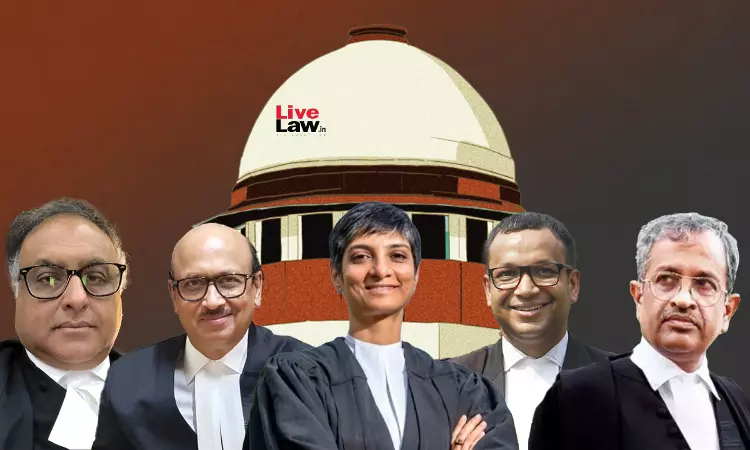
On the 14th day of hearings in the Sabarimala reference, Senior Advocate Jaideep Gupta, appearing for the State of Kerala, submitted before the Supreme Court that social reform finds a place within the chapter on religious freedoms because exclusionary social practices are often given a religious character to shield them from scrutiny.He argued that courts may necessarily have to...
This is a premium content
Available exclusively to
Our subscribers
Subscribe Premium 
INR 1099+GST
Your support helps us to bring you more content at
an affordable subscription scheme !!!
All payment options available
On the 14th day of hearings in the Sabarimala reference, Senior Advocate Jaideep Gupta, appearing for the State of Kerala, submitted before the Supreme Court that social reform finds a place within the chapter on religious freedoms because exclusionary social practices are often given a religious character to shield them from scrutiny.
He argued that courts may necessarily have to examine religious practices when adjudicating questions of social reform, and in doing so, may need to apply the essential religious practices (ERP) test.
“Article 25(2)(b) specifically includes welfare and reform because sometimes, to reform social rules, one has to encroach upon religious rights,” Gupta submitted.
Justice BVNagarathna, however, observed that social reform cannot come at the cost of constitutionally guaranteed religious freedom under Article 25(1).
“In the name of social reform, you cannot violate what is guaranteed under Article 25(1). No doubt it empowers the State, but it cannot hollow out religion,” the judge remarked.
Gupta responded that while the core of a religion cannot be destroyed, that does not mean reform becomes impermissible merely because it affects religious freedom claims.
ERP Test and how far Courts can go
Clarifying the position on the ERP test, Gupta said courts are not engaging in judicial review of theology, but only determining whether a claimed practice is in fact religious, and if so, whether it is essential or secular in nature. He cited Ratilal Panachand Gandhi v. State of Bombay (1954) as authority for using common sense to distinguish religious from secular practices.
Senior Advocate Menaka Guruswamy, however, urged the Court to adopt the doctrine of proportionality instead of the ERP test, arguing that proportionality avoids placing judges in a theological role and confines judicial scrutiny to constitutionally relevant questions such as burden, necessity, rationality, and balancing of competing rights.
"In employing the proportionality test, the Courts would need to assess the nature of the contested religious practice and the significance of its continuance against the basic and inalienable rights guaranteed to the individual," Guruswamy said.
She relied upon Sunil Kumar Singh v Bihar Legislative Assembly(2016) and stated that proportionality is used to identify whether the restriction sought to be placed on the right is proportionate to the objective sought to be achieved by the restriction.
Similar to Gupta's arguments, Guruswamy also said that there is a social history behind why the State's intervention is required in the aspect of religion, because historically, temples and religious institutions were excluded from certain classes of Hindus. For instance, she stated that Dr BR Ambedkar was not allowed entry into the Puri temple owing to his caste, but Lord Mountbatten, who accompanied him, was given a red carpet reception.
Pointing out Rule 3 of the Kerala Hindu Places of Public Worship (Authorisation of Entry) Rules, 1965, she said that not only are women banned from entry, they are also restricted from bathing or using the water of any sacred tank appurtenant to the temple, which not only fails the test of proportionality but also violates of Article 15(2).
"Rule 3 of the Kerala Rules is completely disproportionate as it not only bans the entry of women into the Ayyapa Temple, which historically permitted women to enter, it also restricts women from “bathing or using the water of any sacred tank, well, spring or water-course appurtenant to the Temple, whether situated within or outside the precincts of the Temple or any sacred place including the hill or a road or a street or pathway which is requisite for obtaining the access to the Temple.
She added: "The restrictions imposed by the impugned rule are ex facie contrary to Article 15(2) of the Constitution, which prohibits discrimination on the ground of sex in matters relating to access to “the use of wells, tanks, bathing ghats, roads and places of public resort maintained wholly or partly out of State funds or dedicated to the use of the general public","
Senior Advocate Shadan Farasat also argued against the ERP doctrine, proposing instead that courts should first determine whether a claimant holds a sincere religious belief protected under Article 25(1), and if that conflicts with Article 26 rights, resolve the issue through proportionality analysis.
On the interpretation of Articles 25 and 26
Senior Advocate Vijay Hansaria(appearing for three women devotees who want to go to Sabarimala temple) , argued that Article 26 cannot claim supremacy over Article 25, noting that Article 26 does not contain a non-obstante clause unlike several other constitutional provisions.
He informed the bench that there are 36 provisions in the Constitution that use the term 'notwithstanding', 24 provisions that use 'notwithstanding anything in this part of the Constitution,' and 25 provisions that use the term 'notwithstanding anything in this part of the Article'.
He pointed out that none of the three non-obstante clauses is employed in Article 26 and therefore, it has no reason to claim supremacy over Article 25 right.
Guruswamy stated that Article 26(b) deliberately uses the term 'manage' as opposed to the term 'control', which is reflective of the fact that it is not an unfettered right conferred on religious denominations, and framers intended that both provisions (Article 25(2)(b) and Article 26(b)) must be harmonised. She added that where the framers wanted, for instance Article 243ZH, it used the word 'control'.
Therefore, to make an interpretation that the power to exclude women would come under the right to manage religious affairs under Article 26(b), would be to whittle down the intent of the framers.
She said: "Article 25 & 26 of the Constitution must be harmoniously interpreted so that the right to 'manage' found within Art. 26 does not eclipse the rights under Art. 25. The makers of the Constitution while constructing Art. 26(b) deliberately used the word 'manage' instead of the word 'control', which denotes the legislative intention."
Senior Advocate Sanjay Hedge (appearing for son of Narendra Dhabolkar, presenting a rationalist perspective) took the Court through the historical background in which the Constitution framers drafted Articles 25 and 26. "The background was this, the world has seen what wrong the religion could do. We had partition violence, we had Jewish holocaust, we had the murder of the Mahatma. So when we grew up, it was said that these are the parts where extremism doesn't work."
He thus placed the constitutional provisions in historical context, arguing that the framers drafted Articles 25 and 26 with awareness of religion's potential for exclusion and extremism.
Referring to a book called 'Constitution for Deeply Divided Society', he said that what was done in such Constitutions was a process of constitutional incrementalism. For instance, on the issue of Cow Slaughter, the Constituent Assembly wanted that a clear line should be drawn as to whether it is banned or not but what ultimately happened was that it was added in the Directive Principle of State Policy. This is to incrementally evolve the scientific development.
He added that once individuals band together as collectives, they get some additional rights such as the right to administer property, to manage their own affairs. But that doesn't mean any greater right has been granted to denominations overpowering the individual's rights.
Hedge submitted that Article 26 rights can ot just be claimed against a denomination but also against the orthodoxy within that religion. "Suppose your religion says there is one god and prophet, but there is a denomination which says yes, there is a prophet, but there is a subsequent prophet, with regard to the orthodoxy of the religion, you can manage your own affairs."
Gursimran Kaur Bakshi
Gursimran is the Principal Correspondent with LiveLaw for the Supreme Court. She can be reached out at: simrankaurbakshi@livelaw.in

