



- Home
- /
- Top Stories
- /
- Sabarimala Review: Dabholkar's Son...
Sabarimala Review: Dabholkar's Son Seeks Intervention In Supreme Court, Says Exclusion Of Women Discriminatory
LIVELAW NEWS NETWORK
15 March 2026 1:20 PM IST
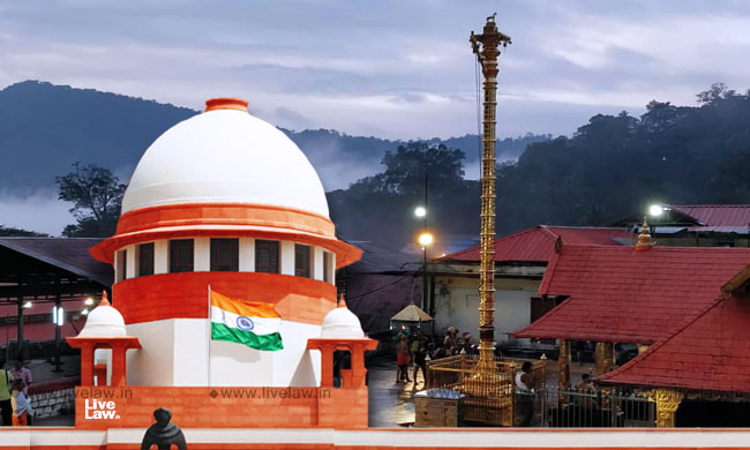
The Court risks becoming a "dharmashastri" or "ulema" if it is interpreting religious texts, the application contended.
The son of rationalist Dr. Narendra Dabholkar has moved the Supreme Court seeking to intervene in the pending review proceedings relating to the Sabarimala temple entry judgment, urging the Court to uphold its 2018 verdict allowing women of all ages to enter the shrine and dismiss the review petitions challenging it.Hamid Dabholkar, along with social activist Nandini Jadhav, filed an...
This is a premium content
Available exclusively to
Our subscribers
Subscribe Premium 
INR 1099+GST
Your support helps us to bring you more content at
an affordable subscription scheme !!!
All payment options available
The son of rationalist Dr. Narendra Dabholkar has moved the Supreme Court seeking to intervene in the pending review proceedings relating to the Sabarimala temple entry judgment, urging the Court to uphold its 2018 verdict allowing women of all ages to enter the shrine and dismiss the review petitions challenging it.
Hamid Dabholkar, along with social activist Nandini Jadhav, filed an intervention application in the review proceedings arising from Indian Young Lawyers Association v. State of Kerala, the case in which a Constitution Bench in 2018 struck down the practice of excluding women between the ages of 10 and 50 from the Sabarimala temple.
The applicants told the Court that they have long been associated with efforts to promote scientific temper and combat superstition through the Maharashtra Andhashraddha Nirmoolan Samiti (MANS), founded by the late Dr. Narendra Dabholkar.
Dr. Dabholkar, a social reformer who led campaigns against superstitious practices, was assassinated in Pune in 2013. His killing led to the promulgation of Maharashtra's Anti-Superstition and Black Magic law shortly thereafter.
The applicants submitted that their intervention is motivated by a commitment to constitutional values such as equality, dignity, fraternity and scientific temper. The applicants have also sought permission to assist the Court as interveners during the hearing of the review petitions.
"The Applicants, grounded in rationalism and scientific temper, submits that constitutionally protecting unsubstantiated religious claims threatens Article 51A(h)'s duty to foster scientific temper, humanism, inquiry, and reform. The Preamble's commitment to fraternity and individual dignity—part of the basic structure—demands rejecting exclusionary practices based on biological impurity, which undermine these core constitutional objectives."
Review Jurisdiction Is Narrow "
The intervention application argues that the review petitions against the Sabarimala judgment do not meet the strict threshold required for review under Article 137 of the Constitution.
Citing the Supreme Court's ruling in Kamlesh Verma v. Mayawati, the applicants said review jurisdiction is limited to correcting errors apparent on the face of the record and cannot be used to re-argue issues already decided.
They submitted that the 2018 Constitution Bench judgment carefully harmonised the rights to equality, dignity and religious freedom under Articles 14, 15, 21 and 25 and rightly found the exclusionary practice unconstitutional.
Reopening such a determination, the applicants argued, would undermine the principle of finality in constitutional adjudication. According to them, the review is unwarranted, as "the judgment under review correctly recognised that menstruation-based exclusion amounts to discrimination on the ground of sex"
“Court Should Not Become Dharmashastris Or Ulema”
The application strongly criticises the continued reliance on the “essential religious practices” doctrine, cautioning that determining what is essential to a religion would place the Court in the position of a theological authority.
"Determining what is “essential” in Hinduism, Islam, Zoroastrianism, or other faiths would position the Court as a theological authority—akin to a Dharmashastri, Alim, or Ulema—interpreting scriptures and faith matters. This contravenes the Constitution's secular character and the judiciary's role in a pluralist democracy."
The applicants rely on observations made by Justice D.Y. Chandrachud in the Sabarimala judgment cautioning that courts should avoid assuming the role of determining theological correctness of religious beliefs.
According to the applicants, a secular constitutional court should avoid deciding questions of religious doctrine in a country characterised by enormous religious diversity.
Exclusion Based On Menstruation Is Discriminatory
The application argues that the Sabarimala restriction effectively discriminates against women on the basis of menstruation.
It submits that the exclusion of women aged between 10 and 50 is rooted in notions of impurity associated with menstruation and therefore violates the guarantees of equality and non-discrimination under Articles 14 and 15.
"The exclusion of women aged 10–50 is not an essential religious practice under Articles 25 and 26. Only practices fundamental to the religion qualify for protection. This exclusion, based on the deity's celibate nature and menstrual impurity notions, reflects socio-cultural constructs, not indispensable Hindu doctrines. No scriptural mandate proves it essential to Lord Ayyappa worship. Even if vratham austerities are central, they are gender-neutral and cannot justify prohibiting women of a specific age group."
The applicants also cite Justice Chandrachud's observation in the 2018 judgment that the exclusion of women based on menstrual status is a form of social exclusion incompatible with constitutional values.
"The exclusion of women between 10 and 50 years of age is manifestly discriminatory and violative of Articles 14 and 15 of the Constitution. Though framed ostensibly as an age-based restriction, the true basis of classification is menstruation, a biological characteristic unique to women. Such classification is founded upon stereotypes and assumptions of impurity, which cannot constitute an intelligible differentia having a rational nexus with a constitutionally legitimate objective."
Questions Referred To Larger Bench Need Not Be Answered
The applicants also urge the Court to decline answering the broader constitutional questions framed in the 2019 reference order in Kantaru Rajeevaru.
According to the application, these questions were already addressed by the majority opinions in the 2018 Sabarimala judgment and do not arise for reconsideration in review jurisdiction.
Entertaining such questions in the absence of a concrete factual dispute would amount to exercising an advisory jurisdiction that the Supreme Court does not possess, the applicants contend.
The intervention application ultimately urges the Court to dismiss the review petitions and reaffirm the 2018 judgment allowing women of all ages to enter the Sabarimala temple.
“The Constitution is a transformative charter,” the applicants submit, arguing that constitutional guarantees of equality and dignity cannot be subordinated to discriminatory religious practices.
The application has been filed through Advocate on Record Anas Tanvir.
A 9-judge bench of the Supreme Court will commence hearing the issues raised in the Sabarimala reference on April 7.


