



- Home
- /
- Top Stories
- /
- Sambhal Mosque Dispute | HC...
Sambhal Mosque Dispute | HC Couldn't Have Upheld Survey Order Due To SC's December 2024 Order : Ahmadi Tells Supreme Court
Gursimran Kaur Bakshi
28 July 2026 9:39 PM IST
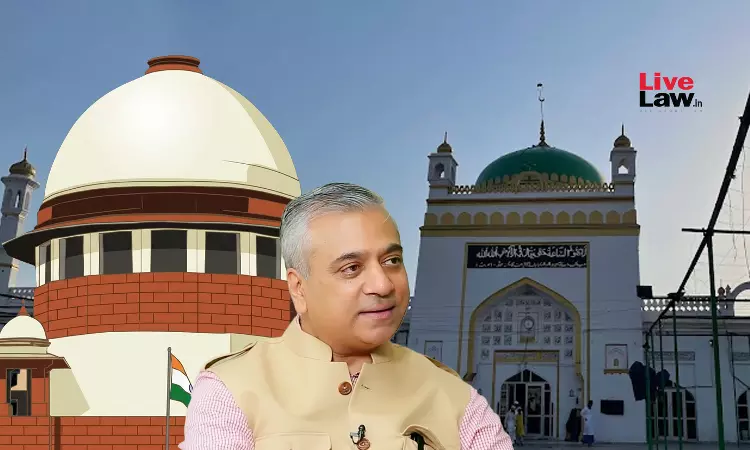
Huzefa Ahmadi argued that the Hindu plaintiffs' suit was barred by the Places of Worship Act, 1991.
The Supreme Court on Tuesday heard the challenge filed by the Committee of Management of the Jama Masjid in Sambhal against the Allahabad High Court's decision upholding the Trial Court's appointment of an Advocate Commissioner to survey the mosque, with the mosque committee arguing that the High Court ignored the apex court's December 12, 2024 order restraining courts from passing...
This is a premium content
Available exclusively to
Our subscribers
Subscribe Premium 
INR 1099+GST
Your support helps us to bring you more content at
an affordable subscription scheme !!!
All payment options available
The Supreme Court on Tuesday heard the challenge filed by the Committee of Management of the Jama Masjid in Sambhal against the Allahabad High Court's decision upholding the Trial Court's appointment of an Advocate Commissioner to survey the mosque, with the mosque committee arguing that the High Court ignored the apex court's December 12, 2024 order restraining courts from passing effective interim orders in disputes concerning places of worship.
A Bench of Justice PS Narasimha and Justice Alok Aradhe heard Senior Advocate Huzefa Ahmadi, appearing for the Jama Masjid Management Committee.
The bench is hearing the mosque committee's Special Leave Petition challenging the High Court's order, which held that the Hindu plaintiffs' suit against the mosque was not barred by the Places of Worship (Special Provisions) Act, 1991, and upheld the survey order.
The Commissioner's visit had led to communal violence, after which the Supreme Court stayed the trial proceedings until the Masjid Committee's challenge to this order is decided by the High Court. On May 19, 2025, the High Court upheld the order and further observed that the Trial Court was right in granting access to the structure as the Hindu plaintiffs' suit is not barred under the Places of Worship Act, 1991, as it doesn't try to alter the religious character of the structure but merely seeks a right to access for worship.
Referring to the December 12, 2024, order, Ahmadi questioned why the Allahabad High Court proceeded to hastily pass orders even though it was pointed out to them on the very first day that the Supreme Court has directed courts not to pass "effective orders" in suits seeking conversion of religious places.
Further, he took the Court through Sections 3 and 4 of the 1991 Act and submitted that the legislation prohibits conversion of places of worship and bars any suit with respect to the religious character.
Taking the bench through the pleadings, Ahmadi said that the suit is styled as one seeking only right to worship; however, it was in effect seeking a conversion of the masjid as a temple, which is barred by the 1991 Act. The statutory bar canot be circumvented by a clever drafting, he argued.
He said: "The reason why I read the whole pleading is because, this is not an application by someone saying I want to visit. The contention specifically is I want to pray, and very substratum is that this was a Hindu temple which was destroyed. This is precisely the mischief the Places of Worship Act sought to remedy."
At this point, Justice Narasimha asked if Ahmadi is inviting the Court to give a finding on all these issues which is the subject-matter of the suit before the Trial Court.
Ahmadi submitted that his core argument is that the survey commissioner could not have been appointed because the suit per se was barred. Hence, before proceeding to appoint the commissioner, the Trial Court ought to have seen the suit was barred. He pointed out that the 1991 Act was upheld by the Supreme Court in the Ram Janmabhoomi judgment.
"I pointed to High Court there was no occasion for a commissioner when suit doesn't lie. If today the object and statement says you must nip it in the bud, how has a survey commissioner been appointed? High Court has missed the impact of section 3," he submitted.
He added: "My respectful submission there is a clear bar. In order for us to go into this submission, whether there is a bar or not, the Allahabad High Court's order is contrary to mylord's order, which said that we are considering the impact of the provisions. The learned judge should not have proceeded. Once he goes into these questions, which is covered by mylords judgment, it should have been tagged. I had pointed it out on day one and it was objected to."
Ahmadi also relied on the Ancient Monuments and Archaeological Sites and Remains Act, 1958, which is applicable to the Sambhal mosque as it is a protected monument. The 1958 legislation also has a similar bar on conversion, Ahmadi emphasised, referring to Section 16, which states that a protected monument, which is a place of worship, "shall not be used for any purpose inconsistent with its character."
Additionally, Ahmadi challenged the findings of the Allahabad High Court that the alleged agreement between Mutwallis and the government didn't define the ownership of the Jama Masjid.
The arguments will continue next week.
Case Details: COMMITTEE OF MANAGEMENT JAMI MASJID, SAMBHAL Vs HARI SHANKAR JAIN| SLP (C) Diary No. 46111 of 2025(AOR Anil Kumar) and COMMITTEE OF MANAGEMENT, JAMI MASJID SAMBHAL, AHMED MARG KOT SAMBHAL vs. HARI SHANKAR JAIN|SLP (C) 21599/2025 (AOR Fazail Ahmad)
Tags
Gursimran Kaur Bakshi
Gursimran is the Principal Correspondent with LiveLaw for the Supreme Court. She can be reached out at: simrankaurbakshi@livelaw.in

