



- Home
- /
- Top Stories
- /
- Sampradayas Attached To Temple Must...
Sampradayas Attached To Temple Must Be Followed While Visiting It: Supreme Court In Sabarimala Reference Hearing
Gursimran Kaur Bakshi
9 April 2026 4:09 PM IST
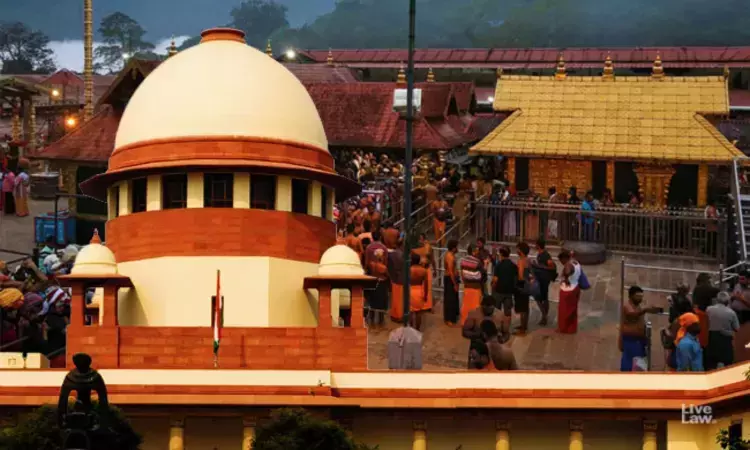
In the course of hearing the Sabarimala reference, the Supreme Court on Thursday observed that while Hinduism does not impose a rigid denominational structure, devotees visiting a particular temple are required to adhere to the sampradayas or customs associated with that temple.A 9-judge bench comprising Chief Justice of India Surya Kant, Justice BV Nagarathna, Justice MM Sundresh,...
This is a premium content
Available exclusively to
Our subscribers
Subscribe Premium 
INR 1099+GST
Your support helps us to bring you more content at
an affordable subscription scheme !!!
All payment options available
In the course of hearing the Sabarimala reference, the Supreme Court on Thursday observed that while Hinduism does not impose a rigid denominational structure, devotees visiting a particular temple are required to adhere to the sampradayas or customs associated with that temple.
A 9-judge bench comprising Chief Justice of India Surya Kant, Justice BV Nagarathna, Justice MM Sundresh, Justice Ahsanuddin Amanullah, Justice Aravind Kumar, Justice Augustine George Masih, Justice Prasanna B Varale, Justice R Mahadevan and Justice Joymalya Bagchi is hearing the reference.
Senior Advocate CS Vaidyanathan, who appeared for organisations including the Nair Service Society, Ayyappa Seva Samajam and Kshetra Samrakshana Samiti, submitted that Hinduism does not have a strict structure, and has various pluralistic practices within.
"We don't have a system of Archbishops, Pope, Bishops and that kind of a theological structure," he submitted.
Justice Nagarathna then remarked : "That means, in Hinduism, Hindus can belong to different sampradayas and can visit any temples. There is no bar, but if Hindus want to visit a particular temple, the sampradayas attached to that temple must be followed."
He submitted that there is no prohibition on persons of other faiths entering the Sabarimala temple, provided they have faith in the deity and comply with the religious disciplines prescribed for devotees.
"In Sabarimala, there is no distinction made that there is no bar to Christians or Muslims, but they must have faith and belief in the divinity of Ayyappa and they have to follow the 40-day vratam and whatever practices enjoined on the believers. Nobody is prohibited and therefore this concept has not been understood," he submitted.
Vaidyanathan further contended that the concept of a "religious denomination" does not necessarily require that members belong exclusively to a particular religion, describing the contrary view as an erroneous understanding.
At this point, Justice Sundresh commented, "In Kerala, in some temples, you can't wear a shirt. You can't say I want to wear a shirt."
Chief Justice of India Surya Kant weighed in to add that in Guruvayoor temple, men cannot wear shirts. The CJI added that when visiting a Gurudwara, one has to cover the head.
Justice Bagchi then observed :
"All these examples show the precedence of Article 26(b) with regard to its superiority in managerial rights of religious affairs manifested through the practices and rituals etc over the core internal belief, which is freedom of conscience and its rights.
If a person is a non-believer, even if he goes to a temple or mutt managed by a denomination, he has to adhere to the religious affairs manifested through the rules and then the real conflict is the propagation of a non-believer of his right becoming eclipse for the temporary period where he submits himself to the domain of the management of the affairs of religious denomination."
Vaidyanathan argued that individual freedom of conscience cannot undermine the collective rights of a religious denomination to manage its affairs. He argued that Article 26(b)- which gives a religious denomination the right to manage its own affairs- prevails over Article 25(2)(b) - which enables State to make law for reform within a religion.
Vaidyanathan stated that he disagreed with the Union's position that Article 26(b) must be read with Article 25(2)(b). He conteded that the judgment in Sri Venkataramana Devaru v. State of Mysore, which held that Article 25(2)(b) prevailed over Article 26(b), was wrongly decided. According to him, Article 25(2)(b) is merely an enabling provision, allowing the State to make a law for reform. On the other hand, Article 26(b) is a fundamental right in itself. Therefore, he wondered how Article 25(2)(b) can control Article 26(b).
He further submitted that in the Sabarimala case, Justice Chandrachud asked a wrong question and got a wrong answer that an individual's right must prevail over the right of the denomination. "He asked whether individual rights would prevail over group or collective rights and he held wrongly that individuals right can prevail over collective religious rights," Vaidyanathan submitted.
Vaidyanathan highlighted that unlike Article 25, Article 26 is not subject to other parts of the Constitution.
Live updates from today's hearing can be followed here.
Also from today's hearing - Excluding Other Denominations From Temples Will Affect Hinduism : Supreme Court In Sabarimala Reference Hearing
Gursimran Kaur Bakshi
Gursimran is the Principal Correspondent with LiveLaw for the Supreme Court. She can be reached out at: simrankaurbakshi@livelaw.in

