



- Home
- /
- Top Stories
- /
- SCAORA Submits Recommendations On...
SCAORA Submits Recommendations On Supreme Court's Draft AI Regulations, Raises Concerns
LIVELAW NEWS NETWORK
18 July 2026 7:35 PM IST
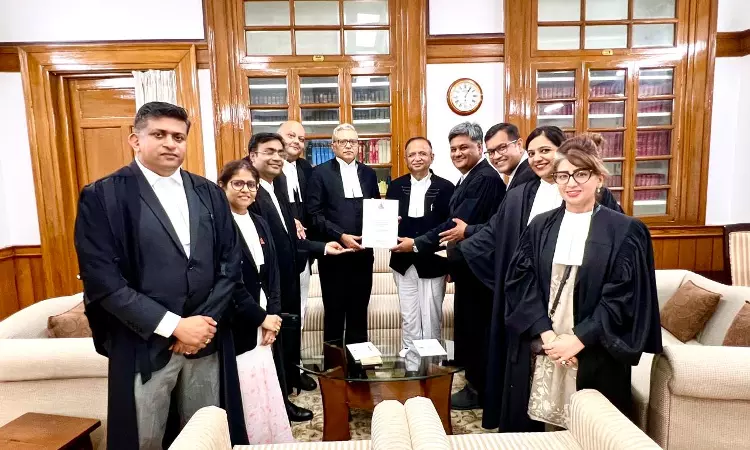
The Supreme Court Advocates on Record Association urges caution in the deployment of AI in the judicial system.
The Supreme Court Advocates-on-Record Association (SCAORA) has submitted its comments and recommendations on the Draft Regulations for the Use of Artificial Intelligence (AI) in Courts, 2026 to Justice Pamidighantam Sri Narasimha, who chairs the Supreme Court's Artificial Intelligence Committee, urging a cautious and phased deployment of AI in the judicial system.The Association's...
This is a premium content
Available exclusively to
Our subscribers
Subscribe Premium 
INR 1099+GST
Your support helps us to bring you more content at
an affordable subscription scheme !!!
All payment options available
The Supreme Court Advocates-on-Record Association (SCAORA) has submitted its comments and recommendations on the Draft Regulations for the Use of Artificial Intelligence (AI) in Courts, 2026 to Justice Pamidighantam Sri Narasimha, who chairs the Supreme Court's Artificial Intelligence Committee, urging a cautious and phased deployment of AI in the judicial system.
The Association's Executive Committee presented the report to Justice P.S. Narasimha, Judge of the Supreme Court of India, along with Justice Alok Aradhe. Justice Narasimha appreciated the efforts undertaken by SCAORA and assured that the recommendations and the Draft AI Regulations would be deliberated upon extensively in the coming weeks.
In June, the Supreme Court's Artificial Intelligence Committee, comprising Justice P.S. Narasimha, Justice K.V. Viswanathan and Justice Joymalya Bagchi, had released the Draft Regulations governing the use of AI in the Supreme Court and invited comments from stakeholders.
SCAORA constituted an AI Sub-Committee, which undertook an extensive clause-by-clause analysis of the proposed framework before submitting its report titled Comments and Recommendations on the Draft Regulations for the Use of Artificial Intelligence (AI) in Courts, 2026.
One of the report's central recommendations is that AI systems should not be deployed in functions directly affecting litigants until adequate safeguards are established. It argues that contemporary AI systems cannot genuinely explain how they arrive at their outputs and therefore should not be entrusted with high-risk judicial tasks.
The report criticises the Draft Regulations for requiring “explainability” while simultaneously permitting deployment of opaque AI systems under heightened scrutiny. According to SCAORA, this creates an inherent contradiction because modern generative AI systems operate through complex neural networks whose internal reasoning cannot be meaningfully traced or verified by humans. It therefore recommends prohibiting deployment of opaque or “black box” AI systems in high-risk applications.
SCAORA also highlights the “black box paradox”, noting that although the Draft Regulations place ultimate accountability on judges and court officers using AI, they do not address how such accountability can realistically be enforced when the AI's reasoning process itself is incomprehensible.
The report further warns against AI hallucinations, referring to the Supreme Court's recent judgment in Pooja Ramesh Singh v. Jammu & Kashmir Bank Ltd., where the Court adopted a “zero-tolerance” approach towards fake or hallucinated AI-generated precedents. It recommends mandatory “human-in-the-loop” and “human-on-the-loop” safeguards for all AI-generated outputs used in court processes.
SCAORA also cautions against automation bias, observing that judges and court staff working under heavy workloads may increasingly defer to machine-generated outputs. It notes that AI-assisted administrative decisions, such as listing urgent matters or identifying filing defects, can substantially affect litigants' rights despite being classified as administrative functions. Accordingly, it recommends restricting AI deployment even in administrative functions that materially influence case outcomes.
On data governance, the report raises concerns over judicial data being processed through AI infrastructure controlled by foreign technology companies. It recommends that court data should remain within sovereign infrastructure and calls for immediate audits of AI systems already deployed by the Supreme Court, including SUPACE, SUVAS, real-time transcription services, AI-assisted e-filing and SuSahayak.
The Association also questions the constitutional basis of the Draft Regulations, noting that they do not specify whether they derive authority from Article 145, Article 142, or are intended as model standards. It argues that while Article 145 empowers the Supreme Court to frame rules governing its own practice and procedure, it does not authorise the Court to impose binding regulations on High Courts, which possess independent rule-making powers.
The report additionally flags concerns over inadequate representation of the Bar in AI governance bodies, overlapping institutional responsibilities and excessive bureaucratic structures. It recommends greater participation of Advocates-on-Record in governance, training and institutional oversight of AI deployment.
Among its principal recommendations, SCAORA calls for a precautionary and phased rollout of AI in courts, prohibition of black-box AI systems in high-risk judicial functions, mandatory human oversight of AI-generated outputs, stronger data sovereignty safeguards, transparent access to AI tools for the entire Bar, and a regulatory framework that prioritises judicial independence and protection of litigants' rights over rapid technological adoption.
The AI Sub-Committee was chaired ex officio by SCAORA President Devvrat, with Vice-President Nikhil Jain and Honorary Secretary Yugandhara Pawar Jha serving as Co-Chairpersons. Advocate-on-Record Dr. Charu Mathur was appointed as Advisor, while Pallavi Barua represented the Executive Committee as senior member. The committee was convened by Rajat Mittal, with Executive Members Nivedita Nair, Dr. Meenakshi Kalra and Anas Tanwir also serving on the panel.
Click here to read the Report.


