



- Home
- /
- Top Stories
- /
- Some High Courts Support Relaxing 3...
Some High Courts Support Relaxing 3 Year Practice Mandate To Join Judicial Service For Specially Abled Candidates
Amisha Shrivastava
12 March 2026 7:42 PM IST
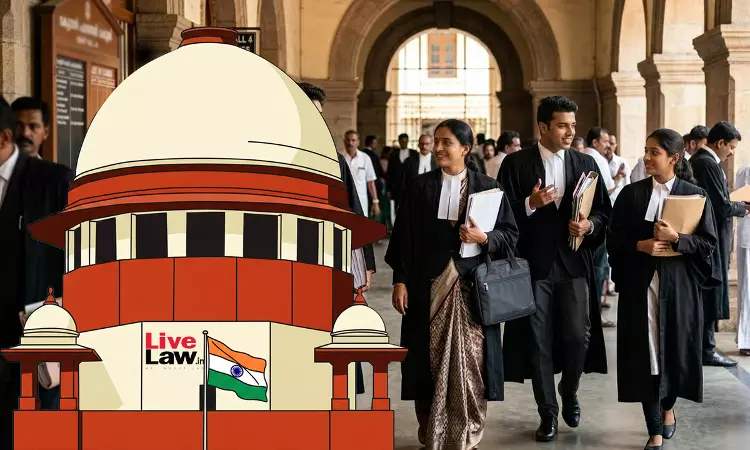
Several High Courts have supported retaining the mandatory requirement of three years' practice at the Bar as a uniform eligibility condition for entry-level judicial service posts while responding to the Supreme Court's call for suggestions on whether the May 2025 judgment should be relaxed for specially abled candidates.Some High Courts, however, suggested limited relaxation for persons...
This is a premium content
Available exclusively to
Our subscribers
Subscribe Premium 
INR 1099+GST
Your support helps us to bring you more content at
an affordable subscription scheme !!!
All payment options available
Several High Courts have supported retaining the mandatory requirement of three years' practice at the Bar as a uniform eligibility condition for entry-level judicial service posts while responding to the Supreme Court's call for suggestions on whether the May 2025 judgment should be relaxed for specially abled candidates.
Some High Courts, however, suggested limited relaxation for persons with disabilities. The Meghalaya High Court said the condition should not be completely dispensed with but the Court may consider reducing the practice period or granting age relaxation of three to five years for specially-abled candidates. The Tripura High Court supported dispensing with the requirement in respect of such candidates.
The suggestions were sought in review proceedings arising from the Supreme Court's May 20, 2025 judgment which restored the condition that candidates must have a minimum of three years' practice as advocates to apply for Civil Judge (Junior Division) posts. The review petitions include a plea seeking exemption of persons with disabilities from the rule.
In one of the review petitions, the petitioner has contended that the direction lacks empirical backing, disproportionately affects candidates from economically weaker and socially disadvantaged backgrounds, and results in an unreasonable restriction on the right to practise a profession under Article 19(1)(g) of the Constitution.
The Court had earlier directed all High Court Registrars to place the order before their respective Chief Justices and asked High Courts and law universities to submit suggestions before the Court takes a holistic view.
Their views have been placed before the Court through a compilation filed on March 11, 2026 by amicus curiae Senior Advocate Siddharth Bhatnagar in the All-India Judges Association case and connected review petitions. The bench of Chief Justice of India Surya Kant, Justice K Vinod Chandran and Justice AG Masih will hear tomorrow the review petitions filed against last year's judgment which restored the 3-year practice condition.
As per the complition given by the amicus, ten High Courts have given the submissions, all of them supporting the rule.
As per the compilation now placed before the Court, several High Courts emphasised that the three-year practice requirement is an essential eligibility criterion linked to competence and judicial temperament. The Delhi High Court informed that amendments to the Delhi Judicial Service Rules, 1970 were notified on February 6, 2026 reintroducing the requirement and that its Rules Committee favoured maintaining uniformity to avoid disparity or discrimination among candidates.
The Gauhati High Court stated that three years' practice would help new law graduates understand the profession and develop maturity and familiarity with the Bench-Bar relationship. The Odisha High Court's Full Court resolved on February 3, 2026 that eligibility conditions should remain uniform across categories. The Chhattisgarh High Court also said the eligibility condition should be uniform for all candidates.
The Punjab and Haryana High Court's Rules Committee observed that entry-level judicial officers adjudicate matters affecting life, liberty and property and require practical exposure to court procedure, evidence appreciation and drafting of orders. It cautioned that relaxation could lower entry benchmarks and lead to varying recruitment standards.
A committee constituted by the Chief Justice of the High Court of Jammu and Kashmir and Ladakh opined that the requirement is a condition of eligibility and cannot be relaxed even for specially-abled candidates.
It distinguished between eligibility and suitability, stating, “While determining the suitability of specially abled persons for being appointed as Civil Judges (Junior Division), some relaxation can be given so as to achieve the objective of Rights of Persons with Disabilities Act, 2016 for removing barriers that are caused to the entry of specially abled persons in the judicial service. However, the eligibility for entering the service cannot be altered for such candidates.”
It said that while lack of infrastructure facilities for persons with disability is a genuine concern, it cannot form a basis for dispensing with eligibility condition. “if relaxation of requirement of practice at Bar is granted to the candidates of specially abled category in absence of a principled basis, then similar demand may emanate from other reserved category candidates on various grounds, which may make it difficult to maintain the eligibility conditions uniformly across all categories of candidates”, it said.
The Karnataka High Court's Accessibility Committee recommended retaining the mandatory requirement while suggesting directions to High Court accessibility committees to assist lawyers with disabilities in securing professional engagement in line with Sections 19 and 23 of the 2016 Act.
The Allahabad High Court informed that the Uttar Pradesh Judicial Service Rules, 2001 were amended on January 30, 2026 following the Supreme Court's judgment and that the impact of the amended framework remains untested as the first recruitment process is at a nascent stage. It deferred to the Supreme Court's wisdom on whether the requirement should be reduced or dispensed with.
The compilation also records divergent institutional views from law universities and colleges. The National Law School of India University expressed the view that the three-year practice requirement may be unnecessary in light of institutional training for selected candidates and suggested wider stakeholder consultations.
Rajiv Gandhi National University of Law, Punjab reported findings of a stakeholder survey based on 256 responses, indicating that about 72% opposed the mandatory rule, around 16% supported it and about 9% expressed partial agreement. It suggested strengthening judicial academies, supervised probation and performance-based confirmation instead of rigid pre-entry waiting periods.
Other institutions proposed recognising clerkships or legal research as equivalent experience, providing accessibility measures and structured mentorship for advocates with disabilities, or retaining the rule with reasonable accommodation safeguards. Some colleges supported continuation of the rule as necessary for practical courtroom knowledge, while one suggested increasing the minimum practice requirement.
During the hearing of the review petitions last month, the Chief Justice had orally commented that the 3-year rule was disproportionately affecting women candidates.
Case no. – W.P.(C) No. 001110 / 2025 and connected cases
Case Title – Bhumika Trust v. Union of India and connected cases
Tags

Amisha Shrivastava
Amisha Shrivastava is a Senior Correspondent with LiveLaw, covering the Supreme Court of India. She can be reached at amisha@livelaw.in

