



- Home
- /
- Top Stories
- /
- Shiv Sena Row | ECI Considered...
Shiv Sena Row | ECI Considered Party-Wide Discontent, Not Just Legislative Split : Shinde To Supreme Court
Amisha Shrivastava
15 Sept 2026 7:14 PM IST
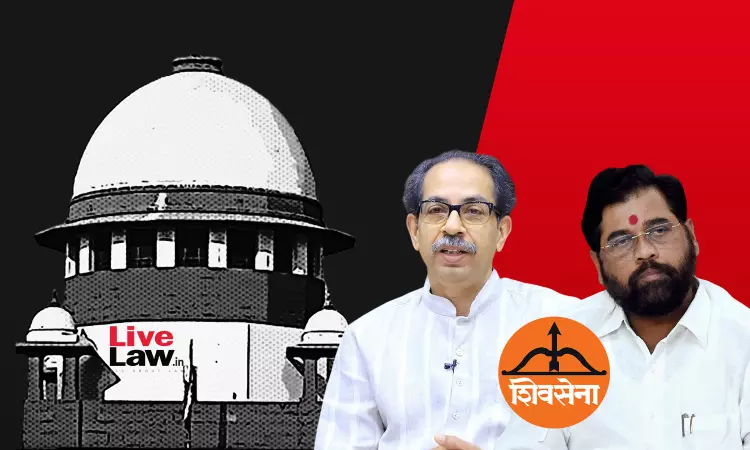
Split emerged from the legislative party and percolates down to the political party, Sr Adv Neeraj Kishan Kaul argued.
In the Shiv Sena case, the Eknath Shinde faction today told the Supreme Court that the 2022 dispute was not confined to a split in the party's legislature wing, but reflected discontent in the political organisation and its cadre, making it open to the Election Commission of India (ECI) to determine which faction represented the real Shiv Sena under Paragraph 15 of the Election...
This is a premium content
Available exclusively to
Our subscribers
Subscribe Premium 
INR 1099+GST
Your support helps us to bring you more content at
an affordable subscription scheme !!!
All payment options available
In the Shiv Sena case, the Eknath Shinde faction today told the Supreme Court that the 2022 dispute was not confined to a split in the party's legislature wing, but reflected discontent in the political organisation and its cadre, making it open to the Election Commission of India (ECI) to determine which faction represented the real Shiv Sena under Paragraph 15 of the Election Symbols (Reservation and Allotment) Order.
Senior Advocate Neeraj Kishan Kaul, appearing for the Shinde faction, was responding to the Uddhav Thackeray faction's argument that the ECI had no basis to assume jurisdiction under Paragraph 15 of the Symbols Order merely because some Shiv Sena MLAs had split from the legislature party.
Kaul defended the ECI's February 17, 2023 decision recognising the Shinde faction as the Shiv Sena and allotting it the bow-and-arrow symbol. The Thackeray faction has challenged that decision before the Supreme Court. The same bench is also hearing Sunil Prabhu's challenge to Maharashtra Assembly Speaker Rahul Narwekar's January 10, 2024 decision refusing to disqualify MLAs of either faction under the Tenth Schedule.
Uddhav Thackeray faction had argued that a “split” for the purposes of the dispute had to be located in the political party and could not be established merely from the numerical strength of rival groups in the legislature.
Kaul submitted that the Shinde faction's case was that the legislative split was only one part of a wider rupture within the party.
“Another argument sought to be forwarded is that when you went to ECI, there was no basis for it to assume jurisdiction and say prima facie that there was split in the party. Our case has been repeatedly that there was discontent in the party. It was really the Shiv Sena and BJP which had gone to the electorate together to fight an election at that stage. The results came on the two jointly fighting an election. For reasons best known to petitioners, they completely opted out and aligned with party which are diametrically, ideologically completely opposed to the philosophy of Shiv Sena. Dissents don't happen overnight. Ultimately, people said this can't go on and resolution said you have an autocratic setup, no one can voice any concern. It was then that a petition under Para 15 was made to ECI to say that there is a split in the party and we represent the real Shiv Sena,” he submitted.
Kaul argued that the ECI had not assumed jurisdiction merely on the basis of the legislative split. He submitted that the Commission had before it material showing discontent within the political party.
He argued that there was no legal requirement that a split under Paragraph 15 must originate in the organisational wing of a political party, and a split could begin in the legislature and subsequently extend to the political organisation.
“It is enough that the split emerges from the legislative party and percolates down to the political party,” Kaul submitted.
He emphasised that the Shinde faction did not ask the ECI to infer a political-party split solely from the number of MLAs supporting Shinde. He contended that there was dissatisfaction among the party cadre, separate meetings and competing claims to leadership and the chief whip, apart from the rival disqualification petitions filed by the two factions.
He also submitted that the discontent was fuelled by the post poll political alliance with the Congress and NCP, failure to hold a national convention and the manner in which the party's organisational structure had been altered.
“There are resolutions passed by us before approaching the election commission and even when the petition is filed under Para 15 of the Symbols Order. Two groups emerging, dissension within the party that you, contrary to a pre-poll alliance with an ideologically aligned party, after the poll results came, to grab power, went and ideologically aligned with the party which was completely against the ethos, culture, and beliefs of the party. These were reasons where groups had been created and splits had emerged within the political party”, he said.
Kaul also defended the ECI's decision to examine the Shiv Sena's 2018 Constitution while deciding the Paragraph 15 dispute.
The Thackeray faction had argued that the ECI had assumed a jurisdiction unknown to law by examining the validity and democratic character of the party Constitution. Kaul submitted that the ECI had been insisting on democratic constitutions of recognised political parties since the 1990s, and that this was relevant to determining organisational majority.
“Reason is that if there is ad-hocism and if there is arbitrariness, how do we determine who represents the majority? Political party's majority is a relevant test, that it must have elected members of overwhelming numbers. Because that is what represents the will of the cadres, the will of the masses,” Kaul submitted.
He noted that the Shiv Sena's 1999 Constitution had emerged after the ECI had required the party to introduce democratic elements into its organisational structure.
“Shiv Sena at some stage came and said that our constitution does not permit elections. ECI persuaded Shiv Sena and late Sh. Balasaheb Thackeray agreed to it and came forward...and an amended constitution (1999) came into being, incorporating all principles of democratic functioning, in tune with amendments to the RP Act and what ECI wrote to them. After that, suddenly in 2018, new constitution emerges. It completely alters the democratic character which 1999 introduced pursuant to ECI telling all political parties to do,” Kaul said.
He argued that the 2018 Constitution was substantially different from the 1999 framework and the ECI was entitled to examine that change while applying the organisational-majority test. Kaul further said that the ECI had found that the 2018 Constitution was not on its records. He disputed the Thackeray faction's reliance on a January 27, 2018 letter sent by Anil Desai to the ECI regarding organisational elections.
“ECI has given a categorical finding that 'we do not possess this constitution. It was never registered with us'. Subhash Desai judgment says even Speaker while looking at party constitution will look at constitution which is registered with ECI. They rely on a letter which talks about certain elections being held. Nothing in that letter to suggest that it was accompanied by 2018 Constitution,” he submitted.
He also opposed the argument that the Shinde faction was estopped from questioning the 2018 Constitution because Shinde had himself held a post created under it.
“This matter is not about estoppel against me as if I am challenging election to a post under the Constitution...this is about the test that ECI employs to determine who represents majority in the political party,” he submitted.
Kaul also disputed the Thackeray faction's reading of the Supreme Court's 2023 Constitution Bench judgment in Subhash Desai v. Principal Secretary, Governor of Maharashtra, particularly its distinction between a political party and its legislature party.
He argued that the Constitution Bench had distinguished the two concepts in the context of the appointment of the whip and the leader of the legislature party and had not completely excluded legislative strength from consideration by the ECI under Paragraph 15.
“It's factually and legally incorrect to say that Subhash Desai said that in Symbols Order, legislative party has no mention and thus no place and can't be looked at. Subhash Desai says under Symbols Order, seats and votes secured are important considerations for freezing a symbol and for a political party to get symbol. Relying on Sadiq Ali, it says that legislative majority test is a relevant test under Para 15,” Kaul submitted.
He added that the Constitution Bench's discussion about not conflating the political party with the legislature party arose in the context of who had the authority to appoint the whip.
“The other side argued that the Whip appointed by legislative party represents the Whip of the political party as well. In that context, Subhash Desai said you can't conflate legislative and political party. Constitution Bench recognized importance of votes and legislative majority...to say that this was completely ousted and done away with is a complete incorrect reading,” Kaul said.
He also distinguished the judgment in Rajendra Singh Rana v. Swami Prasad Maurya, relied upon by the Thackeray faction to contend that a split for the purposes of the Tenth Schedule has to occur in the political party and not merely in the legislature party.
Kaul pointed out that Rana concerned disqualification under the Tenth Schedule, whereas the dispute before the ECI arose under Paragraph 15 of the Symbols Order, which requires the Commission to determine which rival group represents the recognised political party.
On the organisational history of the Shiv Sena, Kaul said the 2018 Constitution had not created the post of Paksh Pramukh, as claimed by the Thackeray faction. He referred to a January 14, 2013 resolution creating the post after Balasaheb Thackeray's death and noted that Uddhav Thackeray had subsequently been elected to it for the 2013-2018 period.
The arguments will continue tomorrow.
Case: Sunil Prabhu v. Eknath Shinde, SLP(C) Nos. 1644-1662/2024 and connected case
Tags

Amisha Shrivastava
Amisha Shrivastava is a Senior Correspondent with LiveLaw, covering the Supreme Court of India. She can be reached at amisha@livelaw.in

