



- Home
- /
- Top Stories
- /
- 'Social Media Must Not Treat...
'Social Media Must Not Treat Courtroom Exchanges As Final Decisions', Justice Manmohan
Yash Mittal
27 Jan 2026 4:16 PM IST
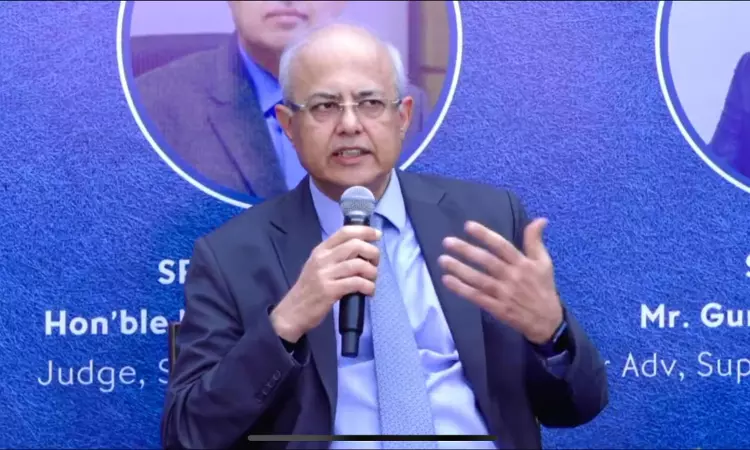
Justice Manmohan flagged the distortion of judgments and observations through selective quoting on the social media.
Supreme Court Judge Justice Manmohan recently expressed concern over the rise of “social media justice”, where judicial decisions are shaped by viral narratives instead of being sustained through reasoned judgments. Speaking at a panel discussion at a legal conference, he spoke about the transformational shift taken place in recent years regarding courtroom reporting, stating that...
This is a premium content
Available exclusively to
Our subscribers
Subscribe Premium 
INR 1099+GST
Your support helps us to bring you more content at
an affordable subscription scheme !!!
All payment options available
Supreme Court Judge Justice Manmohan recently expressed concern over the rise of “social media justice”, where judicial decisions are shaped by viral narratives instead of being sustained through reasoned judgments.
Speaking at a panel discussion at a legal conference, he spoke about the transformational shift taken place in recent years regarding courtroom reporting, stating that “there is hunger for court news” and “everyone wants to be the first person to know what is happening in court.”
Justice Manmohan was speaking on the topic "Justice in the age of Social Media" at the International Legal Conference organised by the Supreme Court Advocates-on-Record Association at Goa on January 24.
He stated that often, selective excerpts, tweets, and viral soundbites create a distorted public perception of courts and judges. He recalled how Constitution Bench judgments with multiple opinions are often misreported due to haste.
“The impression that is embedded in my mind is with regard to one Constitution Bench judgment… The Chief Justice, because he has a priority, he read his judgment first. He upheld the validity of that custom. So, it was flashed all over that the Supreme Court has upheld the validity of that religious custom, while the fact was that the Chief Justice was in a minority,” he said.
He cautioned against projecting the Judge's oral observation as a final verdict, stating that the people are unaware of the difference between the oral observation made in open court and the final verdict. Only the judgment is enforceable, not the Judge's oral remarks made in the Court, he said, stressing that the public at large must be made aware of this basic difference.
“Because of this, the attitude that you want to know everything first, even oral observations of a judge are being reported. They are being given wide publicity…People must know that there is a difference between what the judge orally observes during the hearing and the final judgment that he delivers,” he said, adding, “At times it happens when you go back inside and you read the papers, you reach a totally different conclusion.”
He said that in today's fast-moving world, the public has no patience to read over lengthy judgments going in several hundreds of pages, and therefore they resort to selective excerpts, tweets to understand the judgment.
Although the Judge rejected the use of contempt jurisdiction against the social media users distorting judicial observations/judgments, he stressed the role of the Bar in correcting misinformation.
“…SCORA would have to play an active role… They can fact-check the narrative, point out the relevant passage of the judgment, and ensure that the relevant paragraphs are available to the public at large.”, he said, advocating the need of public literacy.
Judges Should Exercise Restrain to Speaking on Controversial Issues In Public Domain
Justice Manmohan also cautioned judges against participating in public debates on controversial issues, emphasizing that such conduct can undermine the moral authority and perceived impartiality of the judiciary. He observed that a judge derives legitimacy not from popularity or public validation, but from neutrality and reasoned decision-making. If a judge becomes a participant in public controversies, he warned, “he can never be perceived by a litigant as a neutral arbiter of disputes.”
He stressed that judges must resist the temptation of seeking attention or validation through media platforms and social networks, because once a judge enters public debate, the authority of the institution risks being replaced by the personality of the individual.
According to him, judgments must speak for themselves, grounded in reason and institutional integrity, rather than being shaped or influenced by a judge's public opinions or media presence.

Yash Mittal
Yash Mittal is a Correspondent with LiveLaw, covering the Supreme Court of India

