'Society That Treats Tradition As Beyond Scrutiny Fails To Reform Unjust Practices': Justice Ujjal Bhuyan Bats For Scientific Temper
Gursimran Kaur Bakshi
1 Nov 2026 8:47 AM IST
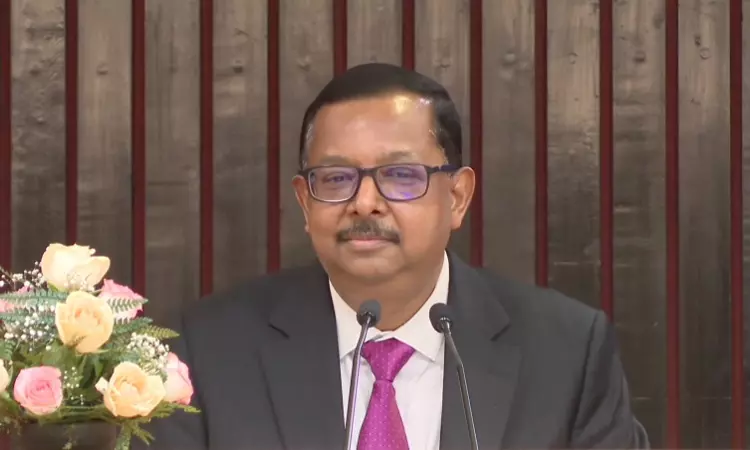
Justice Bhuyan also urged to reject the binary of 'us' v 'them' and embrace the spirit of oneness in the Constitution.
A society that treats tradition as beyond scrutiny may fail to reform unjust practices, while a society that fears questions becomes vulnerable to authoritarianism, Supreme Court Justice Ujjal Bhuyan has said, emphasising the importance of developing scientific temper and rational thinking among students.
Speaking at the 12th Convocation of the University of Science & Technology, Meghalaya, Justice Bhuyan described scientific temper as essential to the rule of law, observing that arbitrary power thrives on ignorance, fear and unexamined beliefs.
"In a recent speech, I had highlighted the importance of scientific temper in the context of the rule of law. I believe, scientific temperament lays the foundation for the rule of law. This is because arbitrary power thrives on ignorance, fear and unexamined belief. A society that accepts claims without evidence is susceptible to superstitious beliefs and becomes vulnerable to misinformation. A society that fears questions becomes vulnerable to authoritarianism. A society that treats tradition as beyond scrutiny may fail to reform unjust practices," he said.


Referring to Article 51A of the Constitution, which enjoins citizens to develop scientific temper, humanism and the spirit of inquiry and reform, Justice Bhuyan said that universities must nurture the capacity to think rationally and protect young minds from prejudice.
Reject the binary of 'us' v 'them'
He also urged students to reject divisive narratives that create a binary of 'us' versus 'them' and embrace the constitutional idea of oneness.
"Friends, for a more just and humane society, it is important that we should move away from such destructive binary of 'us' and 'they' and embrace the idea of oneness. Therefore, the narrative must shift from 'us' and 'they' to 'we'. Not for nothing, the Preamble to the Constitution of India starts with the expression 'We, the People of India'. The Constitution does not address only one section of India. It speaks to all citizens of India as equal members of the constitutional order. The concept of 'we' therefore gives constitutional expression to all people who are diverse in their identities but united by a constitutional framework."
He stated that oneness is a feature of accepting diversity, which helps us transition into a more inclusive and accommodative society. He also stated that diversity teaches us that we must listen and respect views different from our own before we form an opinion.
"In this shared space, learning is not limited to textbooks. It is imbibed when we respect and understand each other's point of view though we may have a differing opinion. Understanding diversity will help us transition into a more inclusive and accommodative society. Because of competing claims and societal conflicts we easily fall into the trap of exclusiveness. Willingly or unwillingly we get drawn into a false narrative; the binary of 'us' and 'they'."
He added: "This constitutional concept of 'we' enables diversity to coexist with unity. Its genius lies in the fact that it does not seek to efface the differences; rather, it seeks to restore unity without demanding uniformity. It does not require that our individual identities should get subsumed in the larger whole. Diversity, therefore, is not an impediment to the constitutional project; rather, it infuses substance and meaning to it. It helps us in making the transition from the binary of 'us' and 'they' to the unifying concept of 'we'."
It is in this context that he pointed out that university is the space which germinates the idea of diversity. It is a space where people come together irrespective of their backgrounds, food habits, and the languages they speak, which in turn makes it a place of diversity.
"A university is also a place to discover the diversity around you. You share space with your fellow students who hail from diverse backgrounds. They speak different languages; they belong to different faiths; and they hail from different regions with different ethnic backgrounds. Their upbringing, their food habits and consequently their ways of thinking may be different from yours; so also their cultural identities. This diversity tells us first to unlearn ourselves and then to discover shared values."
He stated that this is the principle of fraternity which Dr BR Ambedkar called the heart and soul of the constitutional vision.
Justice Bhuyan concluded by highlighting the importance of public reasoning and quoted Nobel Laureate Amartya Sen, who had said, "public reasoning can help us come to grip with what can be done to reduce or even to eliminate gigantic deprivations from which so many people across the globe suffer."
He said that the habit of public reasoning is the very essence of a healthy participatory democracy. At the same time, we need to have an informed citizenry which can only be possible when there is free flow of access to information.