



- Home
- /
- Top Stories
- /
- Sonam Wangchuk Was Instigating...
Sonam Wangchuk Was Instigating Nepal-Like Gen-Z Protest, Gandhian References Just Facade : Centre To Supreme Court
Gursimran Kaur Bakshi
2 Feb 2026 6:05 PM IST
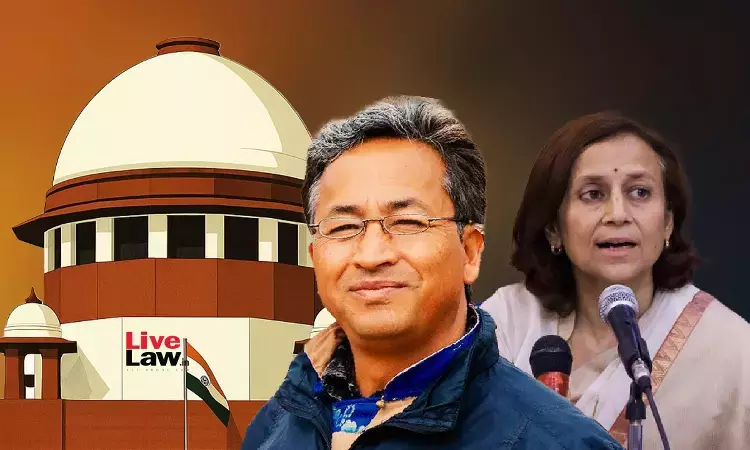
The Union Government today argued that Ladakh social activist Sonam Wangchuk instigated the younger generation of Ladakhis to get inspired by Gen-Z movements in neighbouring countries of Nepal, Bangladesh and Sri Lanka if the demand of the Sixth Schedule is denied to Ladakh. Wangchuk was detained under the National Security Act on September 26, 2025, after the Ladakh protest for statehood...
This is a premium content
Available exclusively to
Our subscribers
Subscribe Premium 
INR 1099+GST
Your support helps us to bring you more content at
an affordable subscription scheme !!!
All payment options available
The Union Government today argued that Ladakh social activist Sonam Wangchuk instigated the younger generation of Ladakhis to get inspired by Gen-Z movements in neighbouring countries of Nepal, Bangladesh and Sri Lanka if the demand of the Sixth Schedule is denied to Ladakh. Wangchuk was detained under the National Security Act on September 26, 2025, after the Ladakh protest for statehood turned violent.
The Supreme Court bench comprising Justice Aravind Kumar and Justice PB Varale continued hearing a habeas corpus petition filed by Wangchuk's wife Dr Gitangli Angmo. Angmo has challenged Wangchuk's detention under the National Security Act, 1980, as illegal.
At the outset, Solicitor General Tushar Mehta(for the Union) submitted that Wangchuk's speech, in which he refers to Gandhian principles here and there, is deliberate to cover its inflammatory contents, where he is seen to have instigated the younger generation towards protests, including violent methods including self-immolation.
Before addressing this point, Mehta first clarified that the judicial review of the Court is very limited. It can't go into the question of whether the detention was justified or not, but whether the procedure was followed so that the detainee is not unfairly treated. Mehta referred to certain judgments on this aspect.
Adding to this, Mehta pointed out that there are certain inbuilt safeguards under the NSA. For instance, the District Magistrate's authority of detention has to be confirmed by the State Government. The detenue has a right to make a detailed representation before the Advisory Board headed by a former judge of the High Court. Mehta submitted that the detenue has neither challenged the State's order confirming his detention nor the order of the Advisory Board.
He said that it is factually incorrect and an "afterthought" for Wangchuk to argue that the four videos were not supplied to him when the service of the detention order took four hours, as the DIG Ladakh had gone to meet him and showed each page of the order, which was videographed.
"When the order of detention was served upon the detenue, the service took about four hours. The DIG Ladakh goes to him, sits with him and shows each page [of the detention order], which is videographed. He shows him all the videoclip that you are satisfied and he says, yes I am satisfied...if necessary, I am ready to produce that," Mehta averred.
When Justice Kumar remarked that the petitioner had argued that the detention order was based on borrowed material, Mehta answered that this argument is inherently fallacious. He said that the authority making the detention order can't be physically present everywhere and each time, and therefore, he has to rely on materials placed before him to arrive at a subjective satisfaction.
"You insulate the inflammatory part with the first part relating to non-violence, etc and the last part to non-violence and Gandhi ji, etc. What the District Magistrate is supposed to see is taking the speech in its holistic manner, whether one line, one word, one sentence or two paragraphs, maybe vouched in a manner that ultimately he may tell your lordships he was preaching what Gandhi ji preached but is it enough or not," Mehta said.
Wangchuk was hoping for a riot-like situation
Reading the speeches by Wangchuk, Mehta argued that he was hoping for a Nepal-like Gen-Z protest in a place that shares a border with volatile countries. He even instigated the young to take inspiration from the Arab Spring, where governments of six countries were overthrown through violent protests.
Mehta remarked: "...please mark this here. You are not addressing Gen-Z in isolation. You are anticipating or hoping for a riot-like situation in Nepal. It is a clear instigation otherwise, what is the relevance of Nepal and Ladakh? He is misleading the young generation to do what Nepalis did in their country...There is something very serious which mylords should see. What Mahatma Gandhi was doing was against another imperial government. Not instigating people to resort to violence against its own government. Comparison with Mahatma Gandhi is fallacious and only a facade to hide the completely inflammatory and instigatory speech."
He was referring to the participation of the younger population in the Ladakh protests.
Adding to this, Mehta argued that Wangchuk had said that the arrival of large number armed personnel in Ladakh is unfortunate. "This is where the concern for security and public order comes for the District Magistrate...Security forces are 'they', and we are 'he'. That is the distance he is trying to make between the people and the security forces of our country."
"Efforts, desire and his wish is to make Nepal an example for Gen-Z...You may use Mahatma Gandhi as a shield in the beginning and in the end. But ultimately, you are saying what I want is Nepal like situation, Bangladesh like situation considering the fact that this is a border state, a very senstive border," Mehta added.
Mehta then remarked that Wangchuk also spoke about self-immolation as a form of protest.
"..I have no difficulty if someone wants to change government, resorting to the democratic process by contesting elections...please mark this now, this is where the problem starts. "I would say, this is not hard, do you all know the concept of Arab Spring?" Mylords, a blood bath and the government of the day was thrown out. Government of six countries were thrown out because of this so-called Arab Spring through by violent mode... "Who was behind it? Not a king or a brave figurebut a fruit and vegetable seller. He was fed up by the corrupt leaders and self-immolated himself in the middle of the market." This is what he wants Gen-Z to do. This is what was desired to be prevented by the District Magistrate," Mehta submitted.
"This is an invitation to indulge in a kind of civil war with blood bath, giving an example of Arab Uprising...he is instigating impressionable youth to resort to this," Mehta added.
Arguments will continue tomorrow.
Arguments of the petitioner
On the last hearing, Senior Advocate Kapil Sibal completed his arguments. He essentially raised four points. First, while a detention order was furnished, that too after 28 days to Sonam Wangchuk, the materials relied upon in the detention order have not been furnished. He was referring to the four videos. He submitted that this violates the right to effective representation, not just via the Advisory Board but also before the government. In addition to this, the September 24 speech in which he appealed for peace was not placed before the detaining authority.
Second, he argued that the authorities can't rely upon Section 5A, which allows severance of the detention grounds, to state that even if the four videos are ultimately discarded, the grounds of detention will be "deemed" to be based on other grounds available. Sibal submitted that Section 5A can only apply when all grounds of detention have been furnished. He explained that in this case, the authority relied on only one ground, which is the event that happened on September 24, and to form the basis for it, it relied on various materials to form a chain of event. Therefore, in this case, independent grounds which can be severed do not exist.
Thirdly, he submitted that the District Magistrate, who issued the detention order, did not apply his mind to satisfy that the recommendation of the SSP that Wangchuk must be detained to ensure that no prejudice is caused to the national interest is fulfilled. Sibal said that the District Magistrate copy and pasted the recommendations of the SSP.
Lastly, Sibal averred that some of the materials referred to in the detention order, including stale FIRs, are irrelevant because some of them date back to 2024. He pointed out that materials were selectively placed or deliberately cut out. He shows that the allegation that Wangchuk told Ladakhis not help the Indian Army during wartime is false. Sibal said that Wangchuk had in fact clarified that politics should not be confused with patriotism. Similarly, Sibal clarified that the speeches which have been deliberately interpreted to show he is a threat to security has actually been deliberately mistranslated.
Sibal had played the video of Wangchuk's speech appealing for peace in one of the hearings. He had submitted that the tenor of the speech did not threaten the security of the State, did not propagate violence, and did not indicate any intent to continue prejudicial activities. On the contrary, he argued, it was consistent with national unity and integrity. He contended that this was the most relevant and proximate material, yet the detaining authority chose not to rely on it while passing the detention order.
What has happened so far?
The writ petition filed under Article 32 is a habeas corpus petition seeking the release of Wangchuk, lodged in a jail in Jodhpur. The Union Government, Ladakh Administration and the Superintendent of the Jodhpur Central Jail are the respondents in the petition.
On October 6, when notice was issued, Sibal had argued that the grounds of detention hadn't been served to them. In contrast, SG Mehta submitted that there is no legal requirement for the grounds of detention to be communicated to the wife. Sibal had replied that he would not be relying on the non-supply of the grounds of detention to the wife as a ground to challenge the detention, and that he was seeking them so that the detention itself could be challenged.
The Leh District Magistrate filed an affidavit in the Supreme Court denying that the detention was illegal. The authority also stated that the grounds of detention were supplied to Wangchuk within the statutorily mandated timelimit and that he was yet to make any representation against his detention. The Jodhpur Central Jail Superintendent stated in a separate affidavit that Wangchuk's wife, brother and lawyers were allowed to meet him in jail.
In her additional grounds, Dr Angmo submitted that the detention order and grounds of detention are ex facie unsustainable in law as they are premised upon irrelevant grounds, stale FIRs, extraneous material, self-serving statements, and suppression of information. She also contended that she has yet to receive the complete grounds of detention. Angomo has submitted that Wangchuk was supplied with an incomplete detention order, and that too after three days after his illegal detention on September 29.
On October 15, the Court allowed Angmo to get access to the notes he had prepared to challenge his detention after SG Mehta did not object to it. The notes were supplied to the wife on October 16.
On December 8 2024, the Union Government had said that it will oppose a request made by Sonam Wangchuk to appear before the Supreme Court via video conferencing from Jodhpur jail in the hearing on the challenge to his detention under the National Security Act.
A request was made by Sibal, who submitted that Wangchuk wants to argue his case and that he may be allowed to appear via VC. However, SG Mehta had opposed this plea and reasoned that if the Union allows this plea, it will have to then accommodate all accused persons similarly situated.
Case Details: GITANJALI J. ANGMO v UNION OF INDIA AND ORS|W.P.(Crl.) No. 399/2025
The writ petition has been filed by Advocate on Record, Dr Sarvam Ritam Khare
Click Here To Read/Download Order
Tags
Gursimran Kaur Bakshi
Gursimran is the Principal Correspondent with LiveLaw for the Supreme Court. She can be reached out at: simrankaurbakshi@livelaw.in

