



- Home
- /
- Top Stories
- /
- Sonam Wangchuk's Detention :...
Sonam Wangchuk's Detention : Detaining Authority Didn't Apply Mind, Copy-Pasted SSP's Recommendation, Sibal Tells Supreme Court
Gursimran Kaur Bakshi
12 Jan 2026 5:15 PM IST
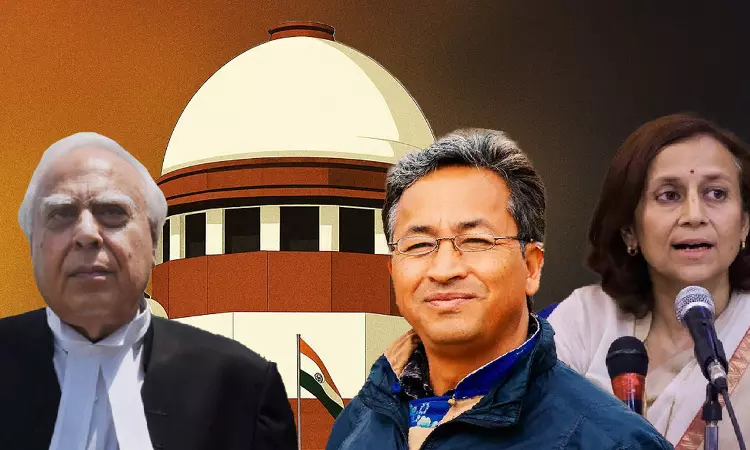
The Supreme Court today(January 12) continued to hear arguments of petitioner Dr. Gitanjali Angmo, who has challenged the detention of the Ladakh social activist and her husband Sonam Wangchuk's under the National Security Act, 1980(NSA), as illegal. Wangchuk has been detained after the Ladakh protests for statehood turned violent since September 2025.A bench comprising Justice Aravind Kumar...
This is a premium content
Available exclusively to
Our subscribers
Subscribe Premium 
INR 1099+GST
Your support helps us to bring you more content at
an affordable subscription scheme !!!
All payment options available
The Supreme Court today(January 12) continued to hear arguments of petitioner Dr. Gitanjali Angmo, who has challenged the detention of the Ladakh social activist and her husband Sonam Wangchuk's under the National Security Act, 1980(NSA), as illegal. Wangchuk has been detained after the Ladakh protests for statehood turned violent since September 2025.
A bench comprising Justice Aravind Kumar and Justice PB Varale has been hearing the matter.
Today, Senior Advocate Kapil Sibal(for Angmo) made essentially three arguments. Firstly, he reiterated that the four videos which has been relied upon by the detaining authority have not furnished to him. This violates his right to effective representation, not just via the Advisory Board under the NSA but also via the government. He referred to Article 22(1) and 22(5) and stated that clause (1) ensures that no person is detained without being informed and that he cannot be denied the right to consult a legal practitioner. He added that the Courts have interpreted that 'legal practitioner' is not limited to a legal counsel and can include a friend, which in this case is his wife.
Adding to this, he referred to clause 5 and said that it ensures that the detention order must be communicated and the detenue must be given the earliest opportunity to make a representation against such order. Here, he had pointed out in the last hearing, that while grounds of detention were supplied on September 29, the four videos on which the detention order is primarily based were not furnished. It was also submitted that there is a delay of 28 days in suppling the grounds of detention to Wangchuk.
Sibal today pointed out that the detaining authority is relying on Section 5A of the NSA to argue that Article 22 is subservient to that. "In normal circumstances, I would challenge this as unconstitutional because how can the statute get into the mind of the detaining authority? What is it saying? [It says] if there are 5 grounds and one of that is irrelevant, it is deemed that detention was made on the other grounds."
When Justice Kumar asked what is the legal proposition here, Sibal replied: "That Section 5A does not apply. It can't be attracted on grounds of effective representation which is a constitutional right. My constitutional right can't be trampled by virtue of Section 5A. If four videos are discarded, it doesn't matter- how can the statute say that?".
Section 5A provides for the severance of the grounds of detention and says that a detention order made on more than one ground cannot be held to be illegal merely because some grounds are found to be irrelevant or non-existent.
In arguendo, he argued that Section 5A will only apply when all grounds of detention, including the materials relied upon has been furnished.
Secondly, he argued that the detaining authority(District Magistrate) did not apply his mind when recommending Wangchuk's detention and only "copy-pasted" the recommendations made by the SSP, Ladakh Administration. Sibal added that the recommendations of the SSP on which the detention order was issued have not been furnished.
He said: "Why do we say what we are saying? In the document of 26 September, 2025 from SSP to District Magistrate, we have been given only the first page. We received it on December 7, and only the first page and that is why we are assuming it is the copy paste. That is the foundation of the submission, rest is the presumption."
When Justice Varale asked if what he meant was that mere reiteration of the recommendations would not be enough to prove that there has been an application of mind by the detaining authority, Sibal answered affirmatively.
Furthermore, he submitted that Section 5A NSA does not apply to the detaining authority because he is not a Tribunal so Article 22 also comes here.
Lastly, Sibal pointed out that some of the materials relied upon by the authority against him date back to 2024. He added that several first information reports registered against unknown persons have been relied against him but no progress has been made to the September FIR which was registered after violence ensued.
At one point, Sibal was asked about one of the materials in which Wangchuk is allegedly talking about self-immolation as a form of protest. Sibal replied that here Wangchuk was asked as to what can be done to seek protection under the Sixth Schedule, and he had responded that in many countries, people have done self-immolation and had also given an example of the Arab Spring, which started in Tunisia after a vegetable vendor had self-immolated himself after authorities illegally confiscated his cart.
Sibal said that ultimately, Wangchuk recommended the Gandhian way of non-violent form of protest, which was hunger strike.
The Court asked how the four videos can be accessed, and Sibal responded that only one is accessible online, so he will give a pendrive in this regard.
On the last hearing, Sibal had played in the Court the video of Wangchuk's speech appealing for peace. He had submitted that the tenor of the speech did not threaten the security of the State, did not propagate violence, and did not indicate any intent to continue prejudicial activities. On the contrary, he argued, it was consistent with national unity and integrity. He contended that this was the most relevant and proximate material, yet the detaining authority chose not to rely on it while passing the detention order.
What has happened so far?
The writ petition filed under Article 32 is a habeas corpus petition seeking the release of Wangchuk, lodged in a jail in Jodhpur. The Union Government, Ladakh Administration and the Superintendent of the Jodhpur Central Jail are the respondents in the petition.
On October 6, when notice was issued, Sibal had argued that the grounds of detention hadn't been served to them. In contrast, SG Mehta submitted that there is no legal requirement for the grounds of detention to be communicated to the wife. Sibal had replied that he would not be relying on the non-supply of the grounds of detention to the wife as a ground to challenge the detention, and that he was seeking them so that the detention itself could be challenged.
The Leh District Magistrate filed an affidavit in the Supreme Court denying that the detention was illegal. The authority also stated that the grounds of detention were supplied to Wangchuk within the statutorily mandated timelimit and that he was yet to make any representation against his detention. The Jodhpur Central Jail Superintendent stated in a separate affidavit that Wangchuk's wife, brother and lawyers were allowed to meet him in jail.
In her additional grounds, Dr Angmo submitted that the detention order and grounds of detention are ex facie unsustainable in law as they are premised upon irrelevant grounds, stale FIRs, extraneous material, self-serving statements, and suppression of information. She also contended that she has yet to receive the complete grounds of detention. Angomo has submitted that Wangchuk was supplied with an incomplete detention order, and that too after three days after his illegal detention on September 29.
On October 15, the Court allowed Angmo to get access to the notes he had prepared to challenge his detention after SG Mehta did not object to it. The notes were supplied to the wife on October 16.
On December 8 2024, the Union Government had said that it will oppose a request made by Sonam Wangchuk to appear before the Supreme Court via video conferencing from Jodhpur jail in the hearing on the challenge to his detention under the National Security Act.
A request was made by Sibal, who submitted that Wangchuk wants to argue his case and that he may be allowed to appear via VC. However, SG Mehta had opposed this plea and reasoned that if the Union allows this plea, it will have to then accommodate all accused persons similarly situated.
Arguments will continue tomorrow.
Case Details: GITANJALI J. ANGMO v UNION OF INDIA AND ORS|W.P.(Crl.) No. 399/2025
The writ petition has been filed by Advocate on Record, Dr Sarvam Ritam Khare
Click Here To Read/Download Order
Gursimran Kaur Bakshi
Gursimran is the Principal Correspondent with LiveLaw for the Supreme Court. She can be reached out at: simrankaurbakshi@livelaw.in

