



- Home
- /
- Top Stories
- /
- Sonam Wangchuk's Speech Appealing...
Sonam Wangchuk's Speech Appealing For Peace Suppressed From Detaining Authority : Sibal Tells Supreme Court; Plays Video Of Speech
Amisha Shrivastava
8 Jan 2026 4:08 PM IST
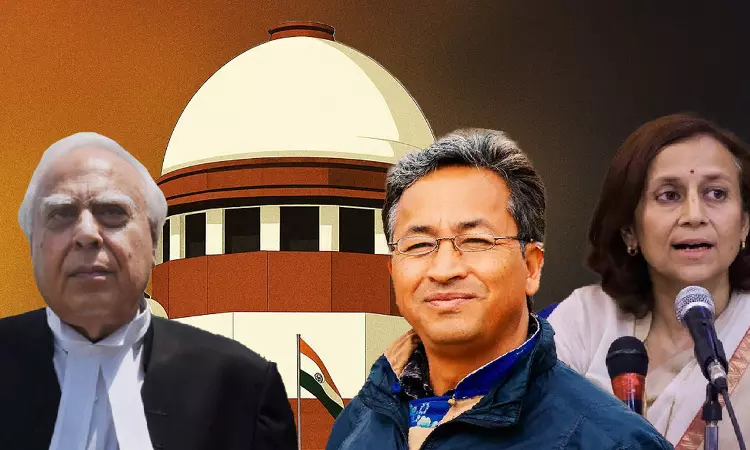
The detention order passed under the National Security Act is vitated by malice, Kapil Sibal argued.
The Supreme Court on Thursday heard in detail the habeas corpus petition filed by Dr. Gitanjali Angmo challenging the detention of her husband and Ladakh-based social activist Sonam Wangchuk under the National Security Act, 1980, following recent protests in Ladakh that allegedly turned violent.A Bench comprising Justices Aravind Kumar and Prasanna Varale heard the matter for the entire...
This is a premium content
Available exclusively to
Our subscribers
Subscribe Premium 
INR 1099+GST
Your support helps us to bring you more content at
an affordable subscription scheme !!!
All payment options available
The Supreme Court on Thursday heard in detail the habeas corpus petition filed by Dr. Gitanjali Angmo challenging the detention of her husband and Ladakh-based social activist Sonam Wangchuk under the National Security Act, 1980, following recent protests in Ladakh that allegedly turned violent.
A Bench comprising Justices Aravind Kumar and Prasanna Varale heard the matter for the entire second half of the day. Senior Advocate Kapil Sibal appeared for the petitioner.
Sibal submitted that the detention order dated September 26, 2025, was founded primarily on four videos relied upon by the detaining authority. According to him, the videos were dated September 10, September 11, and two videos dated September 24. However, while the grounds of detention were supplied on September 29, the four videos were not furnished to the detenue.
He argued that the law is well settled that if the grounds of detention are supplied but the documents relied upon in those grounds are not, it would amount to a violation of Article 22 of the Constitution. Though the Union claims that the materials were supplied, Sibal contended that there was no demonstration or proof of the same.
Sibal further submitted that the grounds of detention were supplied to Wangchuk after a flagrant delay of 28 days, in clear violation of the statutory timeline. He said that on September 29, Wangchuk was provided only with the detention order and incomplete grounds, as the four videos forming the most proximate basis of the detention were not supplied on that date.
Referring to the Union's reply, Sibal stated that what was eventually given were merely links to the videos. He added that although a laptop was provided on October 5, it did not cure the defect since the pen drive supplied on September 29 did not contain the four videos in question.
Sibal also informed the Court that Wangchuk, through several letters from custody, had repeatedly pointed out that the four videos were missing and had sought copies of the same, but they were never furnished. He recounted that Wangchuk's wife was told she would be given copies of those letters, but despite waiting for over an hour and even missing her flight, the documents were not provided.
Emphasising the legal position, Sibal submitted that if documents relied upon in the grounds of detention are not supplied, the detention order stands vitiated. He told the Bench that this principle has been consistently upheld by the Supreme Court in several judgments.
In support, Sibal cited the decision in Ahmed v. Union of India, where the Court held that non-supply of a relied-upon bail application violated the detenue's right to make an effective representation. He reiterated that failure or delay in furnishing the grounds of detention along with the documents referred to therein amounts to a denial of the constitutional safeguard guaranteed to a detenue.
Sibal cited another line of precedent to submit that it is irrelevant whether the detenue already knew the contents of the documents relied upon but not furnished. He further relied on judgments holding that it is equally irrelevant whether the detenue specifically demanded those documents, as it is the constitutional obligation of the detaining authority to supply all material relied upon in the grounds of detention.
Inviting the Bench's attention to Khudiram Das, Sibal submitted that it is the bounden duty of the Court to satisfy itself that all safeguards provided by law have been scrupulously observed and that a person is not deprived of personal liberty except in strict compliance with constitutional and statutory requirements. He stressed that since the detaining authority relied on four specific videos, those videos necessarily had to be supplied to the detenue.
Sibal emphasised that the right to make an effective representation under Article 22 is not an empty formality. The detenue, he argued, must be given sufficient time after supply of documents to logically examine and analyse them before deciding the nature of the representation to be made. There must therefore be a meaningful timeline between the supply of documents and the meeting of the Advisory Board.
“If you say you will supply the documents just one day before the Advisory Board, you are violating the very law,” Sibal submitted, adding that the constitutional guarantee requires adequate time and mental space for the detenue to respond.
Taking the Court through the detention order, Sibal pointed out that even the recommendation forming the basis of the detention decision was not supplied to the detenue. He then addressed the substantive allegation that Wangchuk's conduct affected public order and essential services, which formed the foundation of the preventive detention.
Narrating the factual background, Sibal said that Wangchuk went on a hunger strike on September 11. On the fifteenth day of the hunger strike, incidents of violence occurred, which deeply disturbed him. Breaking his hunger strike, Wangchuk made a public speech appealing for an immediate end to the violence.
Sibal submitted that this speech, far from inciting violence, was aimed at quelling it. He drew a parallel with Mahatma Gandhi's decision to suspend the Non-Cooperation Movement after the Chauri Chaura incident. According to Sibal, the authorities perversely treated this speech as evidence that violence would continue if Wangchuk were not detained, when the intent and effect were exactly the opposite.
With the Court's permission, Sibal played the video of the speech in open court. The Bench watched the video, which, according to Sibal, showed Wangchuk speaking from the very site where violence had occurred and urging people to stop it.
After the video was played, Sibal submitted that the tenor of the speech did not threaten the security of the State, did not propagate violence, and did not indicate any intent to continue prejudicial activities. On the contrary, he argued, it was consistent with national unity and integrity. He contended that this was the most relevant and proximate material, yet the detaining authority chose not to rely on it while passing the detention order.
The tenor of the speech is not in any sense threatening the security of the state or that I will continue such activities or to propagate violence, but to quell it. The tenor of the speech is consistent with our national integrity and unity which is in fact just the opposite of what the detention order says. They did not rely upon this. They should have because that's the most relevant material and the most proximate material and that's the place where the violence is taking place.
Sibal thereafter continued to take the Bench through the contents of the detention order, reiterating that the selective reliance on material and non-supply of crucial documents vitiated the preventive detention.
Sibal submitted that the decision to go on a hunger strike was not an individual act of Wangchuk but a collective decision of the organisation he was associated with. According to Sibal, the organisation resolved to undertake a hunger strike and requested Wangchuk to participate along with other volunteers, which he agreed to as a step in furtherance of Satyagraha, in the spirit shown by Mahatma Gandhi.
Referring to one of the videos relied upon by the authorities, Sibal pointed out that Wangchuk could be clearly heard stating in English that the movement would not be through violence, stones or arrows, but through peaceful means. He said Wangchuk spoke of a peaceful revolution where people would starve themselves to bring about change without troubling others, and of making Ladakh an example for the world. This, Sibal argued, unmistakably demonstrated that the message was rooted in peace, non-violence and democratic methods, and that any contrary interpretation was unjust, misleading and malicious.
Sibal acknowledged that in matters of preventive detention, the Court is ordinarily concerned with procedural safeguards since the subjective satisfaction of the detaining authority is subject to limited judicial review. However, he said these facts were being highlighted to show how the authorities had manipulated the narrative to portray Wangchuk as a criminal.
Drawing attention to the broader context, Sibal submitted that the allegations against Wangchuk surfaced for the first time only in August and September 2025. He said this was immediately followed by a series of coercive actions against institutions associated with Wangchuk, including cancellation of land leases, initiation of a CBI investigation, issuance of Income Tax notices and other proceedings.
Sibal further explained that the background to the hunger strike lay in longstanding demands relating to governance in Ladakh. He submitted that Ladakh currently has a council structure, and the agitation was centred on demands for a council on the lines of those in the North Eastern States.
Referring specifically to events of September 24, Sibal stated that while incidents of violence did occur that day, it was also the day on which Wangchuk called off his hunger strike after publicly declaring that he was against violence. He argued that the video capturing this crucial development was available with the authorities but was deliberately not placed before the detaining authority. According to Sibal, this was done to ensure that the detention order was passed without the detaining authority being made aware of what truly transpired on September 24.
Calling this a serious issue, Sibal submitted that the suppression of material favourable to the detenue went to the root of the matter. He drew an analogy with recent rulings of the Supreme Court holding that even material favourable to the accused must be furnished if it forms part of the prosecution record, irrespective of whether the prosecution chooses to rely upon it.
Sibal argued that under detention law, if the detaining authority was aware of a central fact relating to September 24 and relied on a video to allege propagation of violence, fairness required that the authority also be shown the video in which Wangchuk unequivocally spoke against violence. Suppressing such material, he contended, indicated malice, which by itself constituted an independent ground to vitiate the detention order.
"According to detention law, if the detaining authority is aware of a certain fact that is central to what happened on 24th of September, which is a video relied upon to show that I am propagating violence, then in centrality it must also include a video which in fact states through Wangchuk's words that he was against violence. And hiding that fact from the detaining authority will also suggest a kind of malice which would in fact would be another ground for declaring the order to be vitiated on grounds of malice."
The case is listed for further hearing on Monday at 2 PM.
Case Details: GITANJALI J. ANGMO v UNION OF INDIA AND ORS|W.P.(Crl.) No. 399/2025
The writ petition has been filed by Advocate on Record, Dr Sarvam Ritam Khare.

Amisha Shrivastava
Amisha Shrivastava is a Senior Correspondent with LiveLaw, covering the Supreme Court of India. She can be reached at amisha@livelaw.in

