



State Cannot Accept Gift Of Temple Land; Govt Only Custodian, Not Owner Of Temple Properties Under HR&CE Act : Supreme Court
LIVELAW NEWS NETWORK
17 Oct 2026 4:04 PM IST
“A temple property is held for the deity and not for gratuitous disposal by whoever happens to hold the office of trustee, however well-intentioned,” the Court observed.
The Supreme Court has held that the State Government is a custodian and regulator of temple properties, not their owner, and cannot accept a gift of such property from a trustee, even when the transfer is intended to serve a public purpose.
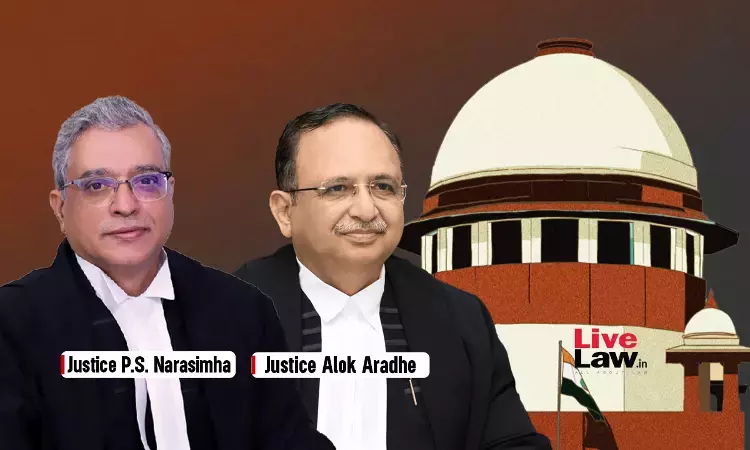
Setting aside a Madras High Court judgment, a bench of Justice PS Narasimha and Justice Alok Aradhe declared void a gift deed through which a temporary trustee of Nagapalayam Mariamman-Ponnachiamman Temple in Tamil Nadu's Erode district had transferred 1 acre and 10 cents of temple land to the State Government for the construction of a Taluk Office.
The Court held that the gift violated Section 41 of the Tamil Nadu Hindu Religious and Charitable Endowments (HR&CE) Act, 1959, which prohibits gifts of inam land granted for the support or maintenance of a religious institution.
“The State, acting through the Commissioner and other functionaries under the 1959 Act, is a custodian and regulator of temple properties, not their owner,” Justice Aradhe, who authored the judgment, observed.


“An acceptance of a gift of temple land by a Revenue functionary, however laudable the public purpose it is intended to serve, offends the object of the 1959 Act,” the Court added.
The Court also directed the Tamil Nadu Government to pay monthly rent of ₹31,000 for the land, retrospectively from March 8, 2019, along with arrears within three months. It imposed costs of ₹1 lakh on the State, payable to the temple.
Temple Property Held For Deity, Not For Gratuitous Disposal
The dispute arose after a temporary trustee executed a gift deed on August 30, 2017, transferring the temple land to the Tamil Nadu Government for constructing a Taluk Office.
The transfer was challenged on the ground that the trustee lacked the authority to alienate temple property without complying with the statutory safeguards under the HR&CE Act.
The Madras High Court dismissed a writ petition challenging the transaction in March 2019, holding that Section 34 of the Act did not expressly mention gifts or settlements and therefore did not prohibit an alienation by way of gift.
During the proceedings before the Supreme Court, however, the Tamil Nadu Government acknowledged that the land was inam property granted to the deity for its support and maintenance. The State also conceded that Section 41 prohibited the gift and that the Revenue Department could retain the land only as a lessee.
The Supreme Court held that the property's character brought the transaction within Section 41, rather than Section 34, of the HR&CE Act.
Section 41 declares gifts of inam land granted for the support or maintenance of a religious institution null and void. Although the provision allows the Government to sanction certain transactions as necessary or beneficial to the institution, it expressly excludes gifts from the transactions that may be sanctioned.
“The Legislature has thus consciously withheld from a gift of an inam property, the very possibility of subsequent validation, by the Commissioner or the Government alike,” the Court held.
It added that such a gift is “void ab initio” and cannot be validated by any subsequent sanction.
The Court also held that the gift deed could not have been validly registered under Section 22-A of the Registration Act, 1908, as applicable in Tamil Nadu, in the absence of the requisite statutory sanction.
Even if Section 34 had applied, the transaction would still have been invalid because the required sanction of the Commissioner and prior approval of the Government had not been obtained.
State Cannot Treat Temple Land As Its Own
Rejecting the argument that the transfer was permissible in the public interest, the Court emphasised that the State's regulatory authority over temple properties does not confer ownership over them.
It observed that property dedicated to a deity ceases to belong to the donor and is held for the deity and the community of worshippers it is intended to serve.
“Every custodian holds it only in trust for the deity and the worshippers it serves,” the judgment stated.
The Court explained that Sections 27 and 28 of the HR&CE Act require trustees to administer religious institutions and their properties with the care expected of an ordinarily prudent person managing their own affairs.
A gift, being a transfer without consideration, cannot ordinarily be regarded as prudent management because it confers no corresponding benefit on the institution.
“A temple property is held for the deity and not for gratuitous disposal by whoever happens to hold the office of trustee, however well-intentioned,” the Court observed.
The Court further held that the State cannot escape its obligations as custodian merely because it is also the sovereign.
Supreme Court Criticises State's Conduct
The Court took note of the fact that the State continued to defend the gift deed even after its own Hindu Religious and Charitable Endowments Department had stated that the land belonged to the deity and that the trustee lacked authority to transfer it.
The Revenue Department had mutated the land in the name of the Taluk Office, reclassified it as government land and proceeded with construction using public funds.
The State changed its position only after the Supreme Court directed the Secretary in charge of Endowments to clarify whether a trustee could gift temple property.
The Court observed that the State, being the statutory custodian of temple property, ought to have recognised the legal position at the outset.
“The State's belated concession, cannot obscure the fact that for over four years the property of the Temple was treated as that of the Government on the strength of a deed which, by the State's own admission, had no sanction in law,” the judgment stated.
Although the Court declared the gift deed void, it declined to cancel the lease in favour of the State because the Taluk Office had already been constructed using public funds and was serving the administrative needs of the area.
The Court, however, found it necessary to revise the rent payable to the temple.
A committee had initially fixed the monthly rent at ₹13,235. Applying the State Government's prescribed formula of valuing religious institution land at 225% of its guideline or market value, whichever is higher, the Court calculated the combined value of the land and building at ₹3.04 crore.
Applying the committee's formula of fixing rent at 0.1% of the total value, the Court arrived at a monthly rent of approximately ₹30,438 and rounded it off to ₹31,000.
The enhanced rent will be payable retrospectively from March 8, 2019, when the land was handed over for construction. The State must pay all arrears, after adjusting amounts already paid, within three months.
The Court clarified that the temple trust would retain the authority to determine the lease period, renewal and other terms in accordance with the HR&CE Act, with the temple's interests as the paramount consideration. Rent must be revised once every three years and cannot be reduced below ₹31,000 per month.
The Supreme Court directed the State Government and the HR&CE Department to strictly comply with Sections 34, 34-A and 41 of the 1959 Act, and the rules framed under them, before effecting or sanctioning transactions involving property belonging to religious institutions.
It further directed that decisions concerning religious and charitable institution properties must be guided by the interests and benefit of the institution, rather than the administrative convenience of the Government.
“The State, as custodian, cannot unilaterally usurp, nor permit any of its officers to usurp, the property of the religious/charitable institutions it is charged to protect,” the Court held.
It added that a transaction violating this principle could be struck down irrespective of its label or ostensible public purpose.
The Court set aside the Madras High Court judgment, declared the gift deed null and void, directed payment of arrears of rent and imposed costs of ₹1 lakh on the State, payable to the temple within eight weeks.


