



- Home
- /
- Top Stories
- /
- State Govt Employees Can't Claim...
State Govt Employees Can't Claim Dearness Allowance Twice A Year Unless Rules Permit : Supreme Court
Amisha Shrivastava
6 Feb 2026 10:20 AM IST
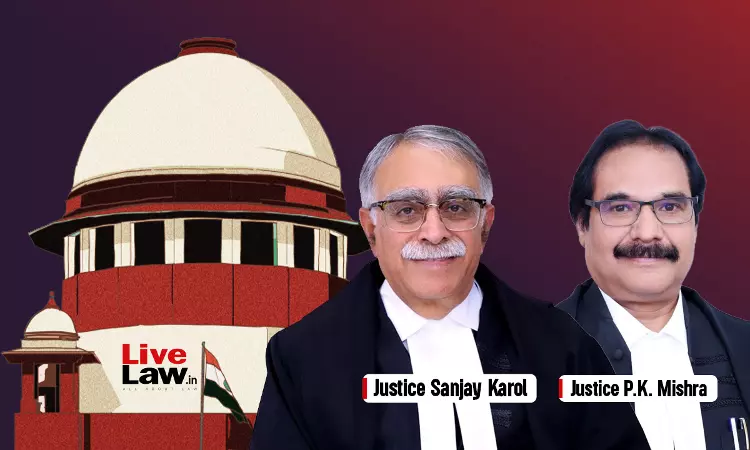
While deciding the State of West Bengal's challenge to directions on payment of Dearness Allowance under the West Bengal Services (Revision of Pay and Allowances) Rules, 2009, the Supreme Court held that state government employees are not entitled, as a matter of right, to payment of DA twice a year.A bench of Justice Sanjay Karol and Justice Prashant Kumar Mishra held –“This is for...
This is a premium content
Available exclusively to
Our subscribers
Subscribe Premium 
INR 1099+GST
Your support helps us to bring you more content at
an affordable subscription scheme !!!
All payment options available
While deciding the State of West Bengal's challenge to directions on payment of Dearness Allowance under the West Bengal Services (Revision of Pay and Allowances) Rules, 2009, the Supreme Court held that state government employees are not entitled, as a matter of right, to payment of DA twice a year.
A bench of Justice Sanjay Karol and Justice Prashant Kumar Mishra held –
“This is for the reason that the RoPA Rules which we have extracted supra nowhere provide that DA will be or can be paid twice a year. Anything that is not provided for in the Rules which govern the distribution of 'existing emoluments' for the time period in question, cannot be said to be a right accruing on any party. The argument based on the principle of legitimate expectation of the employees' right of disbursal of DA twice a year, as alleged to have been disbursed earlier, needs to be repelled for the same does not emanate from the statutory text.”
The issue of twice-yearly payment of DA arose after the Tribunal directed the State to evolve norms for payment of DA under the ROPA Rules, 2009 and observed that DA can be paid at least twice in a year. When the State challenged that decision, the Calcutta High Court upheld the Tribunal's direction observing that once the State had adopted a pattern of ascertaining and paying DA twice a year, abrupt deviation could not be sustained.
Before the Supreme Court, the State argued that ROPA 2009 did not prescribe any mandatory frequency for payment of DA and that neither the Tribunal nor the High Court could introduce a twice-yearly obligation when the statutory rules were silent. The State submitted that frequency of release was an administrative matter and could not be judicially fixed.
The employees, on the other hand, contended that the obligation to pay DA twice a year flowed from the need to protect employees against inflation. They argued that DA is not an additional benefit but minimum protection, and that arbitrariness led the State to stop adjusting/updating DA twice a year as it initially did after enforcement of RoPA. They also alleged discrimination since employees posted in New Delhi and Chennai continued to have DA adjusted twice annually.
Accepting the state's contention, the Court noted that the RoPA Rules do not stipulate payment of DA a specific number of times in a year. In the absence of such a provision, it held, a fixed frequency could not be introduced through judicial direction. The Court observed that the omission of a mandated payment cycle in the State's rules was deliberate and indicated an intention to leave the matter to executive discretion.
The Court further held that this omission assumes significance because the issue bears directly on the State's fiscal affairs, including budgetary planning, allocation of resources and assessment of financial capacity. Judicial direction prescribing biannual payment, it held, would amount to intrusion into the State's fiscal autonomy.
The Court therefore set aside the Tribunal's direction, as affirmed by the High Court, to the extent it required DA to be paid at least twice a year.
Case no. – SLP(C) No. 22628 - 22630/2022
Case Title – State of West Bengal v. Confederation of State Government Employees, West Bengal
Citation : 2026 LiveLaw (SC) 120
Tags

Amisha Shrivastava
Amisha Shrivastava is a Senior Correspondent with LiveLaw, covering the Supreme Court of India. She can be reached at amisha@livelaw.in

