



- Home
- /
- Top Stories
- /
- States With Less Than 1000 Consumer...
States With Less Than 1000 Consumer Cases May Abolish Some District Commissions : Supreme Court
Amisha Shrivastava
26 July 2026 9:06 PM IST
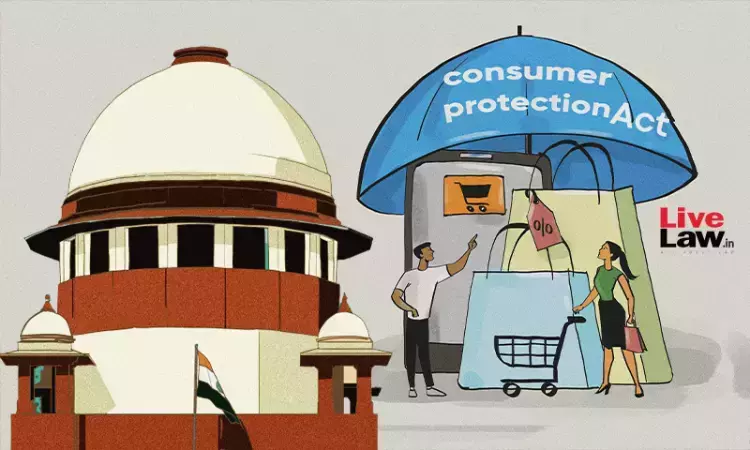
The Supreme Court recently clarified that States where the total pendency of consumer cases is below 1,000 may abolish some District Consumer Disputes Redressal Commissions and entrust their work to serving judicial officers, subject to the prior concurrence of the jurisdictional High Court. The direction was issued in continuation of the Court's February 11, 2026 order, which had...
This is a premium content
Available exclusively to
Our subscribers
Subscribe Premium 
INR 1099+GST
Your support helps us to bring you more content at
an affordable subscription scheme !!!
All payment options available
The Supreme Court recently clarified that States where the total pendency of consumer cases is below 1,000 may abolish some District Consumer Disputes Redressal Commissions and entrust their work to serving judicial officers, subject to the prior concurrence of the jurisdictional High Court.
The direction was issued in continuation of the Court's February 11, 2026 order, which had permitted States and Union Territories with very low consumer case pendency to devise alternative arrangements for consumer dispute redressal instead of maintaining full-fledged Consumer Commissions.
A bench of Chief Justice of India Surya Kant, Justice Joymalya Bagchi and Justice V. Mohana passed the order.
In its February 11 order, the Court had invoked Article 142 of the Constitution to permit States and Union Territories with fewer than 1,000 pending consumer cases to place alternative proposals before it for ensuring consumer dispute redressal. It had also directed that, in States where pendency was too low to justify a separate State Consumer Commission, pending and future cases could be transferred to the Registrar General of the jurisdictional High Court to be dealt with by a Single Judge of the High Court functioning as the State Commission, assisted by technical members wherever required.
The proceedings originally arose from a suo motu case concerning disparities in the pay and service conditions of members of Consumer Commissions across the country. In May 2025, the Court invoked Article 142 to prescribe a uniform pay and allowances structure for Presidents and Members of State and District Consumer Commissions after finding significant variations in remuneration paid by different States despite the Consumer Protection (Salary, Allowances and Conditions of Service of President and Members of the State Commission and District Commission) Model Rules, 2020.
In the latest order, the Court directed all State Governments to comply with its February 11 directions on ensuring the functioning of Consumer Commissions in States with low pendency and apprise the Court of the arrangements they had made.
The Court further clarified that States where the total pendency is below 1,000 cases would be at liberty to abolish some District Consumer Forums and entrust those cases to serving judicial officers, subject to the prior concurrence of the jurisdictional High Courts.
The Court also clarified that not only the matters pending on the date of the February 11 order, but also future cases, would be transferred to the Registrars General of the jurisdictional High Courts wherever the February 11 directions apply. It further clarified that the February 11 order would apply to all North-Eastern States where consumer case pendency is too low.
Four retired members of the District Consumer Forum in Uttar Pradesh contended that their last drawn pay had not been protected upon appointment. It was submitted that one of them did not receive any remuneration, while the others received only ₹5,000 to ₹10,000 per month during their four-year tenure. The Court directed the State of Uttar Pradesh to file an affidavit explaining why its rules did not provide for protection of the last drawn pay and why an appropriate honorarium should not be paid to the four officers.
It also observed that while Andhra Pradesh and Gujarat had amended their rules to provide for protection of the last pay drawn in compliance with the May 2025 judgment, States including Maharashtra, Kerala and Meghalaya had sought recall or modification of those directions, while several others had neither complied nor sought modification. The Court granted two weeks to file replies to the modification applications and directed the remaining States to either comply with the earlier directions or seek appropriate modification within the same period.
The matter has been listed for further hearing on August 13, 2026.
Case Title: In Re: Pay and Allowance of the Members of the U.P. State Consumer Disputes Redressal Commission (W.P.(C) No. 1144/2021)
Tags

Amisha Shrivastava
Amisha Shrivastava is a Senior Correspondent with LiveLaw, covering the Supreme Court of India. She can be reached at amisha@livelaw.in

