



- Home
- /
- Top Stories
- /
- Student Injured In NEET-UG Protest...
Student Injured In NEET-UG Protest Seeks Supreme Court Directions For Mandatory Police Name Badges, Uniform Crowd-Control SOP
Amisha Shrivastava
1 Aug 2026 9:20 AM IST
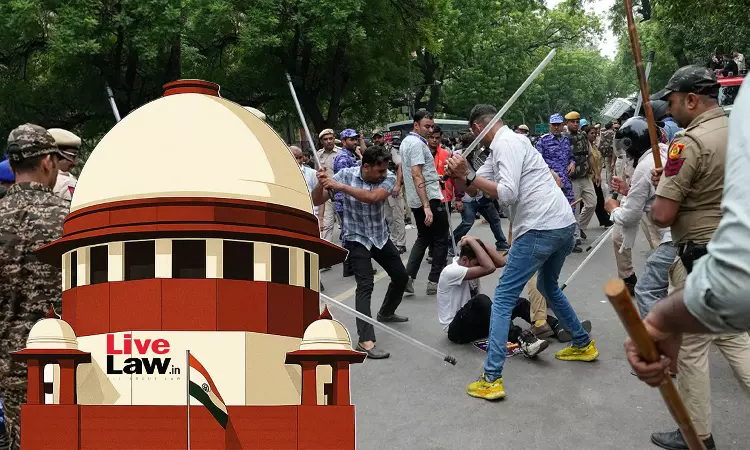
An IIT Patna student who claims to have been injured during the police action at the July 20 "Sansad Chalo" protest in New Delhi has moved the Supreme Court seeking directions for a uniform crowd-control protocol and mandatory identification of police personnel deployed at protests.“The presence and participation of unidentified persons in the use of coercive force against citizens...
This is a premium content
Available exclusively to
Our subscribers
Subscribe Premium 
INR 1099+GST
Your support helps us to bring you more content at
an affordable subscription scheme !!!
All payment options available
An IIT Patna student who claims to have been injured during the police action at the July 20 "Sansad Chalo" protest in New Delhi has moved the Supreme Court seeking directions for a uniform crowd-control protocol and mandatory identification of police personnel deployed at protests.
“The presence and participation of unidentified persons in the use of coercive force against citizens raises serious questions of transparency, accountability and institutional responsibility, particularly when such persons were allegedly acting alongside or in the presence of uniformed police personnel. The circumstances warrant an independent inquiry into the identity, authority and role of each person who participated in the use of force, so as to ensure that no individual responsible for the alleged assault is permitted to evade accountability on account of the absence of proper identification or uniform”, the plea adds.
The plea, filed through Advocate Neha Rathi, seeks to intervene in the pending writ petition concerning the alleged use of excessive force against students protesting over the NEET-UG 2026 controversy. The intervention application has been filed by one Toshiwa Yadav in Himanshu v. Union of India & Ors. pending before the Supreme Court.
The applicant states that she was one of the persons allegedly injured during the police action and seeks to assist the Court in adjudicating issues relating to the alleged arbitrary, excessive and disproportionate use of force by the Delhi Police and other law enforcement personnel against students and young citizens participating in the protest at Jantar Mantar.
The plea states that the applicant participated in the protest on July 20, 2026, which was proceeding towards Parliament seeking the resignation of the Union Education Minister. It states that while returning from the protest site, she was assaulted by police personnel who were in uniform but were not wearing name plates or identification badges. She claims she suffered a deep laceration on the back of her head, requiring immediate medical treatment and stitches.
Referring to the events of July 20, the applicant alleges that police resorted to excessive force against peaceful protesters. The application alleges that students were subjected to repeated lathi blows, several sustained grievous injuries, and some lost consciousness.
“During the course of the demonstration and the subsequent attempt by the protestors to proceed towards Parliament, the police authorities resorted to the use of force against the protestors. The manner, intensity and nature of the force allegedly employed by the police have given rise to grave concerns regarding the arbitrary and disproportionate exercise of coercive State power against students and young citizens exercising their constitutionally guaranteed right to peaceful assembly and expression”, the plea states.
It also raises concerns over the participation of persons in plain clothes or police personnel without name badges in the alleged assault, contending that an independent inquiry is required to identify all those involved.
The application further alleges that lathis fitted with nails were used during the protest. It further refers to reports alleging electrified barricades. It also alleges that women protesters were assaulted, including on private parts, and an Additional Deputy Commissioner of Police slapped a woman bystander during the protest. It additionally refers to media reports alleging the use of pellet guns and shock batons by the Delhi Police and the Rapid Action Force, resulting in injuries to protesters.
The applicant contends that peaceful protest is protected under Articles 19(1)(a) and 19(1)(b) of the Constitution and police action must satisfy the constitutional requirements of legality, necessity, reasonableness and proportionality. It further argues that the power to disperse assemblies under Sections 148 to 151 of the Bharatiya Nagarik Suraksha Sanhita, 2023, cannot be exercised arbitrarily or through excessive force.
The intervention application also proposes safeguards to prevent recurrence of such incidents. These include a uniform and publicly accessible Standard Operating Procedure for crowd control, mandatory display of name plates and identification numbers by police personnel deployed for crowd-control duties, mandatory medical examination and immediate treatment for injured persons, compulsory reporting of every instance of police use of force, and periodic training of police personnel on the constitutional principles governing the use of force.
The applicant has accordingly sought permission to intervene in the pending writ petition and assist the Supreme Court in its adjudication.
The Supreme Court last week sought the responses of the Union, Delhi and many other State Governments on petitions filed against the police action on student protesters. The Court directed that no coercive action should be taken against the students, and ordered the preservation of CCTV footage and official records. The petitions will be considered on August 3.
The Court is also considering a petition filed by persons who suffered pellet gun injuries in the protest.
Case Title: IA in Himanshu v. Union of India & Ors., Writ Petition (Criminal) No. 279 of 2026
Tags
Amisha Shrivastava
Amisha Shrivastava is a Senior Correspondent with LiveLaw, covering the Supreme Court of India. She can be reached at amisha@livelaw.in

