



- Home
- /
- Top Stories
- /
- Students Are Jailed For Merely...
Students Are Jailed For Merely Protesting; Bail Denied Even For Having Biryani On Ganga Boat Trip : Justice Ujjal Bhuyan
Gursimran Kaur Bakshi
25 July 2026 6:26 PM IST
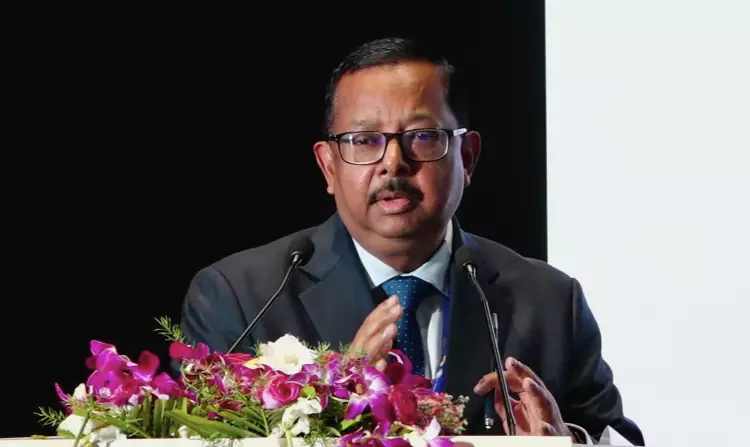
Justice Bhuyan lamented that the space for dissent in India was shrinking.
Justice Ujjal Bhuyan of the Supreme Court today remarked that public spaces for accommodating divergent views are shrinking in India to the extent that students protesting for their rights are being arrested and denied bail. When they are granted bail, Courts impose restrictive bail conditions that severely undermine their liberty."I will not comment on any contemporary happenings in the...
This is a premium content
Available exclusively to
Our subscribers
Subscribe Premium 
INR 1099+GST
Your support helps us to bring you more content at
an affordable subscription scheme !!!
All payment options available
Justice Ujjal Bhuyan of the Supreme Court today remarked that public spaces for accommodating divergent views are shrinking in India to the extent that students protesting for their rights are being arrested and denied bail. When they are granted bail, Courts impose restrictive bail conditions that severely undermine their liberty.
"I will not comment on any contemporary happenings in the country; I will refrain from doing so. But it will not be an exaggeration to say that public space for expressing divergent opinion is shrinking in India. Right to express one's views and right to demonstrate peacefully are fundamental freedoms of citizens. Debate and dissent are the essence of democracy. Unfortunately, even formal activities are criminalised. People who come to voice their anguish for environmental degradation, which is a reality, are chased away as if they are criminals. Students protesting on campuses are arrested, and they don't get bail for 30-40 days. They are suspended, and then have to go to the Court, which takes time."
Courts denying bail, imposing conditions calling for self-censorship
Referring to the denial of bail to a group of young people for organising an Iftar party on a boat in the middle of the Ganga, Justice Bhuyan questioned if bail can be denied for something which is not even a crime. He said: "I am sure consuming chicken biryani is not an offence. There is no law prohibiting consumption of chicken over the Ganga river; they were arrested for that very reason and they had to remain in jail for three months. Can people be arrested and denied bail for 3 months for such an activity, I ask myself! Citizens are watching, people are watching."
He added that Courts are now imposing such bail conditions which virtually restrict the person from expressing his dissent.
"For putting a post on Facebook commenting on the conduct of a minister who had called a serving Indian Army officer a daughter of a terrorist, an FIR is lodged, and he has to seek anticipatory bail. Bail is granted but what does the Court do? [Asking them to] deposit your passport [when] he is not even on a flight risk. [Then it says] don't post anything on Facebook."
Justice Bhuyan also referred to the Gulfisha judgment in Delhi riots where the Supreme Court imposed stringent bail conditions.
"Take the case of young student activists who had suffered long incarceration. While the Court granted them bail, they were directed not only to surrender their passport, but also not to participate or address any public meetings whether physically or virtually. Imposing such restrictive conditions severely undermines their fundamental freedoms and liberty. People would be justified in asking whether, by passing such orders or by imposing such conditions, is the Court also sending a message that don't participate in such public activities?"
Further, Justice Bhuyan also criticised the Bombay High Court for not coming to the aid of the protestors who wanted to hold a demonstration in solidarity with Palestine against the "Genocide" committed by Israel in Gaza.
The Bombay High Court had dismissed a petition filed by Communist Party of India (Marxist) wanting to hold a protest in support of Palestine by stating, "Our country has several issues to deal with...We don't want anything like this. I am sorry to say, you are all short-sighted...You are looking at Gaza and Palestine... Why don't you do something for our own country... Be patriots... Speaking for Gaza and Palestine is not patriotism... Speak up for the causes in our own country... Practice what you preach..."
Justice Bhuyan said he found the High Court's order very amusing. He remarked: "I found it very amusing that when in Bombay, Shivaji Park, when a group of people wanted to demonstrate in solidarity with the people of Gaza, the permission was not granted by the government. So, they moved a writ in the Bombay High Court; the learned judge said 'don't you have any issues in India, why do you have to go that far to agitate?.
Speaking further, Justice Bhuyan stated that India has traditionally recognised Palestine and has a Palestinian Embassy. But despite that, incidents where people were denied permission to protest, etc happened.
"India has recognised Palestine; we have a Palestinian Embassy in India. Traditionally, India has always recognised Palestine. The recent incidents in Gaza, it is South Africa that moved the International Court of Justice against what is happening there, saying that make a declaration that it is Genocide. Justice Muralidhar, former judge of the Orissa High Court, UN appointed him to go into the violence in Gaza. He has published a report, which is accepted by the UN and is now in the public domain, about the violence meted out by the State on such children, women and elderly," Justice Bhuyan told the audience.
"I am not saying that only these issues should be debated. These are the issues which should agitate the mind of a young mind of a student, of a research scholar. You must read, you must question. That is the place of a university."
Justice Bhuyan was speaking at the 5th Justice G.P Singh Memorial lecture organised by the National Law Institute University, Bhopal. He made these comments, urging that universities in India should be a space where students can commit to critical thinking and research on all these issues, rather than taking punitive action against them.
If two legs are in one place, there is danger of the stool falling apart
Justice Bhuyan also spoke on the importance of separation of powers and the working of the three branches independently. It is in this context, he stated, that its fundamantally work for former judges to join politics after retirement because it violates the separation of powers.
Giving an example of a three-legged stool, he said if two legs are at one place, the stool will fall apart: "If we have two legs at one place, the stool will fall apart. This is the fundamental principle. Therefore, when a former Chief Justice of India says he is going to the Rajya Sabha to bridge the gap between the judiciary and the executive, it is fundamentally wrong. It is completely wrong fundamentally. It goes against the principles of separation of powers; it's the fundamental fallacy there," he said.
Former Vice-President wrong in questioning the legitimacy of Kesavananda Bharati judgment
Justice Bhuyan stated that one judgment of the Supreme Court, the Kesavananda Bharati, has stood the test of time, where 13 judges bench held that any provision of the Constitution can be amended but the basic structure can't be altered. He criticised the former Vice-President Jagdeep Dhankar for attacking the judgment.
"The judgment has stood the test of time. It has been applied for more than a dozen times by the Constitution benches. So it is wrong when the then Vice President of India questions the jurisprudential legitimacy of the judgment...It is also wrong when the former Chief Justice of India asserts in the Rajya Sabha that I[he] is not very sure of the jurisprudential legitimacy of the judgment," he said.
Watch the video here.
Gursimran Kaur Bakshi
Gursimran is the Principal Correspondent with LiveLaw for the Supreme Court. She can be reached out at: simrankaurbakshi@livelaw.in

