When Supreme Court Rejected Blanket Ban On Protests At Jantar Mantar In 2018
Malavika Prasad
13 Oct 2026 9:00 AM IST
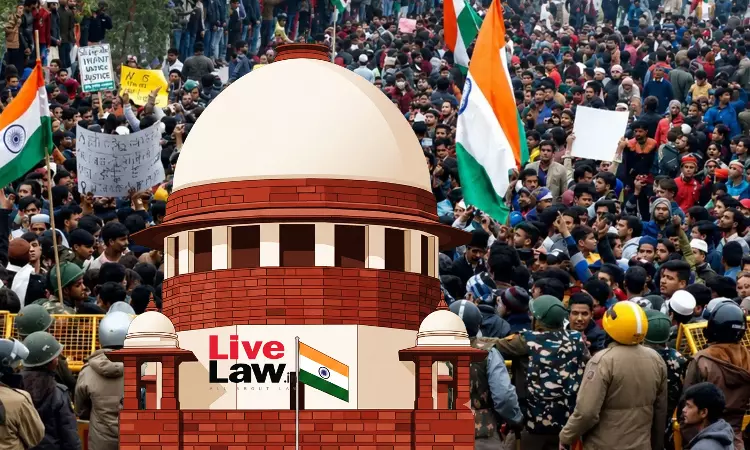
The Court had opined that a total ban may not be a solution, while adding that no one can claim an unqualified right to hold protests at a particular location.
The Delhi Police on Monday (October 12) de-notified Jantar Mantar as a designated protest site, announcing three new venues–Ramlila Ground, Burari Ground and CBD Ground East Delhi–for orgazining protests/demonstration in the city.
It is relevant to note that eight years ago the Supreme Court in Mazdoor Kisan Shakti Sanghatan vs Union Of India (2018), had ruled that there cannot be a blanket ban on protests in Central Delhi, while also acknowledging that Ramlila Maidan, located in a "congested area", may not be able to cater to requirements of protests.
In the said case, the Court was hearing a petition filed by Mazdoor Kisan Shakti Sanghatan challenging the "arbitrary and repeated imposition" of Section 144 CrPC order virtually declaring Jantar Mantar as a prohibited area for holding any public meeting, dharna or peaceful protest.
The Court also heard along with it appeals challenging a judgment by the National Green Tribunal, which had directed the authorities to immediately stop all dharnas, protests, agitations, assembling of people, public speeches, using of loud speakers, etc. at Jantar Mantar Road.


The NGT ordered that the protestors be moved to an alternative site at Ramlila Maidan, Ajmeri Gate, immediately. The NGT's ruling came on petitions filed by residents who complained of hardships caused by protests at Jantar Mantar.
Solution is not to ban protests altogether : SC in 2018
While examining the order passed by the NGT, a bench of Justice AK Sikri and Justice Ashok Bhushan, in its 2018 judgment, disapproved of a total ban on protests and called for a balanced approach.
Though the bench endorsed the NGT's analysis regarding hardships faced by residents, it added that total ban cannot be a solution.
"In this kind of adversarial approach adopted by the parties before the NGT, the NGT went by the ground realities and the pathetic situation faced by the residents because of such demonstrations. Though this analysis of the NGT is without blemish, we, however, feel that the solution was not to ban the demonstrations altogether. Instead, the NGT would have directed the authorities to adopt such measures (some of which are indicated by us above) so that there is a balancing of the rights of both the sections of the society," the Supreme Court had said (emphasis supplied).
Interestingly, the Court also agreed, to an extent, with the petitioner's argument that protests must be held in an area which is proximate to the centre of power to be effective. However, the Court added that with the advent of social media, physical proximity may not be a necessary condition.
The Court also emphasised that a person cannot insist on a right to protest at a particular location.
"It was stressed that the purpose of holding such demonstrations and raising slogans is that they reach concerned persons for whom these are meant. This may be correct. However, it is also to be borne in mind that we are living in an era of technology where a concerned voice by a group of persons can reach the right quarters by numerous means. Electronic and print media play a pivotal role. Then, we have social media and various applications like 'WhatsApp', 'Twitter', 'Instagram' etc. which take no time in spreading such events.
Secondly, though holding protests and demonstrations is an accepted right, at the same time, nobody can claim that I have a right to hold demonstration at one particular area only".
The court said that while regulating such demonstrations in the public interest, particular areas can be earmarked. It, however also acknowledged that "Ramlila Maidan may not be sufficient to cater to this requirement".
"Again, this place in old Delhi is a part of very congested area and it has its own limitations when it comes to using this area for such purposes. Therefore, some other area is required," the court had said.
The Court held that since Jantar Mantar was the area chosen by the authorities and "has been in use for quite some time", balancing can be done by permitting a limited part of this area for holding peaceful public meetings, processions etc., at least to small groups in a manner that no disturbance or inconvenience is caused to the residents.
The Court thus directed the Police Commissioner, in consultation with other concerned agencies, to devise a proper mechanism for limited use of Jantar Mantar area for organizing protests, ensuring that demonstrations, etc. are regulated in such a manner that these do not cause any disturbance to the residents of Jantar Mantar road or the offices situated there. The court had said that "detailed guidelines" can be formulated on this aspect. It had also suggested enactment of a provision for "taking requisite prior permission from the Police Commissioner (or his delegated authority) for holding such demonstration by a particular group".
Notably, last week, the Supreme Court had asked the Centre to consider whether another location should be designated for peaceful protests in place of Jantar Mantar, considering the suggestion that an alternative venue equipped with adequate amenities for protesters needs to be identified.
The Court had passed the direction after Solicitor General Tushar Mehta, while hearing matters concerning the anti-CEC/SIR protests in Delhi, informed the Court that the competent authority would consider designating a place other than Jantar Mantar for peaceful protests, and requested to record the statement in the order.