



- Home
- /
- Top Stories
- /
- Supreme Court Seeks Centre, States'...
Supreme Court Seeks Centre, States' Response On Plea Against Using Aadhaar Card As Proof Of Citizenship, Domicile & Age
Amisha Shrivastava
16 Jun 2026 1:00 PM IST
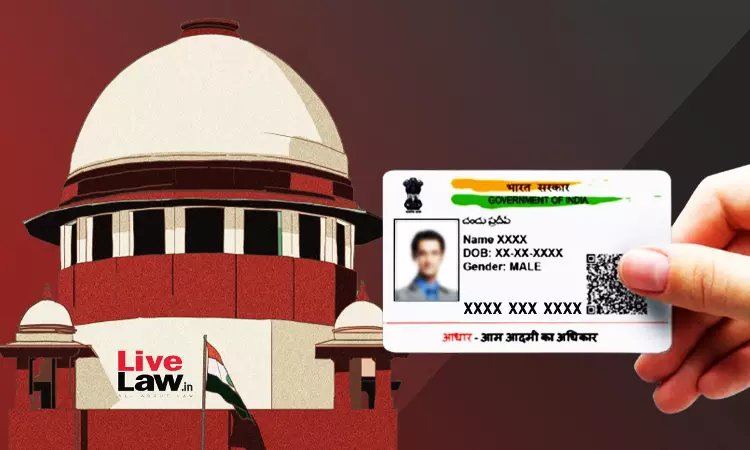
The Supreme Court today issued notice on a plea seeking directions to restrict the use of Aadhaar as proof of citizenship, domicile, address and date of birth, and to ensure that it is used only as proof of identity.A bench of Chief Justice of India Surya Kant and Justice V Mohana issued notice. The petition, filed by advocate Ashwini Upadhyay, contends that Section 9 of the Aadhaar Act,...
This is a premium content
Available exclusively to
Our subscribers
Subscribe Premium 
INR 1099+GST
Your support helps us to bring you more content at
an affordable subscription scheme !!!
All payment options available
The Supreme Court today issued notice on a plea seeking directions to restrict the use of Aadhaar as proof of citizenship, domicile, address and date of birth, and to ensure that it is used only as proof of identity.
A bench of Chief Justice of India Surya Kant and Justice V Mohana issued notice.
The petition, filed by advocate Ashwini Upadhyay, contends that Section 9 of the Aadhaar Act, 2016 expressly provides that an Aadhaar number does not confer any right of, or serve as proof of, citizenship or domicile. It also relies on a UIDAI notification dated August 22, 2023, which states that Aadhaar is proof of identity and not proof of citizenship, address or date of birth.
According to the plea, despite these provisions, Aadhaar is being accepted as proof of age, citizenship and domicile for various purposes, including school admissions, property transactions, obtaining birth certificates, ration cards and driving licences.
“the AADHAAR is not only being used as a proof of age, citizenship & domicile for school admission, property purchase and to obtain birth certificate, ration card, driving licence but also being used in Application Form for New Voter Registration (Form-6) as a proof of date of birth & proof of residence. And thus, infiltrators & illegal immigrants are obtaining various documents using the AADHAAR”, the petition contends.
The petition further challenges the acceptance of Aadhaar in Form-6, the application form for new voter registration, as proof of date of birth and residence.
The petitioner has sought directions to the Union Government, State Governments and the Election Commission of India to ensure that Aadhaar is used only as proof of identity and not as proof of citizenship, domicile, address or date of birth.
He has also sought a declaration that the use of Aadhaar as proof of date of birth and residence in Form-6 is contrary to Section 9 of the Aadhaar Act, Section 23(4) of the Representation of the People Act, 1950 and Article 14 of the Constitution, and is therefore void and inoperative.
The petition argues that all residents, including foreign nationals, are entitled to obtain Aadhaar under the Aadhaar Act and a person becomes eligible after residing in India for 182 days in a year. It highlights that Aadhaar can be obtained through enrolment centres on the basis of documents such as rent agreements and recommendations from local authorities. The petition claims that illegal immigrants and infiltrators are able to obtain Aadhaar and subsequently secure other identity documents, including voter identity cards.
The petitioner contends that Section 23(4) of the Representation of the People Act permits Aadhaar to be used only for establishing identity and not for proving age or residence.
The petition also contends that illegal immigration poses concerns relating to electoral integrity, demographic changes and national security.
Case no. – W.P.(C) No. 654/2026 Diary No. 30016 / 2026
Case Title – Ashwini Kumar Upadhyay v. Union of India
Tags

Amisha Shrivastava
Amisha Shrivastava is a Senior Correspondent with LiveLaw, covering the Supreme Court of India. She can be reached at amisha@livelaw.in

