



- Home
- /
- Top Stories
- /
- Supreme Court 7-Judge Reserves...
Supreme Court 7-Judge Reserves Judgment On States' Power To Levy Surcharge/Additional Tax On Sales Tax
Saima Anjum
22 Sept 2026 4:44 PM IST
The Centre said that the issues have become largely academic after the enactment of the GST Act in 2017
The Supreme Court's Seven-Judge Constitution Bench today (22 September) reserved its judgment in a long-pending reference on the legislative competence of State legislatures to impose a surcharge, additional tax, levy or cess calculated on the basis on a validly levied sales or purchase tax. The Constitution Bench comprising Chief Justice Surya Kant, Justice KV Viswanathan, Justice SV...
This is a premium content
Available exclusively to
Our subscribers
Subscribe Premium 
INR 1099+GST
Your support helps us to bring you more content at
an affordable subscription scheme !!!
All payment options available
The Supreme Court's Seven-Judge Constitution Bench today (22 September) reserved its judgment in a long-pending reference on the legislative competence of State legislatures to impose a surcharge, additional tax, levy or cess calculated on the basis on a validly levied sales or purchase tax.
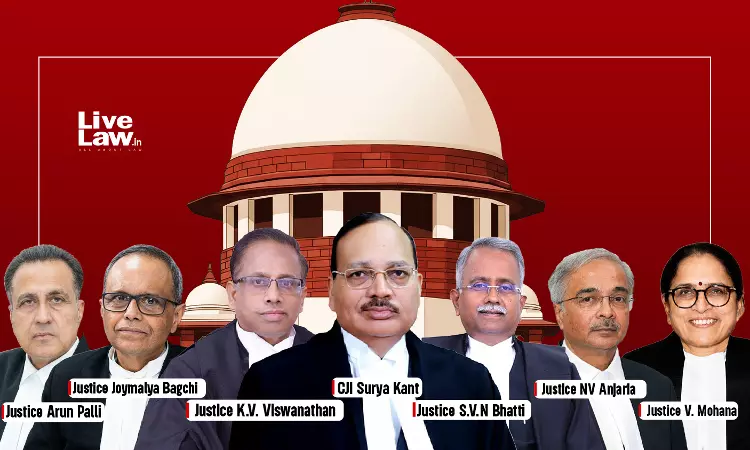
The Constitution Bench comprising Chief Justice Surya Kant, Justice KV Viswanathan, Justice SV Bhatti, Justice Joymalya Bagchi, Justice NV Anjaria, and Justice V Mohana is examining the question referred in 1999 in Arjun Flour Mills v State of Odisha, arising out of a challenge to Section 5A of the Odisha Sales Tax Act, 1947 which was inserted in 1997, prescribing an additional tax of 10% for dealers with annual turnover between Rs 10 Lakh and Rs 1 Crore, and 15% where the turnover exceeded Rs 1 Crore.
The reference traces back to Arjun Flour Mills, challenging the validity of Section 5A. In Hoechst Pharmaceuticals, the Supreme Court had upheld a surcharge under the Bihar Finance Act as being a sales tax falling within Entry 54 of the State list. The petitioner in Arjun Flour Mills contended that Hoechst Pharmaceuticals proceeded on a concession that the levy was relatable to Entry 54, and relied on the seven-judge bench decision in India Cement v State of Tamil Nadu, which had struck down a cess and surcharge connected with mining royalty on the ground that the State could not legislate outside the field assigned to it under the Seventh Schedule. Later, in S Kodar v State of Kerala, a five-judge bench had upheld an additional sales tax under the Tamil Nadu Additional Sales Tax Act, 1970, rejecting the contention that the levy was a tax on income.
In light of the divergence in these rulings, the Supreme Court in 1999 referred Arjun Flour Mills, raising question whether such a levy, calculated with reference to a dealer's annual turnover, could fall outside the State's legislative competence under Entry 54 of the State list and encroach upon Entry 82 of the Union list.
The bench has started hearing the matter today with the Solicitor General of India Tushar Mehta submitting that there was broad consensus among the parties on the scope of the reference, and that the Court could proceed on the basis of the reference order itself without extensive further hearing.
Referring to the order dated August 12, 2026, Mehta further submitted that the reference was prompted by the conflicting views taken by the five-judge bench in S Kodar v State of Kerala and the three-judge bench in Hoechst Pharmaceuticals Ltd v State of Bihar, with a further degree of conflict arising from the observations of the seven-judge bench in India Cement Ltd v State of Tamil Nadu.
Mehta submitted that the question of law for adjudication was “whether the imposition of a surcharge, additional tax, levy, or cess on sale or purchase, which is calculated on the basis of a validly levied sales or purchase tax, is beyond the competence of the State legislature, and any other issues that may arise during the course of the hearing.”
Flagging the practical insignificance of the questions raised after the introduction of Goods and Services Tax (GST) in 2017, Mehta contended, “my submission is that after 2017, when there was a change in the tax regime and GST took over. These questions may have become academic. There may be some very few and far between cases pending, but perhaps not even in three digits. That is our impression.”
He also flagged that the Central government had reservations regarding the correctness of India Cement, noting that it was the subject-matter of a nine-judge bench judgment and stood overruled, and that a curative petition had been filed in that regard. However, he also clarified that the Centre did not wish to press this issue in the present proceedings. Responding to the submissions, Chief Justice Surya Kant remarked that India Cement was no longer a good law and that Kodar had received approval in subsequent decisions.
“India Cement is no longer a good law. Kodar has been quoted with approval, and the measure of tax liability is not the only dominant factor for determining the nature of a tax,” CJI observed. He further noted that the bench would examine Kodar with an open mind, while flagging that it too had received the imprimatur of a nine-judge bench, however, in a different context. Reference was also made to Mineral Area Development Authority (MADA) v Steel Authority of India, to contend that royalty does not include tax, as royalty means a levy on the land which is a contractual obligation in the nature of a lease.
On the contrary, Advocate for the other side submitted that Kodar has been doubted only in the context of the potential conflict with India Cement, and that Kodar itself is not under reference but is to be examined on general parameters. To this, Justice Bagchi remarked that Kodar has been quoted with approval in MADA. Citing Kodar, it was contended by the Counsel that once the authority has the power to tax, it has the power to tax additionally also. On this, Justice Bagchi responded that the legislative competence is to be decided on the basis of the nature of tax, and not on the basis of additional tax. However, both the counsels expressed reservation regarding Justice Bagchi's view.
With respect to the matter concerning Punjab, CJI observed as follows:
“As far as the Punjab matter is concerned, that will have to be segregated because it raises the question of the legislative competence of the State. The Punjab Social Security Act, 2000 has been upheld by the High Court, though whether for good or bad reasons is something we will examine. If the legislature subsequently enacts a law which displaces an earlier executive action, can that law be struck down on the basis of the earlier executive action? There cannot be an estoppel against law.”
CJI Surya Kant indicated that the bench is sitting with an open mind with willingness to examine Kodar. He added, “another logistic or proprietary issue that arises before us that Kodar has been once approved though not directly in this context, but Kodar has received a seal of approval in a nine-judge bench.”
The bench reserved the judgment after the hearing.
Advs Shubhranshu Padhi, Jay Nirupam, Pranav Giri, etc, appeared for the appellants.
Case: Arjun Flour Mills v State of Odisha (Civil Appeal No. 8763 of 1994)
Tags


