



- Home
- /
- Top Stories
- /
- Supreme Court 9-Judge Bench...
Supreme Court 9-Judge Bench Reserves Judgment On Correctness Of 'Industry' Definition In Bangalore Water Supply Board Case
Gursimran Kaur Bakshi
19 March 2026 6:43 PM IST
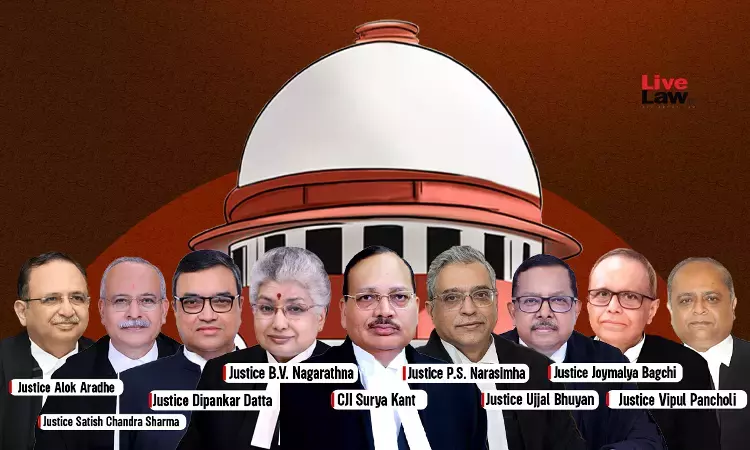
The Supreme Court today(March 19) reserved its judgment on reconsideration of the expansive definition of "industry" given by the then Justice VK Krishna Iyer in Bangalore Water Supply and Sewerage Board v. A. Rajappa (1978).A bench headed by Chief Justice of India Surya Kant and comprising Justices BV Nagarathna, PS Narasimha, Dipankar Datta, Ujjal Bhuyan, Satish Chandra Sharma, Joymalya...
This is a premium content
Available exclusively to
Our subscribers
Subscribe Premium 
INR 1099+GST
Your support helps us to bring you more content at
an affordable subscription scheme !!!
All payment options available
The Supreme Court today(March 19) reserved its judgment on reconsideration of the expansive definition of "industry" given by the then Justice VK Krishna Iyer in Bangalore Water Supply and Sewerage Board v. A. Rajappa (1978).
A bench headed by Chief Justice of India Surya Kant and comprising Justices BV Nagarathna, PS Narasimha, Dipankar Datta, Ujjal Bhuyan, Satish Chandra Sharma, Joymalya Bagchi, Alok Aradhe and Vipul M Pancholi heard on the limited issue of whether the Bangalore Water Supply judgment was rightly decided.
Attorney General for India, R Venkataramani, maintained that while the triple test pronounced by Justice Iyer in the Bangalore Water Supply is logically sound, it's too broad and indiscriminate in its application. He argued that welfare sovereign functions should not be regarded as "industry" for the Industrial Disputes Act, 1947.
Additional Solicitor General KM Nataraj(for State of UP), Senior Advocates Shekhar Naphade(State of Maharashtra), Sanjay Hegde, Shadan Farasat(State of Punjab), also argued in favour of revisiting the Bangalore Water Supply and argued for applying the broader definition of "activities relatable" to sovereign functions as given in the 2020 Industrial Relations Code.
Some of them, particularly Hegde, also submitted that the Bangalore Water Supply can't be considered as a unanimous decision. Naphade contended that the definition of industry has been borrowed from the Australian law. Today, he also argued that the ruling must not have a prospective application because then it will be a futile exercise.
It should be noted that the 2020 Code gets the definition of "industry" from Justice Iyer's triple test, but it excludes charity, social or philanthropic services or any activity related to the sovereign functions, which was not there in the Bangalore judgment.
Against this, Senior Advocates Indira Jaising, CU Singh, Vijay Hansaria and Gopal Sankarnarayan argued that these activities should not be exempted. They have maintained the stance that the Industrial Disputes Act, 1947(now repealed) is worker-centric and the tribunals constituted under it have been given more powers than those exercised by civil courts in terms of reinstatement, imposing lesser punishment, etc.
Senior Advocate Jayna Kothari argued for purposive interpretation, keeping in mind that the Industrial Disputes Act has been interpreted through the lens of Articles 38, 39, 42, 43, and 43A of the Directive Principles of State Policy.
Countering Hegde and others' submissions that the Safdargunj judgment of six judges holds the field and not the Bangalore water supply, Singh today submitted that on the basis of an incorrect application, Safdargunj came to the conclusion that a hospital is not an industry.
Jaising also explained that the definition was borrowed from Australian law because it formed part of a common law framework, which was equally applicable to India.
Whereas, Shankarnarayan cited one judgment before the Court in which it was said that it has to first decide if there is a fair degree of unanimity in revising the old judgment. If there is, the Court has to then inquire what would be the impact of the error on the general administration of public good, whether the decision has been followed somewhere, and whether reversal of the said decision would lead to public inconvenience.
Senior Advocates JP Cama and P Sengupta were appointed as the amicus curiae by the bench. They also made their arguments. Cama maintained that the words 'undertaking' must be given the same colour as the words preceding or succeeding it, such as business, trade, or manufacturer. He said: "An undertaking is an industry; it is either the whole industry or a part of the industry. And it must be read ejustem generis to the preceding and subsequent words. If everything else around it is industry, then surely one work can't itself stand out."
He argued that he does not agree with the triple test because it focuses most on the employer-employee relationship, which may exist in all organisations, but that does not mean it would be referred to as industry. He said that "pure charity" is not an industry. Likewise for research organisations, clubs and social organisations. He also did not agree on the point that the profit motive is irrelevant.
"Where I find fault with Justice Iyer's three principles is that he insists that it has to be a management and employer relationship which brings about industry. I don't agree because in any employment, even if it's purely altruistic, there might be an employer-employee relationship. So, employee-employer relationship or master servant relationship can't be the test," he said.
On the other hand, Sengupta argued that the 1947 Act is worker-centric and provides for the remedies which no other legislation does. He adopted Justice Iyer's arguments on charity and said that even if an organisation is charitable, the labour that it involves is not a part of the charity.
"A person may be philanthropic, trying to do charitable jobs, but at whose cost? at the cost of the labour. The material difference b/w commercial and compassionate employers is not in reference to development, but with reference to the recipients of the goods and services," he said.
Background
The Constitution Bench is examining whether the broad interpretation of “industry” adopted in the 1978 judgment authored by Justice VR Krishna Iyer requires reconsideration.
In the Bangalore Water Supply case, a seven-judge bench had laid down a sweeping interpretation of the term “industry” under the Industrial Disputes Act, 1947. The Court held that any systematic activity organised by cooperation between employer and employee for the production or distribution of goods and services could fall within the definition of industry, even if the organisation was not engaged in profit-making.
The triple tests for 'industry', as laid out in the said judgment, are :
(1)There must be an organised and systematic activity,
(2) by cooperation between employer and employee (the direct and substantial element is chimerical), and
(3) for the production and/or distribution of goods and services calculated to satisfy human wants and wishes (not spiritual or religious), but inclusive of material things or services for celestial bliss
In the order passed on February 16, the three-bench led by CJI observed that the following issues broadly emerge :
(i) Whether the test laid down in paragraphs 140 to 144 in the opinion rendered by Hon'ble Mr. Justice V.R. Krishna Iyer in Bangalore Water Supply and Sewerage Board's case (supra) to determine if an undertaking or enterprise falls within the definition of “industry” lays down correct law? And whether the Industrial Disputes (Amendment) Act, 1982 (which seemingly did not come into force) and the Industrial Relations Code, 2020 (with effect from 21.11.2025) have any legal impact on the interpretation of the expression “industry” as contained in the principal Act?
(ii) Whether social welfare activities and schemes or other enterprises undertaken by the Government Departments or their instrumentalities can be construed to be “industrial activities” for the purpose of Section 2(j) of the ID Act?
(iii) What State activities will be covered by the expression “sovereign function”, and whether such activities will fall outside the purview of Section 2(j) of the ID Act?
The reference arises out of a 2002 appeal. In 2005, a five-judge bench, headed by Justice N.Santosh Hegde, referred the Bangalore Water supply case to a larger bench, in State of Uttar Pradaesh v. Jai Bir Singh. In 2017, a 7-judge bench referred the matter to a 9-judge bench, since Bangalore Water supply case was rendered by a 7-judge bench.
Case Details : STATE OF U.P. Vs JAI BIR SINGH | C.A. No. 897/2002
Tags
Gursimran Kaur Bakshi
Gursimran is the Principal Correspondent with LiveLaw for the Supreme Court. She can be reached out at: simrankaurbakshi@livelaw.in

