



- Home
- /
- Top Stories
- /
- Supreme Court Asks Union To...
Supreme Court Asks Union To Consider Curbs On Retail Sale Of Acid
Debby Jain
31 Aug 2026 6:25 PM IST
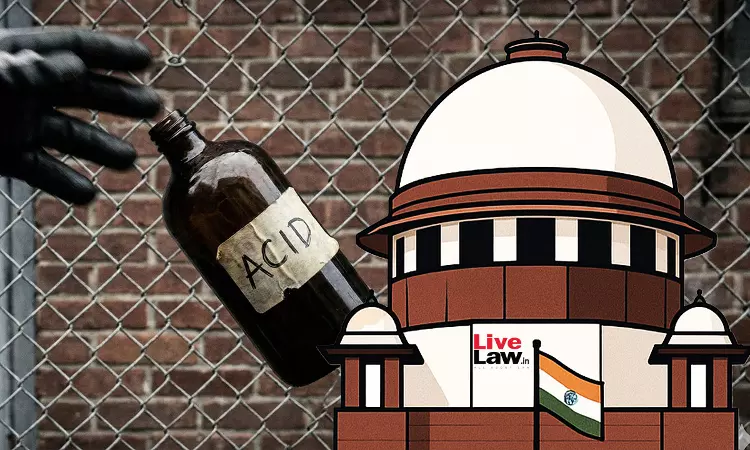
The Supreme Court today asked the Union of India to consider formulating severe restraints on the retail sale of acid in India to curb the instances of acid attacks.A bench of CJI Surya Kant, Justice Joymalya Bagchi and Justice V Mohana was dealing with an intervenor's application in the PIL filed by Shaheen Malik (assailing non-completion of trial in her case and raising issue of...
This is a premium content
Available exclusively to
Our subscribers
Subscribe Premium 
INR 1099+GST
Your support helps us to bring you more content at
an affordable subscription scheme !!!
All payment options available
The Supreme Court today asked the Union of India to consider formulating severe restraints on the retail sale of acid in India to curb the instances of acid attacks.
A bench of CJI Surya Kant, Justice Joymalya Bagchi and Justice V Mohana was dealing with an intervenor's application in the PIL filed by Shaheen Malik (assailing non-completion of trial in her case and raising issue of forced administration of acid). The applicant urged that the Union's guidelines on the issue were of 2013, which are not being implemented effectively.
The applicant, an acid attack survivor herself, was present in court and urged that the physical and mental trauma suffered by an acid attack survivor is tremendous. She highlighted that the ban on retail sale of acid will not adversely affect anyone and argued that the government can take many steps to address the situation, yet nothing is being done because "no one cares" about acid attack survivors. To underline the impact of the attack she suffered 17 years ago, she stressed that even today, she cannot sleep without medicines and is fighting the cause so that others do not have to suffer the same agony. The applicant also claimed that about 3 persons are subjected to acid attack every day.
Hearing her, the CJI assured that the court is considering the matter and will take it to some logical conclusion. He further said that the court is not restricted by the 2013 guidelines, rather, it will be laying down the guidelines.
To the Union, the CJI said, "Suppose there is a condition that it will have to be sold only to a person not below the age of, say, 50 years, 55 years or 60 years, let it be. Somebody will challenge it on the ground of age discrimination and all that. We will see that. Two, that person will have to give in writing why he is purchasing it and for what purpose. That record must be maintained about that person. Three, there must be automation so that the moment somebody purchases it, this information must go somewhere where the information can be reported. How much in a day is flowing in the market, how much has been sold and how much quantity is now available?"
The CJI also underlined the key role of non-governmental organizations in generating awareness against use of conventional treatments on acid attack survivors. Calling for their suggestions, the Court observed that there can be appropriate intervention at the school/college curriculum level to generate such awareness.
"The NGOs which have come forward to assist the Court may also submit their suggestions and recommendations, specifically with respect to the nature of curriculum required to be introduced at the school and college level for awareness regarding preventive measures and how to deal with post-incident cases on an emergency basis", the order said.
Earlier, the Court had directed the states/UTs to formulate rehabilitation measures for acid attack survivors. While these states/Us were to submit reports on the implementation of the schemes developed by them for rehabilitation and medical aid to acid attack survivors, they were also ordered to furnish details of cases registered related to acid attacks (whether chargesheets had been filed and at what stage the cases were pending). The authorities were further required to furnish particulars of each survivor of acid attack with reference to their academic qualifications, employment status, marital status and medical treatment (including expenditure incurred on it).
In view of its direction to the states/UTs for considering a proposal to pay honorarium at par with subsistence allowance to acid attack survivors, the Court today directed that the states/UTs frame and place on record an appropriate scheme (providing for free education and free treatment) within 6 weeks. It also said that the Union may consider the desirability of formulating a model scheme as well as providing assistance to the states/UTs for the proposed scheme.
Insofar as the issue of application of RPwD Act to acid attack survivors suffering from internal injuries, Senior Advocate Saurabh Kirpal, for certain survivors of forced acid administration, submitted that the protective cover has been extended to survivors who suffered internal injuries, but the Union may clarify the guidelines for issuance of disability certificates to such persons.
In this regard, ASG Archana Pathak Dave said that the assessment guidelines of 2024 are in the process of being amended. "[They] will be out very soon", she said.
Case: SHAHEEN MALIK v. UNION OF INDIA | W.P.(C) No. 1112/2025

Debby Jain
Debby Jain is a Correspondent with LiveLaw, covering the Supreme Court of India

