



- Home
- /
- Top Stories
- /
- Supreme Court Admits Somnath...
Supreme Court Admits Somnath Bharti's Appeal Challenging Election Of Satish Upadhyay In 2025 Delhi Assembly Polls
Gursimran Kuar Bakshi & Amisha Shrivastava
17 July 2026 11:57 AM IST
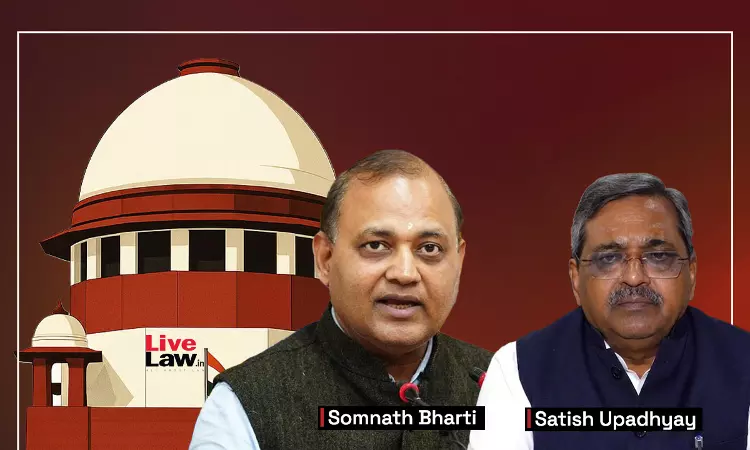
The Supreme Court today(July 17) has agreed to hear Aam Aadmi Party (AAP) leader Somnath Bharti's plea challenging the election of Bharatiya Janata Party's Satish Upadhyay from Malviya Nagar Assembly constituency in the 2025 Delhi assembly elections.A bench comprising Justice Vikram Nath and Justice Sandeep Mehta granted leave to appeal, after briefly hearing Senior Advocate Kapil...
This is a premium content
Available exclusively to
Our subscribers
Subscribe Premium 
INR 1099+GST
Your support helps us to bring you more content at
an affordable subscription scheme !!!
All payment options available
The Supreme Court today(July 17) has agreed to hear Aam Aadmi Party (AAP) leader Somnath Bharti's plea challenging the election of Bharatiya Janata Party's Satish Upadhyay from Malviya Nagar Assembly constituency in the 2025 Delhi assembly elections.
A bench comprising Justice Vikram Nath and Justice Sandeep Mehta granted leave to appeal, after briefly hearing Senior Advocate Kapil Sibal(for Bharti) and Senior Advocate Maninder Singh(for Upadhyay).
Sibal submitted that the Delhi High Court rejected Bharti's election petition on the erroneous grounds that he failed to make Congress candidate Jitender Kumar Kochar a necessary party.
It may be recalled that Bharti alleged that corrupt practices were adopted during the election campaign, including claims that the BJP candidate had financially supported Kochar to target him and divide votes. However, the Congress candidate was not made a respondent to the petition. On January 17, the Delhi High Court dismissed his election petition.
Sibal explained that the High Court applied Section 82(b) of the Representation of the People Act, 1951 (RoPA), which requires that the petitioner shall add as respondent "any other candidate against whom allegations of any corrupt practice" are made out in the petition.
To this, Justice Nath asked: "Does Kocher fall in the category of any other person?"
Sibal responded: "He can't be. It has to be with the consent of the candidate. There is no consent as far as Kocher is concerned."
He argued Kochar doesn't fall within the category of "any other candidate" under Section 82(b) because as per Section 123(1)(A) of the RoPA, bribery is defined as a gift, offer or promise by a candidate or his agent "with the consent" of the candidate. However, there is no consent on the part of Kochar to accept any bribery.
Bharti, a former Delhi Law Minister and three-time MLA from Malviya Nagar, had approached the High Court seeking to set aside Upadhyay's victory in the 2025 Delhi Legislative Assembly elections. The BJP leader had won the seat by a margin of a meagre 2,131 votes.
Justice Jasmeet Singh of the High Court rejected Bharti's petition on the ground of non-joinder of the necessary party, holding that failure to implead a candidate against whom allegations of corrupt practices were made is an incurable defect mandating dismissal under Section 86(1) read with Section 82(b) of the Representation of the People Act, 1951 (ROPA).
The High Court also rejected Bharti's contention that "accepting money" does not constitute a corrupt practice and thus Kochar was not a necessary party. Relying on the 1958 amendment to Section 123 of ROPA, the Court clarified that the receipt of gratification is indeed a corrupt practice, making the candidate against whom such an allegation is made a necessary party.
The High Court clarified that it is not concerned with the perceived harshness or technicality of the law. However, once a legal position has been conclusively settled by the Supreme Court, it is binding on all Courts under Article 141 of the Constitution.
Rejecting Bharti's argument that the defect could be cured by later amendment or deletion of allegations, the High Court held that the election law is a self-contained code and does not permit curing such lapses once the statutory 45-day limitation period has expired.
Case Details: SOMNATH BHARTI Versus SATISH UPADHYAY|Diary No. 10053-2026
Tags


