



- Home
- /
- Top Stories
- /
- Supreme Court Agrees To Hear MP's...
Supreme Court Agrees To Hear MP's Plea Against Police Use Of Facial Recognition & Biometric Surveillance Tools At Protest Sites
Amisha Shrivastava
13 Aug 2026 11:22 AM IST
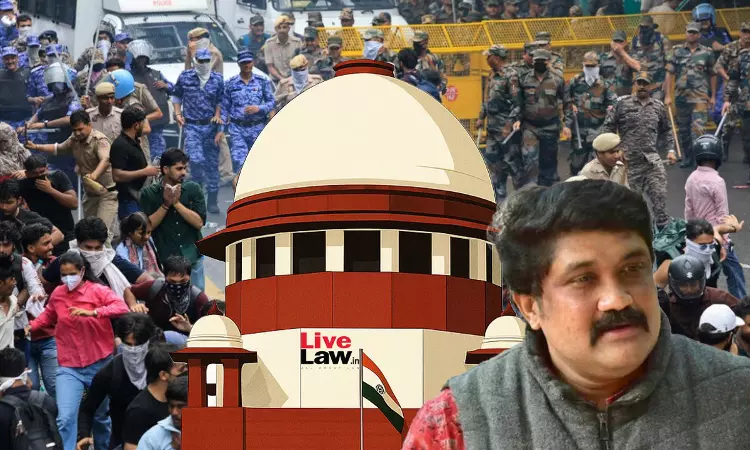
The Supreme Court on Thursday agreed to hear a writ petition filed by Rajya Sabha CPI(M) MP AA Rahim against the deployment of facial recognition technology(FRT) and allied biometric-surveillance measures by police at protest sites.A bench of CJI Surya Kant, Justice Joymalya Bagchi and Justice V Mohana tagged the petition along with the other pending petitions concerning the recent...
This is a premium content
Available exclusively to
Our subscribers
Subscribe Premium 
INR 1099+GST
Your support helps us to bring you more content at
an affordable subscription scheme !!!
All payment options available
The Supreme Court on Thursday agreed to hear a writ petition filed by Rajya Sabha CPI(M) MP AA Rahim against the deployment of facial recognition technology(FRT) and allied biometric-surveillance measures by police at protest sites.
A bench of CJI Surya Kant, Justice Joymalya Bagchi and Justice V Mohana tagged the petition along with the other pending petitions concerning the recent student protests organised by the Cockroach Janata Party (CJP).
Senior Advocate Dr Menaka Guruswamy, appearing for the petitioner, submitted that the petition was filed in the context of the Delhi police using digital tools for the surveillance of protesters at Jantar Mantar. She submitted that the services of two private entities, Aditya Infotech Ltd and Dimension NXG Pvt Ltd, are used, and that data was processed and stored in violation of the Digital Personal Data Protection Act, 2023.
"One maps your face, and the other is a vehicle. So spectacles are used and a vehicle is also used. And that data is all taken without permission. These private entities host the data in violation of the DPDP Act," she submitted. The bench agreed to consider the matter.
Background
The main grievance raised in the petition is that the Delhi police carried out surveillance in a complete legal vacuum. It has been argued that neither the Delhi Police standing orders governing protests, nor the Criminal Procedure(Identification) Act, 2022, authorises the biometric surveillance of persons in a civilian assembly.
The petition alleges that the police used CCTV cameras, drones, a mobile command and control vehicle and other technologies to collect and process photographs and footage of protesters, journalists and other persons present at the protest.
It argues arguing that such biometric surveillance of persons participating in a peaceful assembly is not authorised by any existing law. The plea contends that the Delhi Police's standing orders governing protests and the Criminal Procedure (Identification) Act, 2022 do not permit indiscriminate biometric identification of people at a civilian assembly.
The petition relies on the Supreme Court's 2017 judgment in K.S. Puttaswamy v. Union of India, which held that State action infringing privacy must satisfy the requirements of legality, legitimate aim and proportionality. The petitioner argues that the surveillance also raises concerns about the retention, sharing and processing of biometric data and its possible linkage with national criminal databases.
The petitioner has also submitted that there should be a disclosure of technologies, databases and vendor arrangements involved, and establishing a mechanism enabling any affected persons to access such data and to seek its deletion through a grievance redressal process. There is also a direction to private respondents to preserve, cease using and permanently delete biometric data in their custody.
The petition was filed through AoR K Subhash Chandran.
Case: A.A. Rahim M.P. v. Union of India, Diary No. 45049/2026
Tags

Amisha Shrivastava
Amisha Shrivastava is a Senior Correspondent with LiveLaw, covering the Supreme Court of India. She can be reached at amisha@livelaw.in

