



- Home
- /
- Top Stories
- /
- Supreme Court Allows First Passive...
Supreme Court Allows First Passive Euthanasia, Permits Withdrawal Of Life Support For Man In Vegetative State
Gursimran Kaur Bakshi
11 March 2026 10:54 AM IST
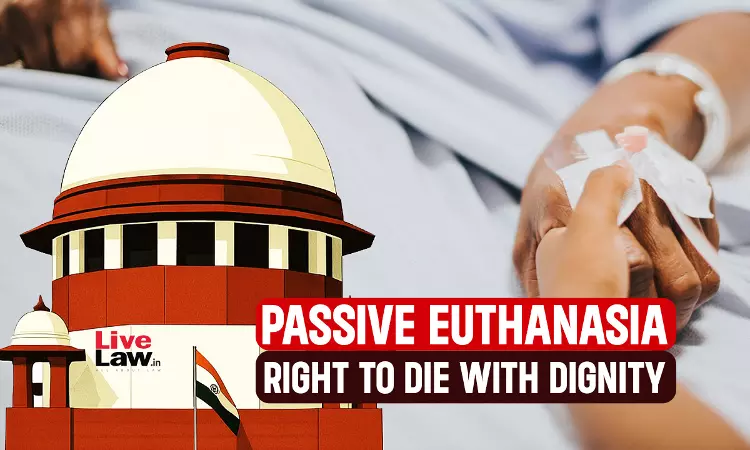
The Court directed that his dignity must be ensured while withdrawing his life support.
The Supreme Court on Wednesday passed its first-ever order allowing passive euthanasia, in terms of its 2018 Common Cause judgment (as modified in 2023) recognising the fundamental right to die with dignity.A bench comprising Justice JB Pardiwala and Justice KV Viswanathan allowed the withdrawal of life support for a 32-year-old man, who has remained in an irreversible permanent vegetative...
This is a premium content
Available exclusively to
Our subscribers
Subscribe Premium 
INR 1099+GST
Your support helps us to bring you more content at
an affordable subscription scheme !!!
All payment options available
The Supreme Court on Wednesday passed its first-ever order allowing passive euthanasia, in terms of its 2018 Common Cause judgment (as modified in 2023) recognising the fundamental right to die with dignity.
A bench comprising Justice JB Pardiwala and Justice KV Viswanathan allowed the withdrawal of life support for a 32-year-old man, who has remained in an irreversible permanent vegetative state for the past 13 years after falling from a building. The bench passed the order on a miscellaneous application of the father seeking to remove all life-sustaining treatment from his son.
"Harish Rana, presently aged 32 years, was once a young, bright boy. He met with a tragic life-altering accident after a fall from the fourth floor of his paying guest accommodation. His brain injury left him in a condition of Persistent Vegetative State (PSV) with 100% quadraplegia... Medical reports show that his medical condition has not improved in the past 13 years," the bench noted. He is sustaining life only on Clinically Administered Nutrition (CAN) administered through surgically installed PEG tubes.
The Court held that CAN is a medical treatment, which can be withdrawn in the best judgment of Primary and Secondary Medical Boards.
The Court noted that the continuation of treatment merely prolonged his biological existence without any therapeutic improvement.
The Court noted that the patients' parents, the primary and secondary medical boards, have reached the opinion that the CAN administered to the patient should be discontinued, as it was not in the best interest of the patient.
The Court stated that when primary and secondary boards have certified withdrawal of life support, there is no need for the Court's intervention. However, since this was the first instance, the reference to the Court was felt. The Court stated that withdrawal of life support must be done in a dignified manner.
The Court passed the following directions.
1. The medical treatment, including the CAN administered to the patient, shall be withdrawn or withheld. The reconsideration period of 30 days stand waived.
2. AIIMS shall grant admission to the patient to its palliative care centre, so that the withdrawal of CAN be given effect to. AIIMS shall give all facilities for shifting the applicant from residence to the palliative care centre.
3. It must be ensured that life support is withdrawn with a tailored plan so that dignity is maintained.
3. The High Courts of all States shall issue directions to all Judicial Magistrates to receive intimations from hospitals, in accordance with the guidelines laid down in Common Cause, in the event the Primary Medical Board and Secondary Medical Board arrive at a unanimous decision to withdraw or withhold life support.
4. Union of India shall ensure that Chief Medical Officers in all districts maintain a panel of Registered Medical Practitioners for nomination to the secondary medical boards.
The Court has also recommended that the Union Government bring comprehensive legislation in this regard.
While Justice Pardiwala wrote the main judgment, Justice Viswanathan penned a concurring opinion. The bench recorded its special appreciation for the parents of Harish Rana for showing their immense love and care for their son. "His family never left his side...to love someone is to care for them even in the darkest times," Justice Pardiwala stated.
In the 2018 judgment in Common Cause, a Constitution Bench of the Supreme Court recognised the right to die and formulated a procedure to be followed for passive euthanasia. These guidelines were further modified in January 2023. As per these guidelines, withdrawal of life support is permissible only after the approval of Primary and Secondary Medical Boards.
This becomes the first case where the directions of the Court in Common Cause have been judicially applied.
Background
The petitioner, through his father, first approached the Delhi High Court in 2024, seeking permission for passive euthanasia. The High Court dismissed the petition in July 2024, observing that the petitioner was not terminally ill.
The petitioner later approached the Supreme Court. The Supreme Court, in August 2024, refused to entertain the plea, but directed the State of Uttar Pradesh to bear the treatment expenses.
In 2025, the petitioner filed a miscellaneous application in the disposed of matter, highlighting that his condition has worsened and there was no scope for improvement. The Court then directed the constitution of a Primary Medical Board to examine his health.
The Primary Medical Board reported that the man's chances of recovery were negligible. It was reported that he has been lying on the bed with a tracheostomy tube for respiration and a gastrostomy for feeding. The photographs showed that he has suffered huge bed sores.
Following that, the Court ordered the examination of the case by a Secondary Medical Board to be constituted by the All India Institute of Medical Sciences (AIIMS). After perusing the report, Justice Pardiwala remarked that it's a "sad report" and the man can't continue to live like this. Before passing the final order, the Court met the parents.
Advocate Rashmi Nandkumar appeared for the petitioner. Additional Solicitor General Aishwarya Bhati appeared for the Union.
Case Details: HARISH RANA Vs UNION OF INDIA|MA 2238/2025 in SLP(C) No. 18225/2024
Citation : 2026 LiveLaw (SC) 229
Click here to read the judgment
Other reports from the judgment - His Family Never Left His Side, Real Love Is Caring In Saddest Hours : Supreme Court Lauds Harish Rana's Parents
Tags
Gursimran Kaur Bakshi
Gursimran is the Principal Correspondent with LiveLaw for the Supreme Court. She can be reached out at: simrankaurbakshi@livelaw.in

