



- Home
- /
- Top Stories
- /
- Supreme Court Allows NGO To...
Supreme Court Allows NGO To Approach Govts With Plea Seeking Balanced Demolition Policy Ensuring Shelter Rights' Protection
Debby Jain
12 Aug 2026 2:42 PM IST
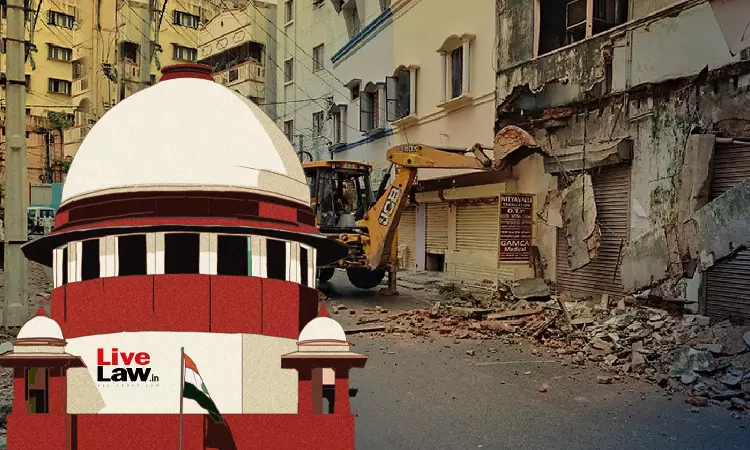
The Supreme Court on Wednesday disposed of a Public Interest Litigation alleging disparity in judicial and administrative approaches to the demolition of unauthorized structures.Observing that it was a policy matter, the Court declined interference, leaving it open to the petitioner to approach the Union, States and Union Territories to formulate or revisit policies.A Bench comprising...
This is a premium content
Available exclusively to
Our subscribers
Subscribe Premium 
INR 1099+GST
Your support helps us to bring you more content at
an affordable subscription scheme !!!
All payment options available
The Supreme Court on Wednesday disposed of a Public Interest Litigation alleging disparity in judicial and administrative approaches to the demolition of unauthorized structures.
Observing that it was a policy matter, the Court declined interference, leaving it open to the petitioner to approach the Union, States and Union Territories to formulate or revisit policies.
A Bench comprising Chief Justice of India Surya Kant, Justice Joymalya Bagchi and Justice V Mohana was hearing a PIL filed by Centre for Law and Good Governance impleading the Union and all States as respondents. The petitioner highlighted cases where authorities had allegedly permitted unauthorized structures to remain for decades, provided civic amenities and collected municipal taxes, only to initiate demolition proceedings years later.
The petitioner contended that demolition, being an extreme measure, can't be carried out without a policy that reconciles the enforcement of planning laws with rights to shelter, livelihood and dignity.
Appearing for the petitioner, counsel argued that the right to shelter has been recognised as an aspect of the right to live with dignity, but that there were also judgments holding that the mere passage of time would not condone even compoundable unauthorized constructions.
The counsel submitted that authorities sometimes provide water and electricity connections and collect municipal taxes from residents before, decades later, taking action against the very structures they had allowed to exist. The petitioner sought the constitution of a court-empowered committee to examine the issue and evolve an appropriate framework.
Chief Justice Surya Kant, pointed out that the Supreme Court had already issued directions governing demolition proceedings.
Justice Joymalya Bagchi observed, "You cannot substitute powers vested in a state to enforce rule of law. These are policy decision calls. We can step in if state's policy is arbitrary or not accommodating due process."
In its order, the Bench noted the petitioner's contention that governments across the country had, for decades, allowed unauthorized structures to remain unchallenged and, in some cases, facilitated their continued existence by providing water and electricity connections and collecting municipal taxes.
The order noted that such situations arise in States and Union Territories including Andhra Pradesh, Telangana and Delhi, while in other places unauthorized colonies constructed decades ago are allegedly ordered to be demolished, sometimes without adequate notice or any welfare scheme for affected families..
The Bench said it appreciated the concerns raised regarding families whose right to shelter could be adversely affected by demolition.
However, the Court held that such questions essentially fall within the policy domain.
“Fact situation may vary from state to state and may therefore warrant variation in policy,” the Court observed, declining to prescribe a uniform policy applicable across the country.
The Court consequently disposed of the PIL, while granting the petitioner liberty to forward a copy of the petition to the Union Government, States and Union Territories.
The Bench expressed hope that the competent authorities would give due consideration to the concerns raised, particularly the need to balance enforcement of planning and building laws with the impact of demolition on affected families.
Case : Centre for Law and Good Governance v. Union of India and others | WP(c) 984/2026

Debby Jain
Debby Jain is a Correspondent with LiveLaw, covering the Supreme Court of India

