



- Home
- /
- Top Stories
- /
- Supreme Court Asks Tamil Nadu Govt...
Supreme Court Asks Tamil Nadu Govt To Ascertain Land Needed To Establish Navodaya Vidyalayas, Directs Consultations With Centre
Amisha Shrivastava
15 Dec 2025 4:27 PM IST
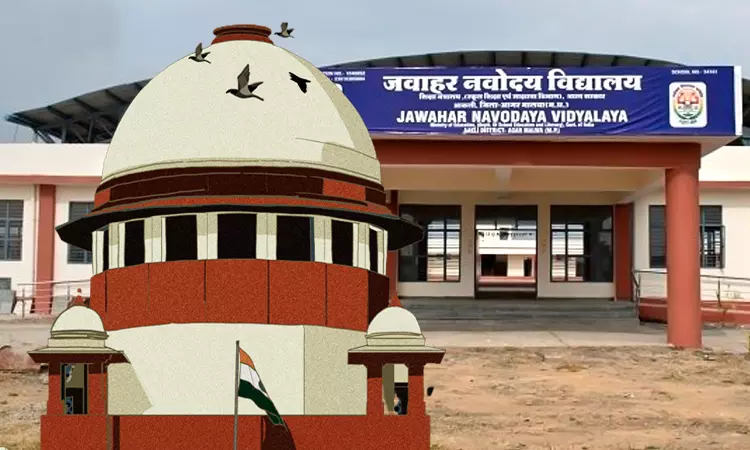
The Court said that Tamil Nadu can raise its two-language formula during its consultations with the Centre
The Supreme Court on Monday directed the Union Government and the Tamil Nadu Government to hold a joint consultation on the issue of establishing Jawahar Navodaya Vidyalayas (JNV) in the State and to submit a report to the Court.A bench of Justice BV Nagarathna and Justice R Mahadevan also directed the authorities to ascertain the extent of land required for establishing JNVs in each district...
This is a premium content
Available exclusively to
Our subscribers
Subscribe Premium 
INR 1099+GST
Your support helps us to bring you more content at
an affordable subscription scheme !!!
All payment options available
The Supreme Court on Monday directed the Union Government and the Tamil Nadu Government to hold a joint consultation on the issue of establishing Jawahar Navodaya Vidyalayas (JNV) in the State and to submit a report to the Court.
A bench of Justice BV Nagarathna and Justice R Mahadevan also directed the authorities to ascertain the extent of land required for establishing JNVs in each district of Tamil Nadu.
Justice Nagarathna said that a “my State, my State” attitude must be avoided and called for a federal discussion. She further said that during the consultation, the state can put conditions such as having a two-language policy, instead of the three-language policy followed by JNVs.
“There must be a federal discussion. You come one step they will also come one step. They may come two steps. After the bifurcation of Andhra Pradesh, Tamil Nadu has gotten all the glory. It is the largest industrialized state in South India. Everything first. You grab this opportunity. Don't take it as imposition, it is an opportunity for your students. You can say this is our language policy. They will look into it. They cannot also discredit your policy. Bring to the notice of the Secretaries of the Central Government about your Act and how you are going about it. Please have a positive attitude”, she said.
The Court made it clear that the exercise ordered by it today was only exploratory. Justice Nagarathna said, “We are only making an exercise. We are not asking you to put a foundation stone today.”
The Court said that its directions were issued in the interest of students, observing, “We have passed the aforesaid directions only in the interest of those students who are entitled to be admitted to said schools in the State of Tamil Nadu.”
The Court was hearing a plea filed by the State of Tamil Nadu against a judgment of the Madras High Court directing the State to establish a Jawahar Navodaya Vidyalaya in every district.
During the hearing today, Senior Advocate P Wilson, for the State, reiterated Tamil Nadu's objections, stating that Jawahar Navodaya Vidyalayas follow a three-language formula, whereas the State has a statutory two-language policy.
He submitted that the State would also be required to provide around 30 acres of land in each district and bear related costs. He contended that the State had a bad experience with the central government, with pending dues to the tune of over Rs. 3000 Crores under the Samagra Shiksha Abhiyan.
Justice Nagarathna responded that the issue should not be turned into a language dispute. She said, “Don't make it into a language issue. We are a federal society. You are part of the Republic. If you come one step forward, they will also come one step forward.”
The State's counsel also alleged that the NGO was "set up" to file the petition before the High Court and gain a “backdoor entry”. The counsel for the State further alleged that there was an attempt to impose Hindi.
However, Justice Nagarathna asked the state not to take an adversarial approach and added, “We are not on Hindi. We are on rural students getting the education.”
Justice Nagarathna suggested that the State could place its conditions during consultations, including adherence to its two-language policy and clearance of financial arrears. She said that the Centre would consider these concerns. Justice R Mahadevan added that all aspects could be discussed in detail during the consultations.
Justice Nagarathna also advised both sides to avoid public statements and engage directly with each other. She said, “Please don't talk through press or through the media. Go face to face and go on talk to them. Everybody is issuing statements and there is no talking between the actual persons.”
Advocates G Priyadharshni and Rahul Shyam Bhandari appeared for Kumari Mahasabha, the NGO on whose petition the High Court issued the direction. Additional Solicitor General KM Nataraj appeared for the Union.
Background
The High Court had held that Jawahar Navodaya Vidyalayas would not violate the Tamil Nadu Tamil Learning Act, 2006, and directed the State to provide temporary accommodation for 240 students in each district within two months. It had found that the State's blanket refusal curtailed students' rights to choose educational institutions and was inconsistent with the Right of Children to Free and Compulsory Education Act.
In its Special Leave Petition, Tamil Nadu argued that education policy falls within its exclusive domain and that its two-language policy under the 2006 Act is incompatible with the three-language formula followed by Navodaya Vidyalayas.
The High Court had rejected this contention after noting that Navodaya Vidyalayas in Tamil-speaking regions use Tamil as the medium of instruction up to Class VIII, offer Tamil as the first language in Classes IX and X, and provide it as an optional subject in Classes XI and XII. It had also noted that the Central Government bears the full financial burden, with the State required only to provide land.
Case no. – SLP(C) No. 33459/2017
Case Title – State of Tamil Nadu v. Kumari Maha Sabha
Amisha Shrivastava
Amisha Shrivastava is a Senior Correspondent with LiveLaw, covering the Supreme Court of India. She can be reached at amisha@livelaw.in

